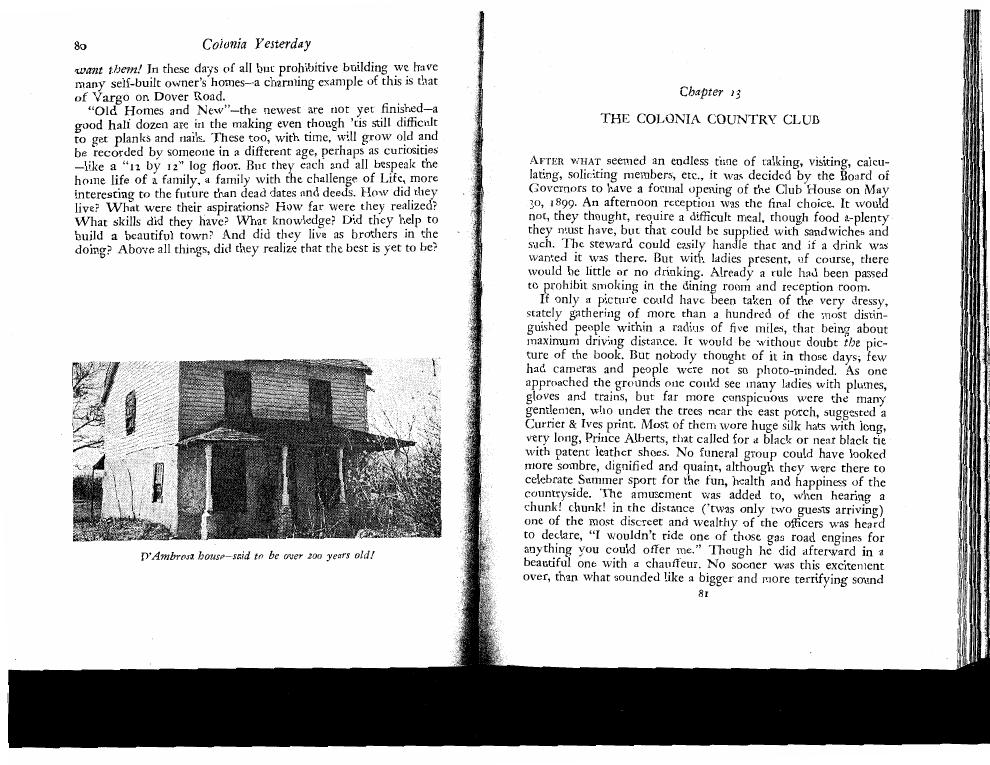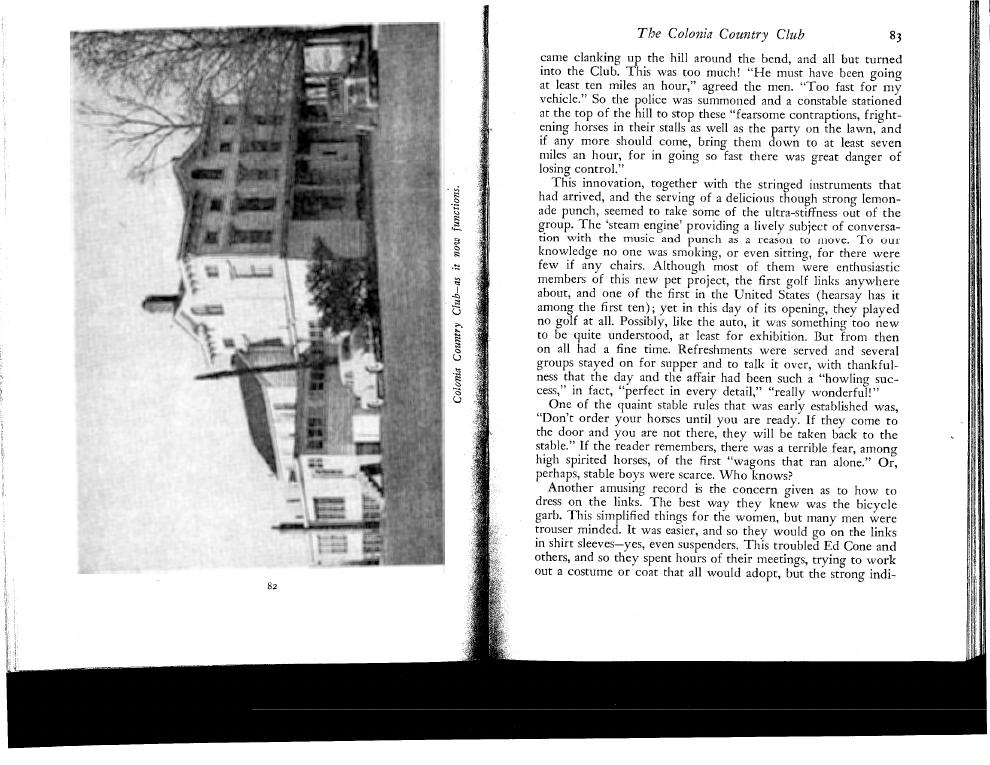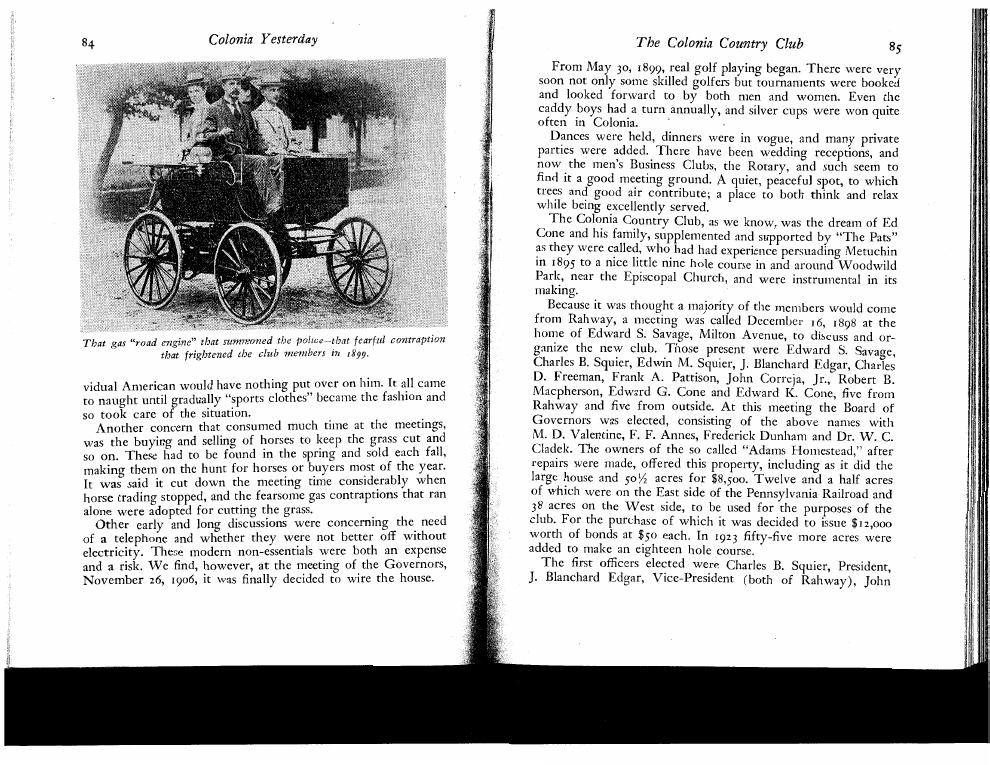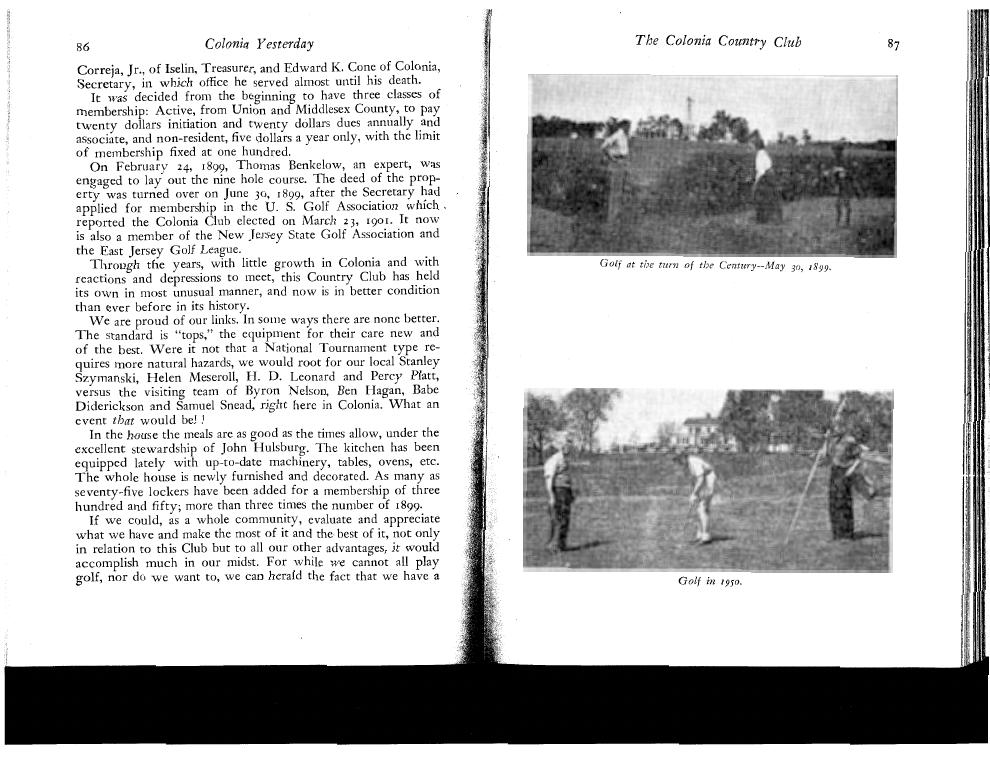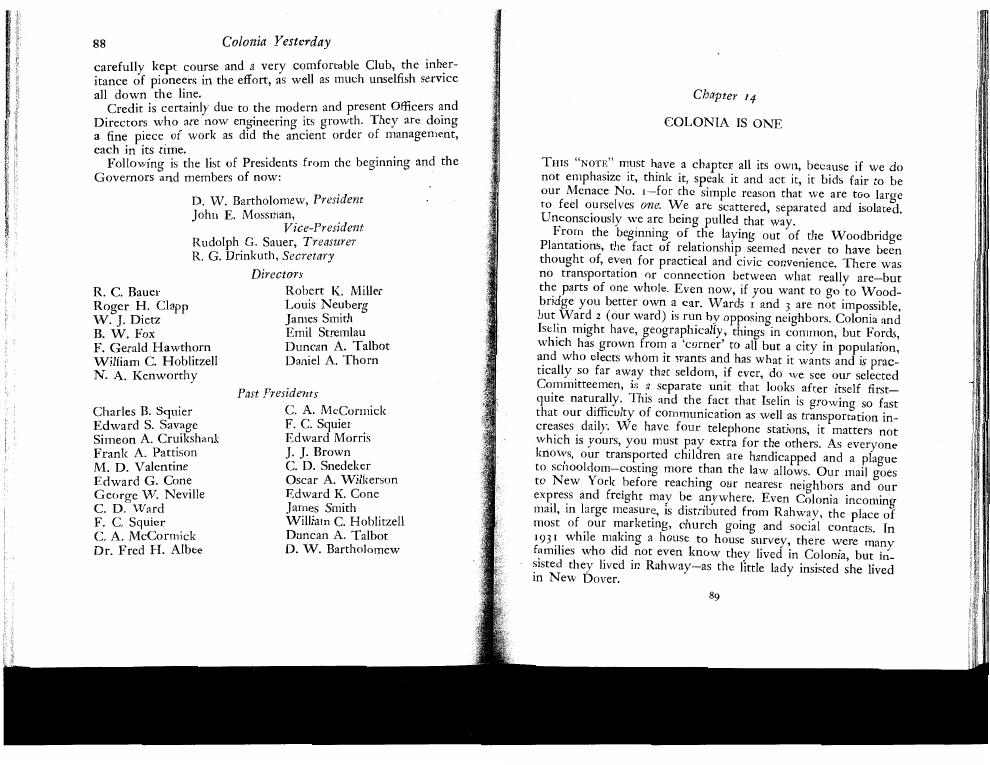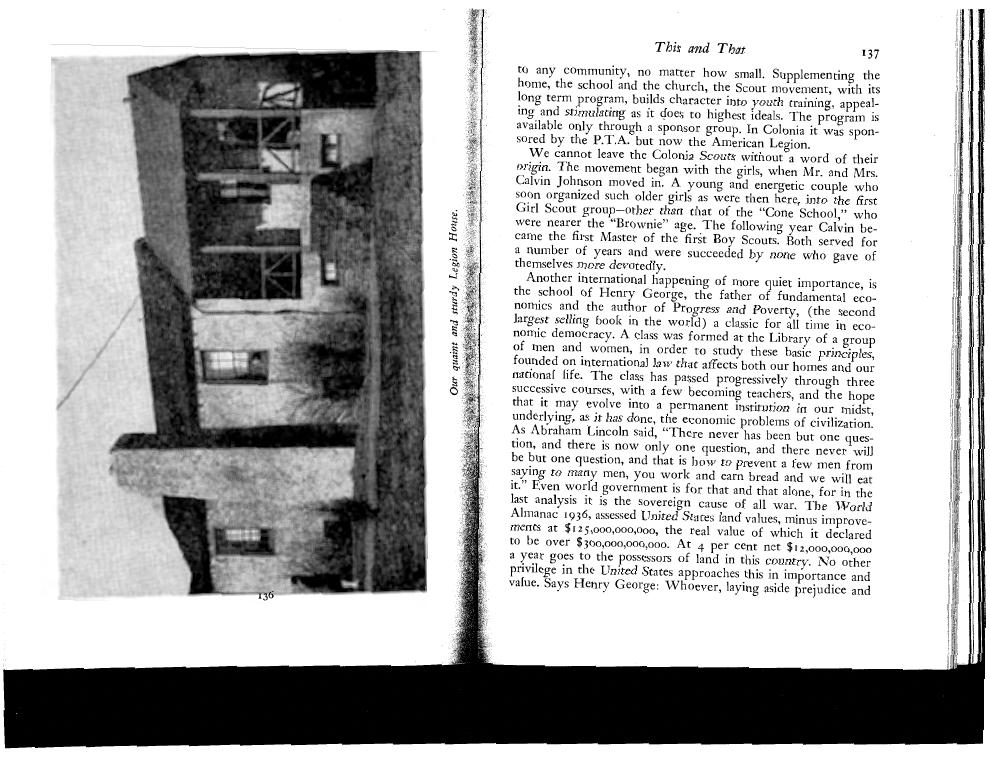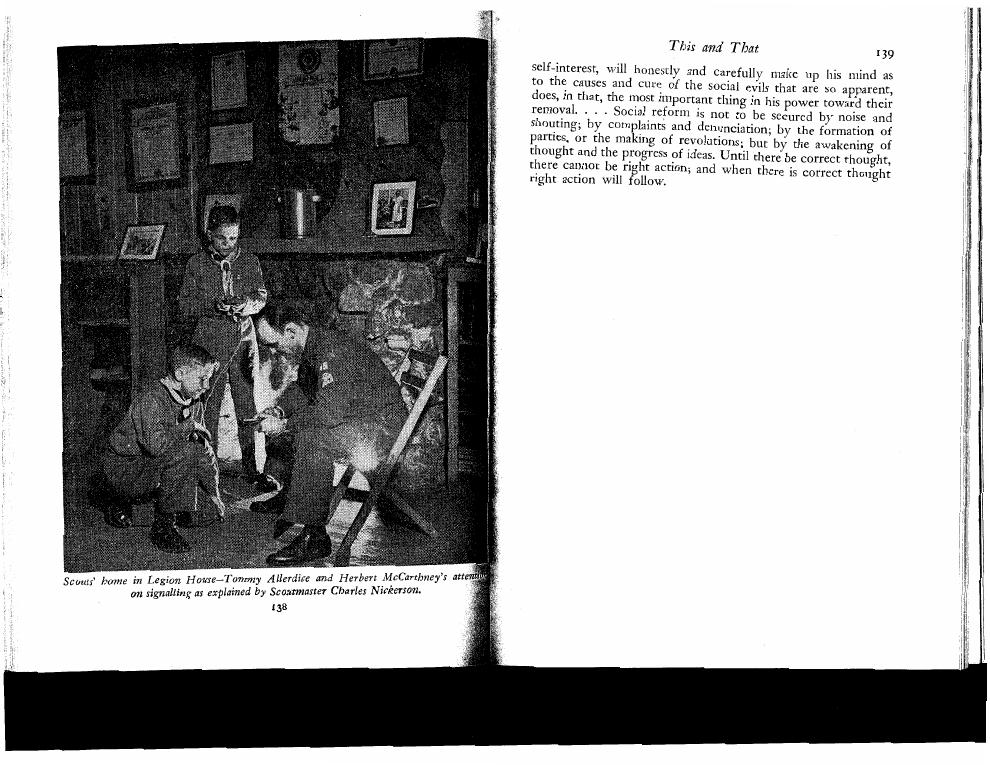
Chapter 1 THE SHEEP AND THE WOLVES
Can you imagine anyone wanting to write the history of a town before it has lived? Even Clio herself would have difficulty finding any continuity of events in our lovely Colonia that, to date, could be called history, save it is on its way, and yesterday should always be recorded by someone. There is a beginning in every end: a cause for every effect, always a tiny unit “start” in life to e’en the greatest growth. Towns, like people, are born, live, grow, mature and die, to be resurrected or buried, as events have it.
First, we found we had a name properly recorded in 1894 during Cleveland’s Administration. It was given us by the Cone family, the first settlers of what might be called modern Colonia— or the newly named Colonia which, before that, and still indefinitely before, was known as Houghtenville, with a variant spelling. You may take your choice from the map you happen to see. Of course the name came from somewhere—it seems safe to believe from one called Houghton—here we have another spelling—a very early settler, who, it is said, had a sheep farm where now gather the golfers. His little farmhouse, judging from the old stone cellar, was situated on the northwest corner of the then County Pike, or Highway, and New Dover Road, afterward occupied by one E. Potter, and now buried forever by the Overpass, with nothing but an old apple tree to suggest the marking of any home life.
It is said he raised beautiful sheep and wool, as did others on the plantation, for this is what it was called, a “plantation of Woodbridge,” and an early one. He built privately,—inasmuch as the railroad has no listing of such,—a “Platform,” recorded on Evert’s map, at which the then New Jersey Railroad and Transportation Company agreed to stop for the shipping of cattle. We know not for how long this served, nor have we knowledge
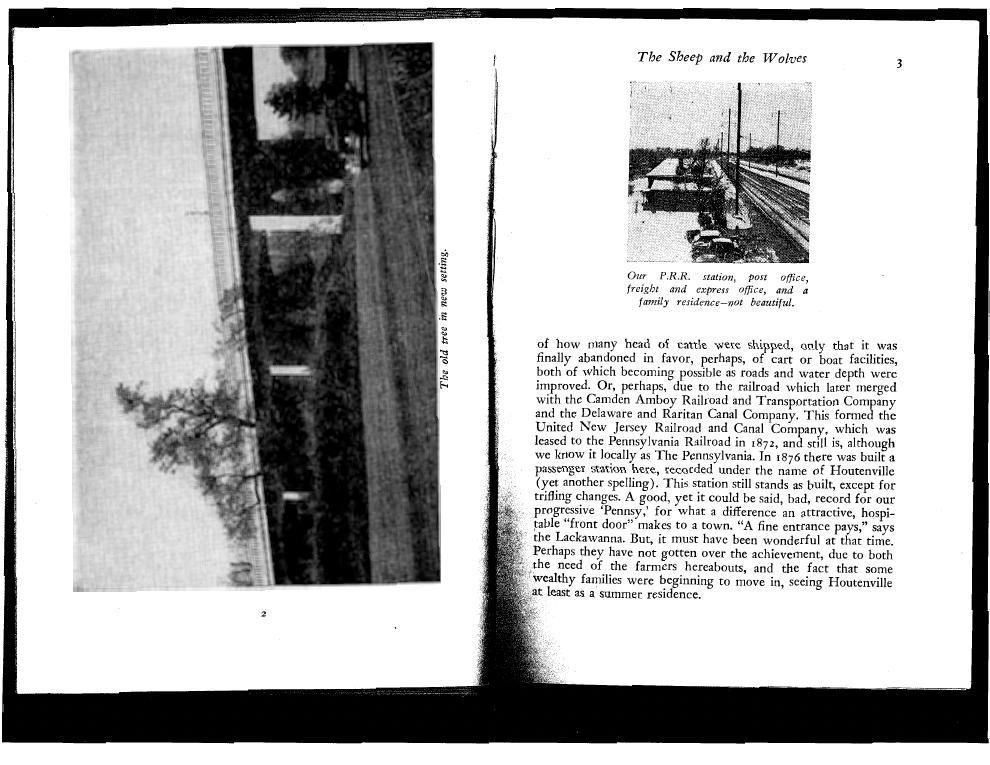
Our P.R.R. station, post office, freight and express office, and a family residence—not beautiful.
of how many head of cattle were shipped, only that it was finally abandoned in favor, perhaps, of cart or boat facilities, both of which becoming possible as roads and water depth were improved. Or, perhaps, due to the railroad which later merged with the Camden Amboy Railroad and Transportation Company and the Delaware and Raritan Canal Company. This formed the United New Jersey Railroad and Canal Company, which was leased to the Pennsylvania Railroad in 1872, and still is, although we know it locally as The Pennsylvania. In 1876 there was built a passenger station here, recorded under the name of Houtenville (yet another spelling). This station still stands as built, except for trifling changes. A good, yet it could be said, bad, record for our progressive ‘Pennsy,’ for what a difference an attractive, hospitable “front door” makes to a town. “A fine entrance pays,” says the Lackawanna. But, it must have been wonderful at that time. Perhaps they have not gotten over the achievement, due to both the need of the farmers hereabouts, and the fact that some wealthy families were beginning to move in, seeing Houtenville at least as a summer residence.
Back of Mr. Houghton, somewhere between 1669, when Woodbridge Township was created, and 1867 when E. Potter is recorded, this area, now called Colonia, included Leesville, Bridgetown and Milton, on the south of Rahawak River and, on the north, the land down to Robinson Creek, all of which is now Rahway. It was one of the largest plantations in the township but was inhabited more by wolves than by people. In fact, so many wolves were complained of in the forests and fields of the Township, of which Houghtenville had a-plenty, that the Freeholders were greatly disturbed, and on March 13, 1697, a price was agreed upon of 25-s for every wolf delivered to the ‘“dyg-pit.” The returns were so great as to cause a raid on the public treasury, so that the price had to be cut in half. Yet, still they were delivered.
As far back as we have any record, this upper section of the township is spoken of as “beautiful country, serene, fertile, and greatly to be desired.” When making a survey of the homes in 1931, we were impressed with the fact that there was to be found, in each of the fifteen districts (into which Colonia was divided for workable purposes) a brook or stream, a bridge, a lake or pond and much woodland, with many conspicuously handsome trees (a beautiful oak on the Stillman farm was seven feet in diameter now gone with the Parkway), and practically no unremovable nuisance—even the mosquitoes—Nature has done her best to make us happy. The completion of the job is up to us.
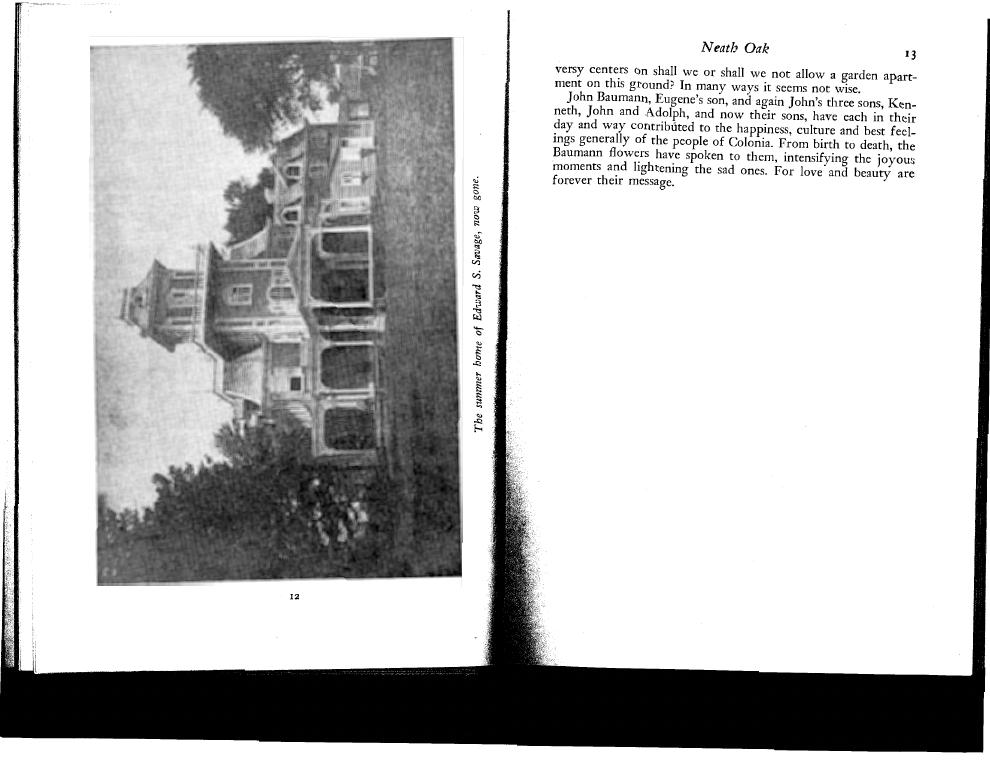
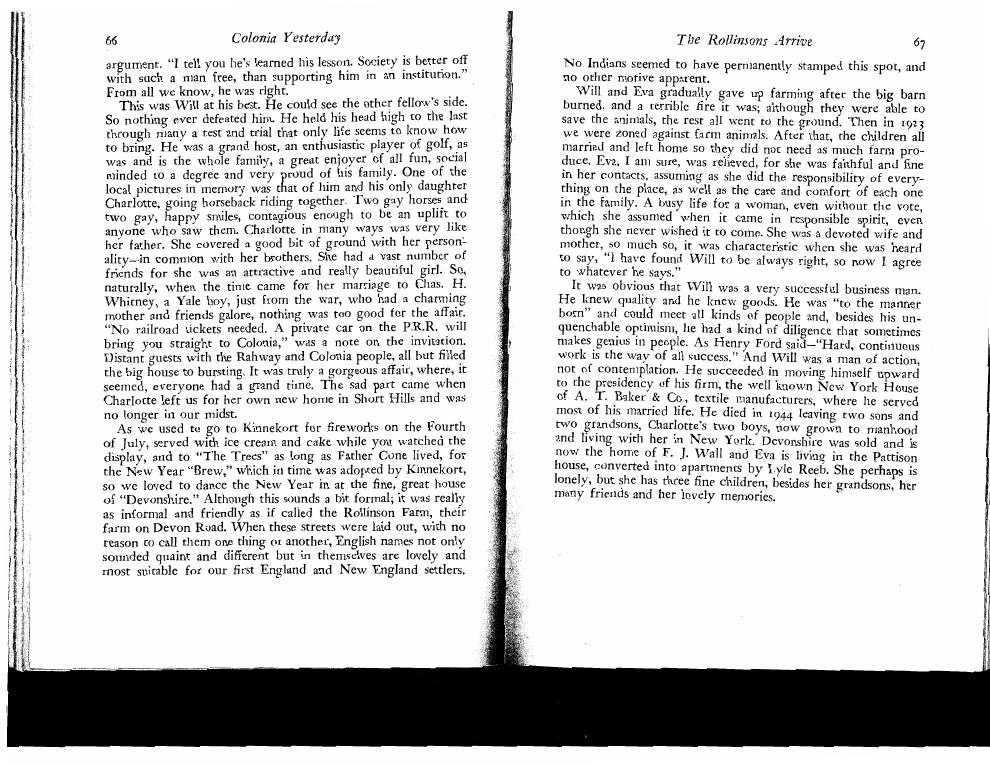
One of the oldest known settlers on New Dover Road, Miss Sarah Toms, told us, some time before her death, of her pleasure as a child in watching the makers of brick somewhere near Wood Avenue. Legend has it that these hand-made bricks helped to form the handsome Georgian home built by George P. Gordon (the wealthy “printing-press” man who built the Gordon Theatre in Rahway). It was called “Neath Oak” and later purchased by Edward S. Savage and remodeled. These same bricks, if legend is correct, now form the Colonia Library.
Miss Toms showed us some truly lovely handmade furniture her mother had had built in the same neighborhood. With these exceptions, no industries are recorded other than farming and the shipping of cattle, hay, meal, flour and the selling of farm prodThe Sheep and the Wolves 5
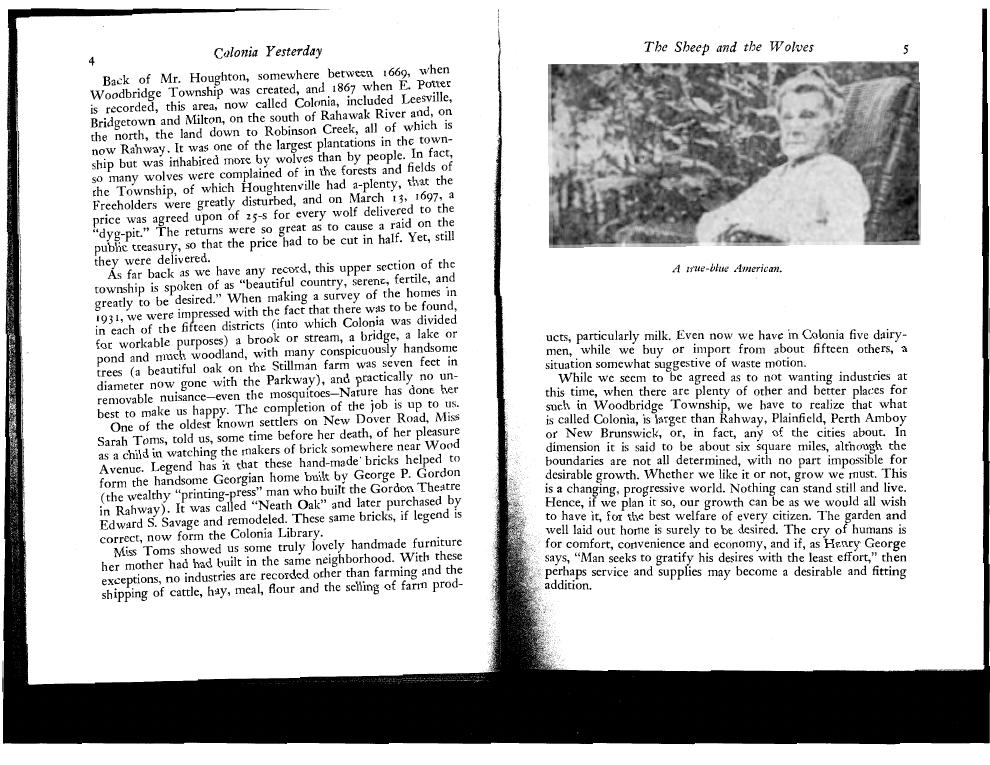
A true-blue American.
ucts, particularly milk. Even now we have in Colonia five dairymen, while we buy or import from about fifteen others, a situation somewhat suggestive of waste motion.
While we seem to be agreed as to not wanting industries at this time, when there are plenty of other and better places for such in Woodbridge Township, we have to realize that what is called Colonia, is larger than Rahway, Plainfield, Perth Amboy or New Brunswick, or, in fact, any of the cities about. In ‘dimension it is said to be about six square miles, although the boundaries are not all determined, with no part impossible for desirable growth. Whether we like it or not, grow we must. This is a changing, progressive world. Nothing can stand still and live. Hence, if we plan it so, our growth can be as we would all wish to have it, for the best welfare of every citizen. The garden and well laid out home is surely to be desired. The cry of humans is for comfort, convenience and economy, and if, as Henry George says, “Man seeks to gratify his desires with the least effort,” then perhaps service and supplies may become a desirable and fitting addition.
For the past century, more or less, Colonia has been pouring her substance into Rahway, with but small percentage for Woodbridge, and little or nothing for herself. It has helped to build Rahway, while being thrown into debt by Woodbridge. Even our railway station stands as is because Rahway is more comfortable and convenient. We might have been better off to have permanently become Rahawack, instead of giving away our early lines—but regret is fruitless and that was not to be our history. Still, to regain consciousness of our place and possessions is perhaps desirable. Sometimes it is healthier, and so happier, to live on a crust, as it were, and to “live your own life” than to be subject to the purposes of others.
Future industries, however, may be very different from those of the present, with perhaps undreamed-of comforts, conveniences and economies. Perchance all factories and their machines will be far off by themselves, devised with minimum unpleasantness for anyone, even the most fastidious worker, leaving wide open spaces in which to have our homes and our hopes mature.
The world is on the move, and never before at such a pace.
Chapter 2 NEATH OAK
In sEARCHING through the New Jersey Historical Society, the report came that nothing save the names Houghtenville and Colonia could be found. The reply intimated that there was nothing which could be interpreted as history. There was no church, no tavern, school, store or industry of any sort; nothing to begin with. This is, of course, history’s right arm, the chronological description of the place and its institutions. Now, at least, we have our school and library, our Country Club, Legion House and our new Civic Club House, as well as “Benny’s Corner” in Upper Colonia. But, the historical “left arm” has perhaps a larger part to play in the feeding and functioning of the right, and, that left is the people i action. It is “folks,” first, that make history, not forms. Forms are the visible proofs or results, but as folks first make those forms, the interest to most people is in the making and not in the results alone. Senator Morrow once said that “while city planning was associated with the finished and misformed city, it was more important to start with the fields, before any permanent misforms had taken place.” Sounds sensible, does — it not? Which reminds us of the first statement of the great planning expert and engineer, Russell Van Ness Black, at a Woodbridge Township Civic Conference meeting in 1945 at Woodbridge Town Hall. “I am not here,” he said, “‘to tell you how to plan, but to show you the way, of how to plan not to plan.” In other words, nothing is static in this world that should control one, if something better appears. The natural law of spontaneity fits here. For life is an eternal moving on, with the best to be a little ahead of what we see.
An incident illustrating this developed at the beginning of our research. One of our oldest living residents of the township was visited and asked to tell us of any tradition connected with her home life in Colonia. We thought that to go back from what we had, was to build toward the present, as well as the past. But her reply was, “I know nothing of Colonia, I never lived in Colonia and I never want to. I can’t tell you anything.” “But where do you live?” she was asked. “I live in New Dover, and always have.”’ That there is no New Dover in Woodbridge Township convinced her not at all. So our plan was to re-plan on the spot as far as she was concerned, or we might have been discouraged.
Our next step was to get from authoritative records, the State, County and Township, what they had, handicapped with the fact that there is nothing particularly new in what already has been printed many times. However, we did make some connections and verified a few things that perhaps are new to you, our reader.
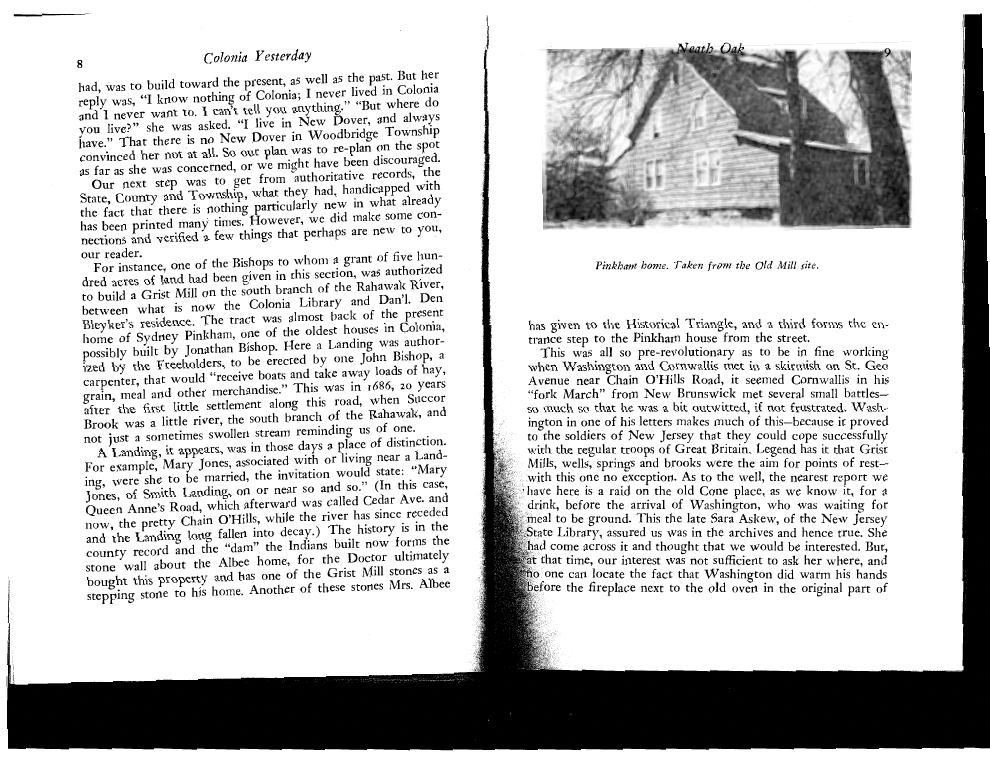
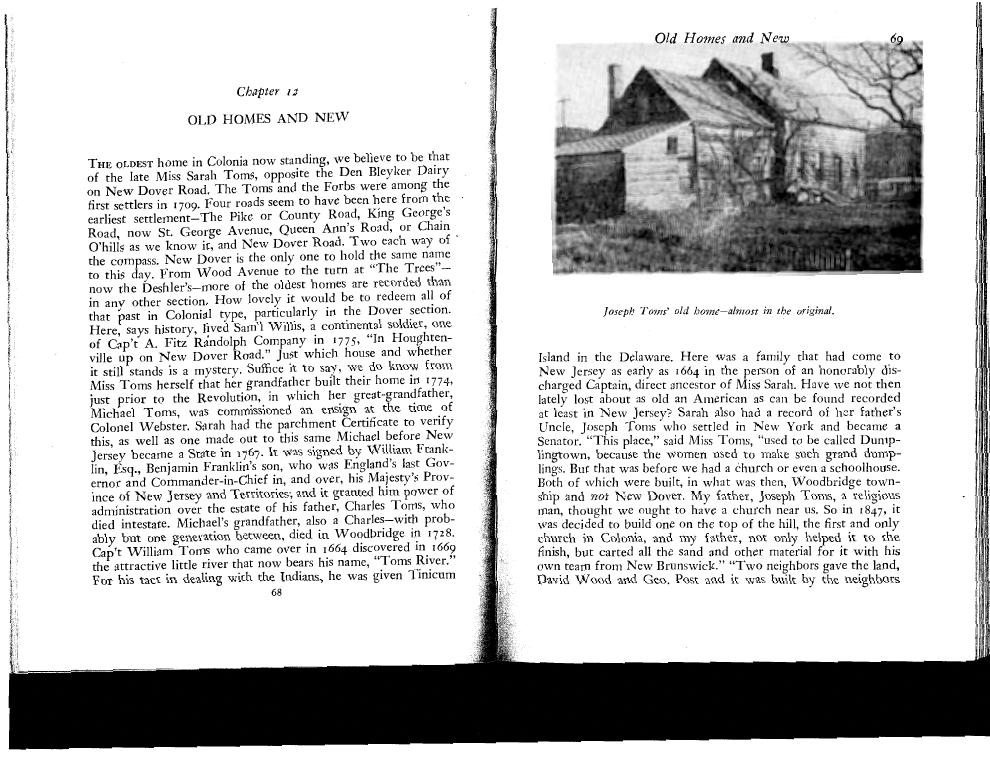
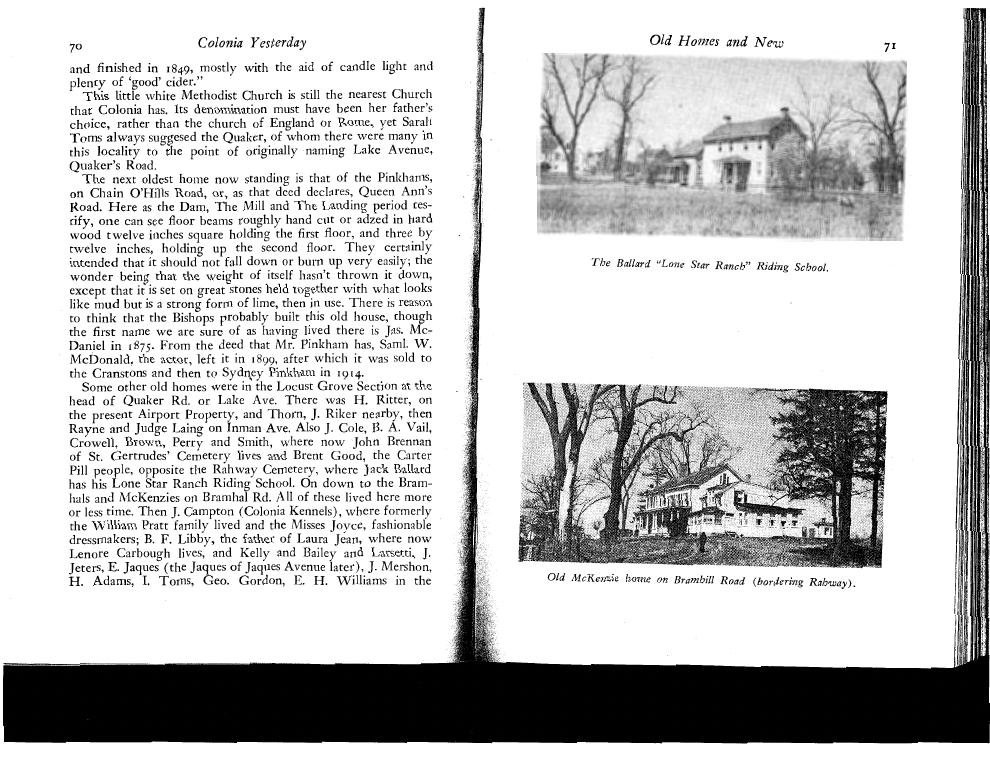
For instance, one of the Bishops to whom a grant of five hundred acres of land had been given in this section, was authorized to build a Grist Mill on the south branch of the Rahawak River, between what is now the Colonia Library and Dan’l. Den Bleyker’s residence. The tract was almost back of the present home of Sydney Pinkham, one of the oldest houses in Colonia, possibly built by Jonathan Bishop. Here a Landing was authorized by the Freeholders, to be erected by one John Bishop, a carpenter, that would “receive boats and take away loads of hay, grain, meal and other merchandise.” This was in 1686, 20 years after the first little settlement along this road, when Succor Brook was a little river, the south branch of the Rahawak, and not just a sometimes swollen stream reminding us of one.
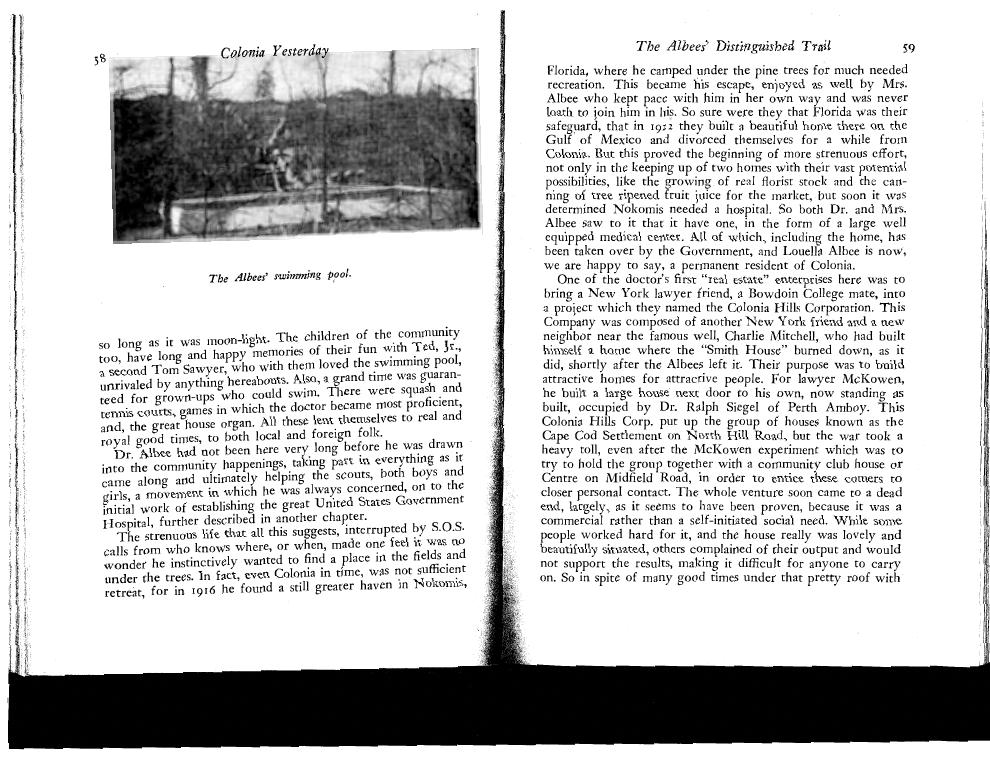
A Landing, it appears, was in those days a place of distinction. For example, Mary Jones, associated with or living near a Landing, were she to be married, the invitation would state: “Mary Jones, of Smith Landing, on or near so and so.” (In this case, Queen Anne’s Road, which afterward was called Cedar Ave. and now, the pretty Chain O’Hills, while the river has since receded and the Landing long fallen into decay.) The history is in the county record and the “dam” the Indians built now forms the stone wall about the Albee home, for the Doctor ultimately bought this property and has one of the Grist Mill stones as a stepping stone to his home. Another of these stones Mrs. Albee
Pinkham home. Taken from the Old Mill site.
has given to the Historical Triangle, and a third forms the entrance step to the Pinkham house from the street.
This was all so pre-revolutionary as to be in fine working when Washington and Cornwallis met in a skirmish on St. Geo Avenue near Chain O’Hills Road, it seemed Cornwallis in his “fork March” from New Brunswick met several small battles— so much so that he was a bit outwitted, if not frustrated. Washington in one of his letters makes much of this—because it proved to the soldiers of New Jersey that they could cope successfully with the regular troops of Great Britain. Legend has it that Grist Mills, wells, springs and brooks were the aim for points of rest— with this one no exception. As to the well, the nearest report we have here is a raid on the old Cone place, as we know it, for a drink, before the arrival of Washington, who was waiting for meal to be ground. This the late Sara Askew, of the New Jersey State Library, assured us was in the archives and hence true. She had come across it and thought that we would be interested. But, at that time, our interest was not sufficient to ask her where, and no one can locate the fact that Washington did warm his hands before the fireplace next to the old oven in the original part of
9GCE 8YCZO EESL E
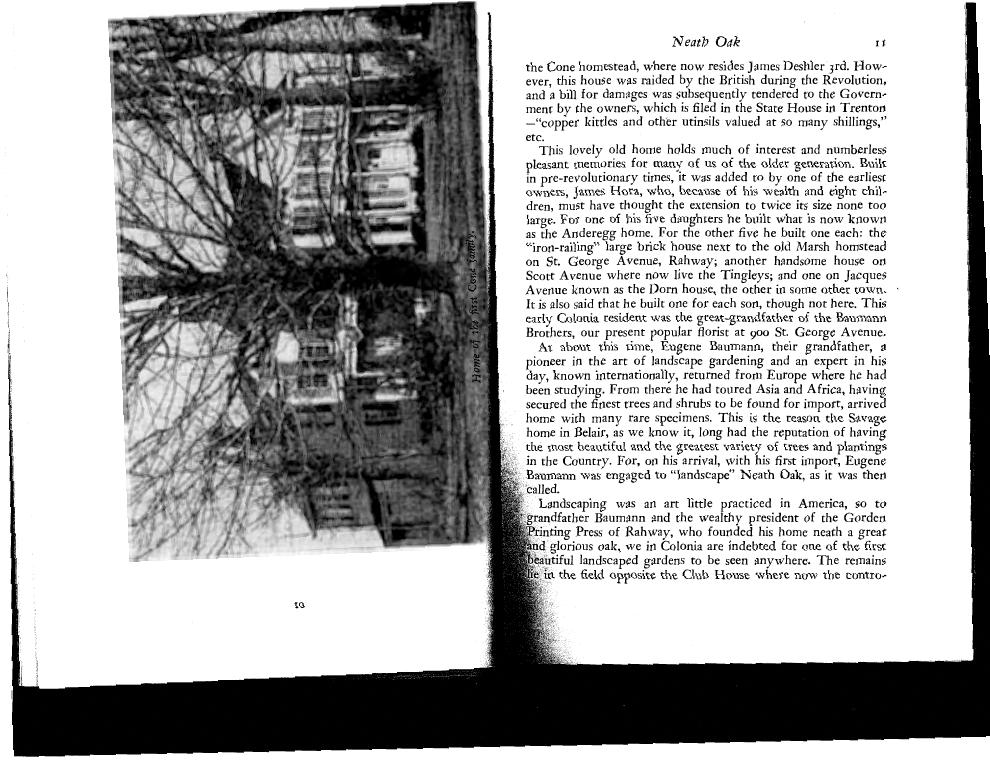
Home of the first Cone familv.
Neath Oak II the Cone homestead, where now resides James Deshler 3rd. However, this house was raided by the British during the Revolution, and a bill for damages was subsequently tendered to the Government by the owners, which is filed in the State House in Trenton —“copper kittles and other utinsils valued at so many shillings,” etc.
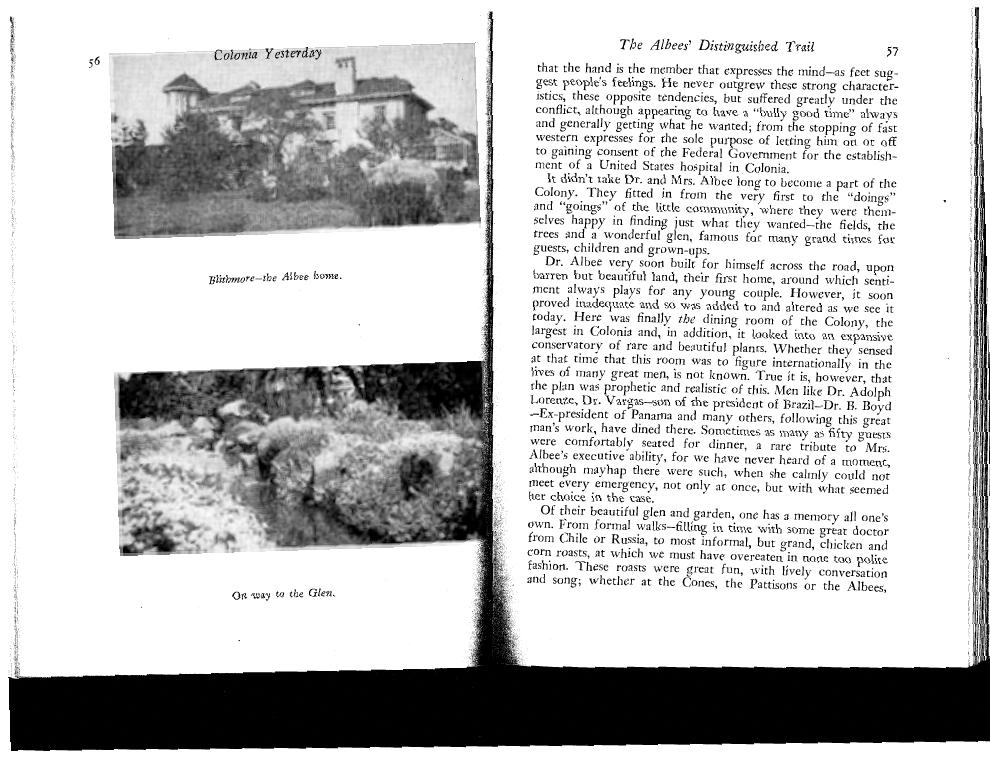
This lovely old home holds much of interest and numberless pleasant memories for many of us of the older generation. Built in pre-revolutionary times, it was added to by one of the earliest owners, James Hora, who, because of his wealth and eight children, must have thought the extension to twice its size none too large. For one of his five daughters he built what is now known as the Anderegg home. For the other five he built one each: the “ron-railing” large brick house next to the old Marsh homstead on St. George Avenue, Rahway; another handsome house on Scott Avenue where now live the Tingleys; and one on Jacques Avenue known as the Dorn house, the other in some other town. It is also said that he built one for each son, though not here. This early Colonia resident was the great-grandfather of the Baumann Brothers, our present popular florist at goo St. George Avenue.
At about this time, Eugene Baumann, their grandfather, a pioneer in the art of landscape gardening and an expert in his day, known internationally, returned from Europe where he had been studying. From there he had toured Asia and Africa, having secured the finest trees and shrubs to be found for import, arrived home with many rare specimens. This is the reason the Savage home in Belair, as we know it, long had the reputation of having the most beautiful and the greatest variety of trees and plantings in the Country. For, on his arrival, with his first import, Eugene Baumann was engaged to “landscape” Neath Oak, as it was then called.
Landscaping was an art little practiced in America, so to grandfather Baumann and the wealthy president of the Gorden Printing Press of Rahway, who founded his home neath a great and glorious oak, we in Colonia are indebted for one of the first beautiful landscaped gardens to be seen anywhere. The remains lie in the field opposite the Club House where now the contro-
‘2U08 Mou ‘asvavg °§ pavaupy fo ausog sauuuns aq T versy centers on shall we or shall we not allow a garden apartment on this ground? In many ways it seems not wise.
John Baumann, Eugene’s son, and again John’s three sons, Kenneth, John and Adolph, and now their sons, have each in their day and way contributed to the happiness, culture and best feelings generally of the people of Colonia. From birth to death, the Baumann flowers have spoken to them, intensifying the joyous moments and lightening the sad ones. For love and beauty are forever their message.
Chapter 3 WHAT'S IN A NAME
“A RosE by any other name would smell as sweet.” We wonder! There is something lovely and liquid in the very sound, rose. There is dignity and charm. We picture beauty. Surely it would not be the same if one were asked to smell this exquisite red stinkweed—or perhaps snake gut? This suggests the scientific experiment test of not long since when a carefully prepared dinner of fillet, asparagus, ice cream, coffee and what not, were caught in a hard and brilliant green light that made them appear to be of that color. No one could eat or drink a mouthful, even though it was known to be but a ruse.
Science explains the senses as art interprets their use. Rasping and discordant noises, or soothing and rhythmic tones, undoubtedly give opposite effects and make all the difference in the world. Again, we are as definitely moved by sight and touch, as by sound and smell. The commercial artist knows very well how important is the choice of a name. To induce the right mood for reception is a sure proof of his skill. And what are nicknames but an affectionate feeling of the mood of approval? “When I hear, ‘Johnny dear,’ I’m safe,” said the youngster, “but oh, Boy! am I scared when mother calls ‘John Denman Putnam!’” (With the D and the P hit hard.) Even the slight difference of whether you be Mrs. Houghton, Mrs. Houghten, or Mrs. Houten, has its effect in the modified gesture of tone. Mrs. Catt used to privately admit her name had been a handicap, even in Woman’s Suffrage, and surely one would hesitate to introduce as an honored guest, Mrs. Buzzard of Dumplingtown!
Admittedly there is something in a name. Mr. Shakespeare, of course, knew this to be true, or he would not have raised the question. His wisdom was to make one think—through emotion. There is a natural law in sound effect that can be learned and practiced. Contrast Romeo and Juliet with Scrooge and Uriah
What’s in a Name 15
Heep. Or locally, such names as Spanktown and Colonia. The first hurts a bit, as you say it, or even think it, while the latter is universally pleasing.
In discussing the “why” of the change with the Cones, Elizabeth Cone replied, “It’s a precious place with a pitiful name. Indeed, we just couldn’t stand it. The very sound suggests hungry dogs. An awful feeling! While in Colonia you expect to meet the amenities in life. It just had to be changed! We could never live under the name of Houghtonville.”
If there is anything in the science of sound vibration, then there is much in a name, for it both leads and follows the personality which towns possess, as do people. It might be of passing interest to estimate the fitness of the name Colonia from the angle of the classic symbolism of its letters,
C-the physical expression of the fusing of agriculture and business, the first really social happening from the single selfinterest to the awakening of neighborly concern. This is accentuated in the L which suggests both the physical and the intellectual approach. The O is community consciousness complete. The interest of all in the larger or smaller circle, that means life with others and the responsibility of such, whether in family or group, or, in the broadest of human relations. We get individuality in the letter A, both creative and original— pushing for change for the better. The N, means new life and hope on the way. The I, high regard ultimately for the best possible condition throughout every part. This ‘Il is the personal in the third or universal dimension.
On the whole, Colonia is more interested in beauty than it is in business; in art, culture and creative projects, than in merely drab living. It definitely is practical, because well balanced, though it is slow in expression, because including much, yet, never inclined to be vulgar, mean or mundane.
“Where is Colonia?” While this has been a fifty year question, Colonia is distinguished as being “the one and only” in the United States,—_there is one however in Mexico—and it has an atmosphere, as one can see, of finer vibration than the usual small town name, which far from making us smug, should give us greater responsibility in the need for its citizens to get together on that sympathetic plane that realizes and practices the cooperative way for best results.
In fact, the vibratory tendency or motive is so strong that we cannot long avoid this creative united way, either in great or small activity. We, the people, must choose, and we, the people, must do our own determining.
How much wiser to move with the current and with the better flow of the tide, and so not entangle ourselves in cross waves. For no opportunity is so fine in life that one cannot make a mess of it, if not forever on guard, with some larger view.
The natural vibration of Houghtonville on the contrary is a work-a-day routine world, with little or no inspiration or desire for anything different. Although this be but the science and art of symbolism, it does seem to prove—there is much in a name, as the Cone family instinctively felt, and as Shakespeare, of course, knew well.
HAMPERED BY SIZE
By REFERRING to the history of the Elizabethtown Purchase in Union County, the readers will find a copy of the original deed, obtained from the Indians on the 28th of October, 1664, which includes this Township. “Under permission from Governor Nicoles, John Bailey, Daniel Denton and Luke Watson obtained from Matano, Manamoaone, and Conescomen, Indians, for all land bounded on the South by a River commonly called the Raritan and on the East by the River which parts Staten Island and the Maine and to run Northward up After Cull Baye till we come to the first river which sets Westward out of the Bay aforesaid and to runn Westward into the country, thence the length as it is Broad from the North to the South of the aforesaid bounds. All for the barter of twenty fathom of Traydon cloth—2z cotes—2 Gunnes—z Kittles ten barre lead—twenty handful powder—four hundred fathom of White Wampom or two hundred fathom of Black wampom. The whole valued at £ 36-145.”
This large area included what now is Rahway, Carteret, Woodbridge Township, Perth Amboy, Piscataway, Metuchen and all the little places between, not forgetting a large part of Elizabeth.
In dividing, selling and exchanging, the Township of Woodbridge finally reduced itself to about 17,280 acres, or twentyseven square miles, and the largest and second oldest Township in Middlesex County. Of this, Colonia, although not accurately defined, has about 3,700 acres or about six square miles. No wonder the “Grants” were from 15 to 500 acres a piece, with 1,000 acres set aside for the King, or “Lords Proprietors.” These Grants were drawn by lots and by the men who served or were to serve the township in one way or another. The Freeholders, of course, came first. To be a Freeholder of land wasn’t a bad job as time went on. They served their town on demand, but from average estimation, they seem to have been well paid for it. Unlike present land value, the early acres of Colonia abounded in food, clothing and shelter. Every sort of wild animal for food and clothing went with the deed. Wild fruits, honey and berries were abundant, wool and grasses for clothing, trees and stone for their homes and all the fuel they could use for the cutting. So, really, they didn’t draw just acres, they drew homes, equipped for living all but the labor—an untold amount. No wonder “Kittles and Lead” were to the Indians so choice. They didn’t sprout in the woods. But how long, we wonder, did the pots last the first poor tribes? Certainly not long enough to bequeath to their “heirs and assigns forever.” However, one thing we note, whether the people were originally English, or New English, they saw fit to set aside one hundred acres of land as “free land for schools forever,” although the first school was not built until 1711, with George Burbanks chosen teacher. It was on Strawberry Hill, where now stands St. Joseph’s Orphanage. Previous to this there had been three teachers who held school somewhere. James Fullerton 1689, John Beacher 1691 and John Brown 1694.
This early background is but to show how far apart, even in the first settlement, have been the people of Colonia. Acres and acres in everyway. Before the Revolution from the oldest map we have been able to discover, the settlement here was divided. New Dover so named, no doubt, from England’s Dover (of the “White Cliffs”) appears as early as any with eight houses, including the Locust Grove line, six in the middle, from “The Trees” to the station—four around the Club house with twelve all told—from the Railroad to Woodbridge, of which four were adjacent to the Pinkhams—four between there and Iselin, or Uniontown, as it was then called and before that Perrytown and four scattered in and around St. George Avenue, or King George Road, as it was named. A maximum total of twenty-four homes on six square miles, with impossible roads between, and each family having all it could do to subsist. There was no church, for the reason that even if every house served the same God, there were not enough to hold a preacher. So they went where they chose, in different directions. This has held until today, save for an hour a week for a temporary Roman Catholic Mission and school in the Public Library. For school and Sunday School, children went to the nearest one, or none at all until the St. Paul Extension in the school building—under the long and faithful guidance of the late Ralph Fowler, and now John DuBois.
For politics, the leaders “controlled” much as they now do, but only the men were voters until 1913. There is little or no social life mentioned anywhere. For generations it appears to have been the need to look after oneself, with no live community feeling for social, religious, economic or political interests of any kind, except among close neighbors. Most of the inhabitants were from England, so there may have been a “race” affinity. Of course, we know that the second strongest human instinct is that of social contact, or human relations—but, apparently history has taken little note of what was done in friendly fashion, or how it was expressed. This of course was not true of Woodbridge proper, where the Church, school and town-hall were early established.
This awkward feeling of separateness has carried to this day. Geographically we are too large for our village size of 3,000 people, pulled apart as we are by Rahway, Woodbridge, Iselin, Plainfield and Perth Amboy. Up to 1927 and the building of the school, there was no spot or place where “two or three” of the public could gather, except in private homes. We voted in Iselin, where the first recorded vote for Colonia and Iselin was 17. All told we took our trains from there, or Rahway, in large measure, and we shopped for our food as now, wheresoever we were inclined to be. This alone suggests the expenditure of one to $200,000 a year in a “foreign market,” with vo exports. It is not “supporting our own.” To be sure, our natural shopping place is
_ Woodbridge, but only if we have a car is it convenient, and then it is but a few minutes on to Perth Amboy to larger and so per-
_ haps better service, so that Woodbridge suffers from having more
“convenient” shopping districts to compete with. Colonia, like a crow, gathers from hither and yon and takes home its spoils for consumption, seldom even meeting a neighbor in the store.
And now for the other side, for nothing is a handicap that is not a good hurdle. To have too close community interest in too small space is to grow narrow and self-centered—the negative use of the social instinct—which, of course, is not healthy. None of us, nor all of us, are the center of any universe. We are living on the run—in 1949—here and there, going home to roost and refresh. We, in Colonia, instead of having that danger, where the town lives around a small square, sometimes a very beautiful square, have about fifteen different neighborhoods, all with some wonderful people. On the whole, each has a character all its own with much to give and take from the other. We develop in parts, then assemble to exchange each his findings and inspire each other to more and greater achievement—which is a way to preserve the privacy wanted and at the same time to assume such individual and collective responsibility as is imperative in any and all democratic fulfillment. We have been decentralized for greater growth, before we have been, what might be called, centered. Meaning not a store, church or square, per se, but what these normally signify, a mingling and co-mingling in community fashion. Evidently we can live without it. We have not had it. We have passed its regular stage and are probably on a better and more progressive road through a greater variety of local thought. Colonia is not hampered in having just one point of view. It has at least fifteen—and then some. It is a modern community of many sides, one of which is a long varied and interesting past (even if not definitely historical), which we are having a lot of fun in resurrecting.
Chapter 5 EARLY BITS
In 1492 Colonia was indirectly discovered by Christopher Columbus. In 1609 there was no white inhabitant in New Jersey. The Leni Lenape, meaning original people or “red man,” together with forests, streams and animals, had had possession for generations. No man knoweth how long.
_ In 1664 the land known as Woodbridge Township, was purchased from the Indians. This, with much more, was known as the East Jersey Colony, with Sir Geo. Carteret and Lord Berkely joint proprietors over the Province. The Commission of Governor was given to Carteret’s brother Philip before leaving England. Although Philip was really a cousin, he was always known as George’s brother.
In 1665 the first settlers came to Woodbridge from a company of thirty English people, under the appointed Governor of the New Cesarea as New Jersey was called, although many of the group settled in Elizabethtown, named for Elizabeth, wife of Sir George.
In 1669 a charter was drawn defining Woodbridge Township, which went immediately into effect, but was not confirmed until three years later in 1672.
“We, the Lords-proprietors of the Province of New Cesarea (or New Jersey), having taken a view of this deed, grant or _ charter, made by Cap’t Philip Carteret, Esq., Governor of our said Province, and by his Councill, bearing date, ye first day of June 1669, whereby he did enable and give power to ye Justices, Magistrates and Freeholders, in the Town of Woodbridge, in the _ said Province forever to become a corporation with general limitations, privileges, Buttalls and bundalls therein particularly ex- _ pressed, “Now, known’ ye that wee, the said Lords proprietors at _ the request of the said Justices, Magistrates and Freeholders, and ry Colonia Yesterday for divers good causes and considerations, us thereunto moving have ratified and confirmed, and for these presents do for our heirs, successors and assigns forever Ratify and Confirme unto the said Justices, Magistrates and Freeholders of Woodbridge, the said grant and Charter with all and every—the lands and meadows soe limited butted and bounded and all and singular other privileges and immunities therein mentioned and expressed. Referring to us, our heirs and successors what else is therein reserved. Giving order hereby to ye Secretary of our said Province to enter this our confirmation into our records there and to fix to it our province seale. Given under our hands and seals at Whitehall, the seventh day of December in the year of our Lord God 1672.
Jo Berkeley | Geo. Carteret”
A good, stout and an advantageous charter—most liberal—but it is reported that Lord Berkely became disgusted with his Nova Cesarea property and sold his share for less than $5,000 to John Fenwich and Edward Byllinge on the 18th of March 1673. From here on it seems to have been called simply New Jersey, in recognition of Carteret’s defense of the Isle of Jersey.
In July 1673, a fleet of Dutch vessels appeared in the New York harbor capturing that City, and with it the whole of New Jersey was subjugated. By a treaty of peace the following year, between Holland and England, the Province was restored to English rule and Philip Carteret retained as Governor, but not long afterward he sold out to Daniel Pierce and his associates for £80, who immediately took possession, and the government of our Township began.
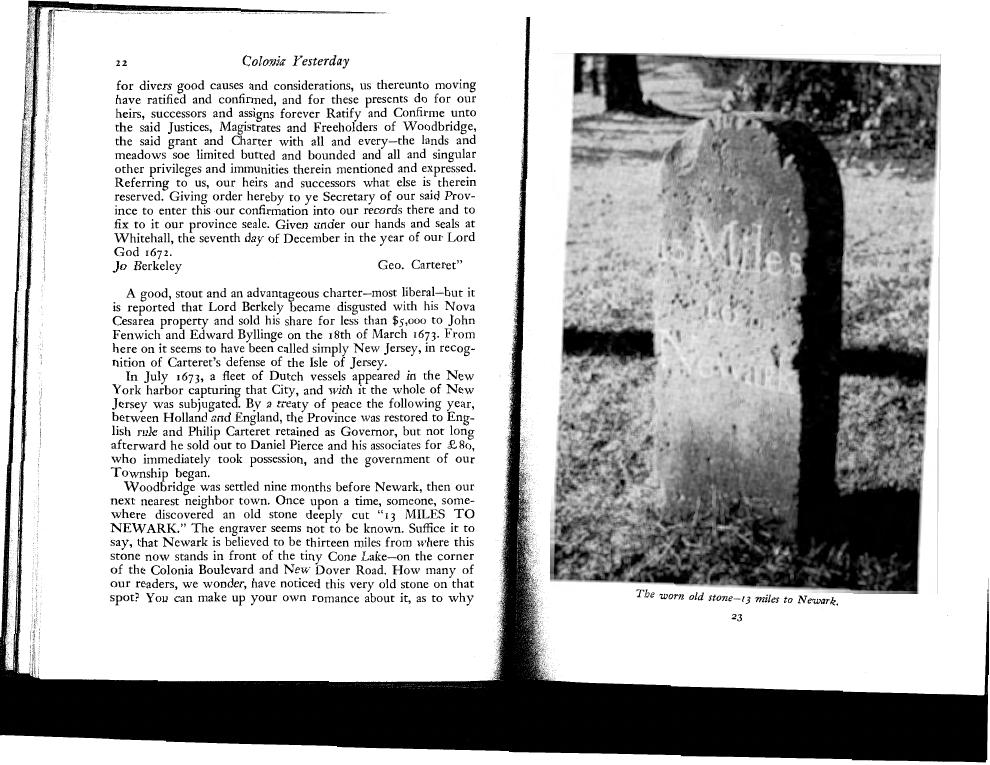
Woodbridge was settled nine months before Newark, then our next nearest neighbor town. Once upon a time, someone, somewhere discovered an old stone deeply cut “13 MILES TO NEWARK.” The engraver seems not to be known. Suffice it to say, that Newark is believed to be thirteen miles from where this stone now stands in front of the tiny Cone Lake—on the corner of the Colonia Boulevard and New Dover Road. How many of our readers, we wonder, have noticed this very old stone on that spot? You can make up your own romance about it, as to why
The worn old stone—13 miles to Newark.
it was marked and when. No one living, it seems, can dispute you. Just one of those incidents taken for granted. Two Eke seem obvious, however; one, it must have been cut for use, and placed for permanency. There was, however, a time that it might have been reversed, for from 1666 to 1682 Woodbridge was larger in size and population than the whole of Newark. Whether the stone was an aid to men at war or to the market folk, the stone does not say. It merely expresses the same solid truth, as when carved, and where placed, and appears to have already lived a long and patient life, waiting, while simply stating the one thing —13 Miles to Newark—but obviously it must have been after Newark was named in 1666. So how old are you—you lovely weather beaten, big brown stone?
In 1682 Middlesex County came into being, one of the first four Counties into which East Jersey was divided. The others were Bergen, Essex and Monmouth. Our neighbor, Union, was the last county in the State to be named.
About this time Jonathan Bishop was admitted as a Freeholder in Woodbridge and given a grant of common land, in what is now Colonia, in consideration of his building a saw mill there along the Rahawack Smith branch, now Succor Brook. The price of Jonathan’s initiation as a Freeholder was fixed at 30S “in good pay.” This transaction was handled by the first town clerk, Saml Moore, and called Jones Saw Mill. At this time Perth Amboy was called Amboy Perth. After passing through several other evolutions, it was made in due time the County Seat, inherited from Elizabethtown.
So much for our governmental early bits.
Perhaps the earliest bits are what we know—or think—we know by signs and proof, of the Indians, the stone age, and the topography of our locality.
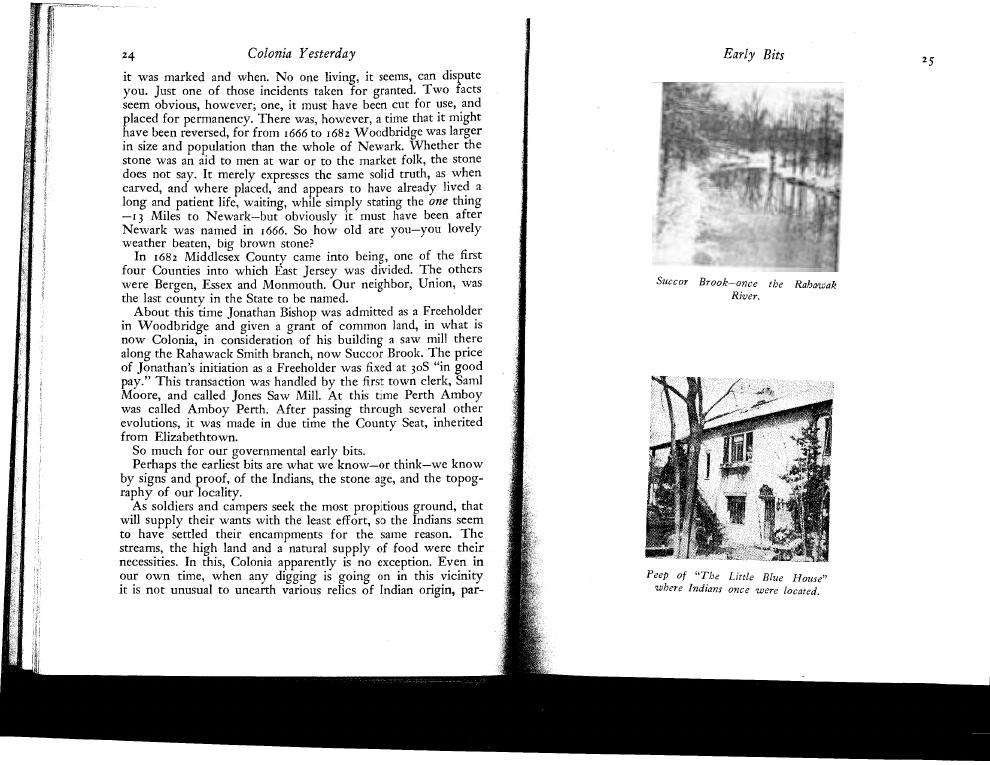
As soldiers and campers seek the most propitious ground, that will supply their wants with the least effort, so the Indians seem to have settled their encampments for the same reason. The streams, the high land and a natural supply of food were their necessities. In this, Colonia apparently is no exception. Even in our own time, when any digging is going on in this vicinity it is not unusual to unearth various relics of Indian origin, parEarly Bits
Succor Brook—once the Rahawak River.
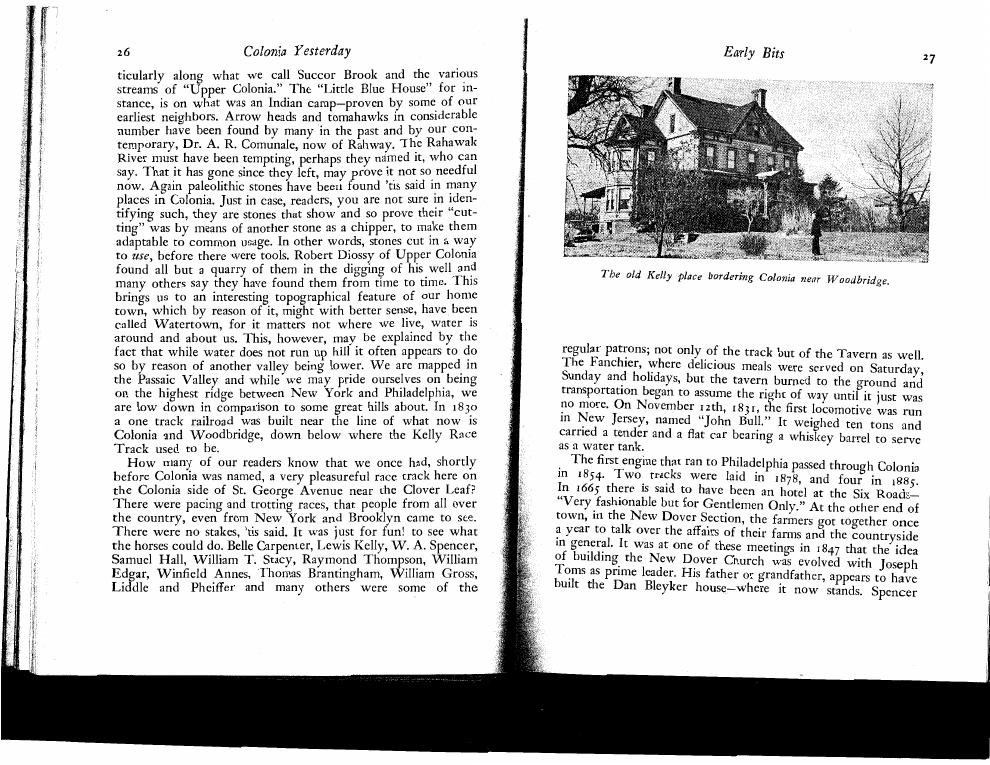
Peep of “The Little Blue House” avbere Indians once were located.
ticularly along what we call Succor Brook and the various streams of “Upper Colonia.” The “Little Blue House” for instance, is on what was an Indian camp—proven by some of our earliest neighbors. Arrow heads and tomahawks in considerable number have been found by many in the past and by our contemporary, Dr. A. R. Comunale, now of Rahway. The Rahawak River must have been tempting, perhaps they named it, who can say. That it has gone since they left, may prove it not so needful now. Again paleolithic stones have been found ’tis said in many places in Colonia. Just in case, readers, you are not sure in identifying such, they are stones that show and so prove their “cutting” was by means of another stone as a chipper, to make them adaptable to common usage. In other words, stones cut in a way to use, before there were tools. Robert Diossy of Upper Colonia found all but a quarry of them in the digging of his well and many others say they have found them from time to time. This brings us to an interesting topographical feature of our home town, which by reason of it, might with better sense, have been called Watertown, for it matters not where we live, water is around and about us. This, however, may be explained by the fact that while water does not run up hill it often appears to do so by reason of another valley being lower. We are mapped in the Passaic Valley and while we may pride ourselves on being on the highest ridge between New York and Philadelphia, we are low down in comparison to some great hills about. In 1830 a one track railroad was built near the line of what now is Colonia and Woodbridge, down below where the Kelly Race Track used to be.
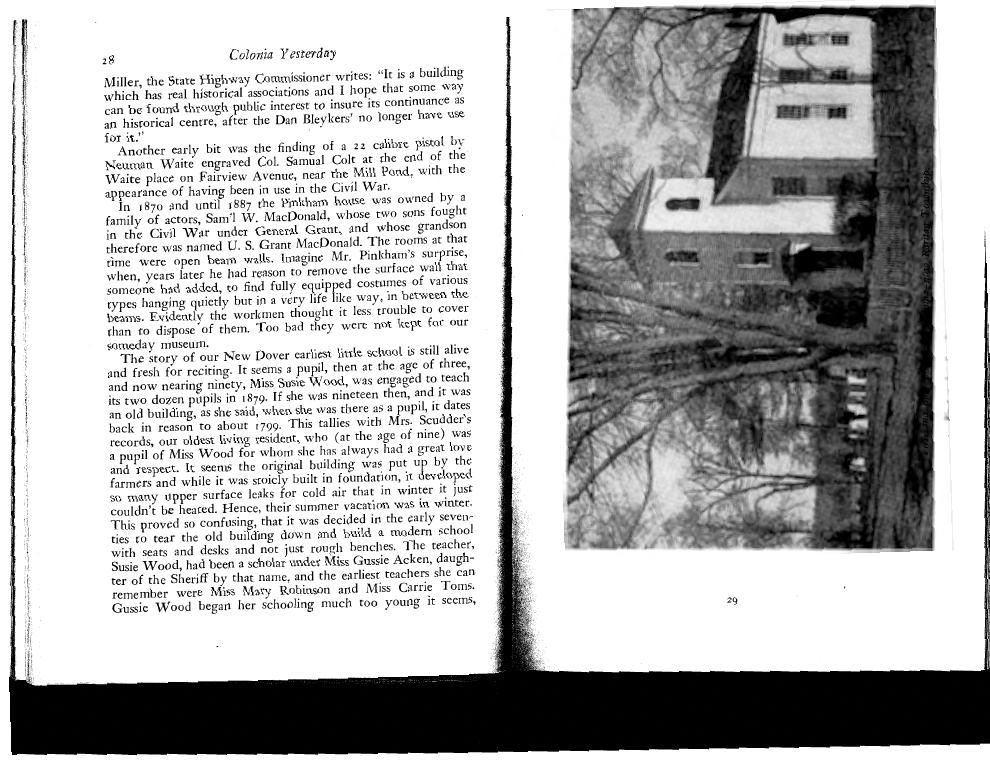
How many of our readers know that we once had, shortly before Colonia was named, a very pleasureful race track here on the Colonia side of St. George Avenue near the Clover Leaf? There were pacing and trotting races, that people from all over the country, even from New York and Brooklyn came to see. There were no stakes, ’tis said. It was just for fun! to see what the horses could do. Belle Carpenter, Lewis Kelly, W. A. Spencer, Samuel Hall, William T. Stacy, Raymond Thompson, William Edgar, Winfield Annes, Thomas Brantingham, William Gross, Liddle and Pheiffer and many others were some of the
The old Kelly place bordering Colonia near Woodbridge.
regular patrons; not only of the track but of the Tavern as well. The Fanchier, where delicious meals were served on Saturday, ‘Sunday and holidays, but the tavern burned to the ground and transportation began to assume the right of way until it just was no more. On November 12th, 1831, the first locomotive was run in New Jersey, named “John Bull.” It weighed ten tons and carried a tender and a flat car bearing a whiskey barrel to serve as a water tank.
The first engine that ran to Philadelphia passed through Colonia in 1854. Two tracks were laid in 1878, and four in 1885. In 1665 there is said to have been an hotel at the Six Roads— “Very fashionable but for Gentlemen Only.” At the other end of town, in the New Dover Section, the farmers got together once a year to talk over the affairs of their farms and the countryside in general. It was at one of these meetings in 1847 that the idea of building the New Dover Church was evolved with Joseph Toms as prime leader. His father or grandfather, appears to have built the Dan Bleyker house—where it now stands. Spencer
Miller, the State Highway Commissioner writes: “It is a building which has real historical associations and I hope that some way can be found through public interest to insure its continuance as an historical centre, after the Dan Bleykers’ no longer have use fort
Another early bit was the finding of a 22 calibre pistol by Neuman Waite engraved Col. Samual Colt at the end of the Waite place on Fairview Avenue, near the Mill Pond, with the appearance of having been in use in the Civil War.
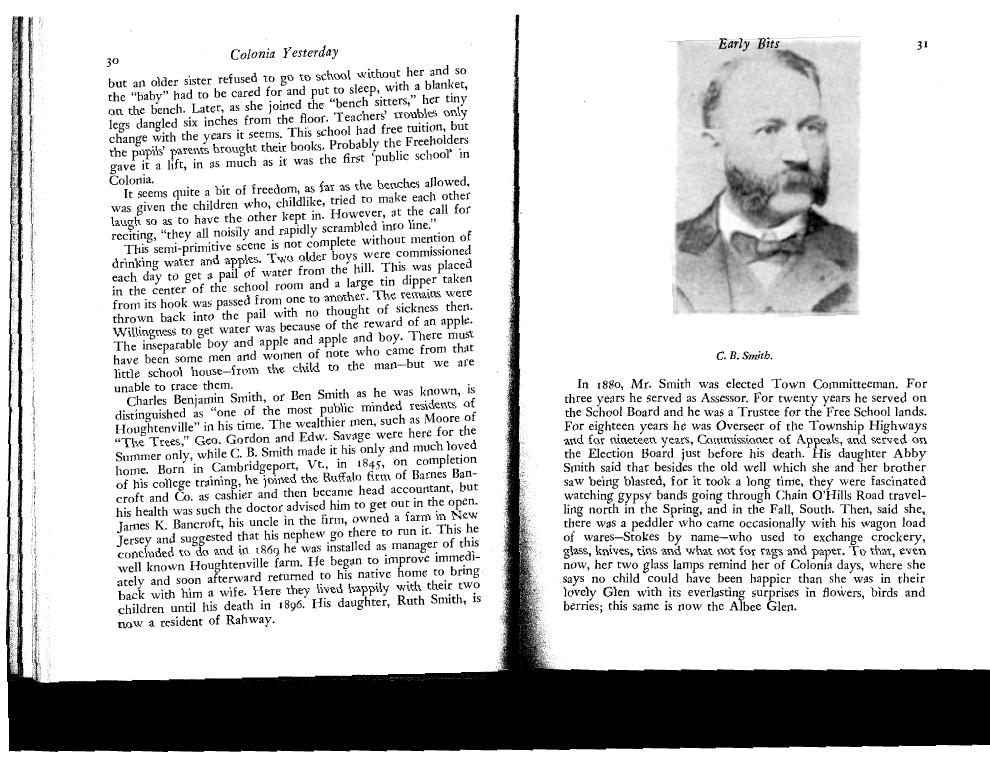
In 1870 and until 1887 the Pinkham house was owned by a family of actors, Sam’l W. MacDonald, whose two sons fought in the Civil War under General Grant, and whose grandson therefore was named U. S. Grant MacDonald. The rooms at that time were open beam walls. Imagine Mr. Pinkham’s surprise, when, years later he had reason to remove the surface wall that someone had added, to find fully equipped costumes of various types hanging quietly but in a very life like way, in between the beams. Evidently the workmen thought it less trouble to cover than to dispose of them. Too bad they were not kept for our someday museum.:
The story of our New Dover earliest little school is still alive and fresh for reciting. It seems a pupil, then at the age of three, and now nearing ninety, Miss Susie Wood, was engaged to teach its two dozen pupils in 1879. If she was nineteen then, and it was an old building, as she said, when she was there as a pupil, it dates back in reason to about 1799. This tallies with Mrs. Scudder’s records, our oldest living resident, who (at the age of nine) was a pupil of Miss Wood for whom she has always had a great love and respect. It seems the original building was put up by the farmers and while it was stoicly built in foundation, it developed so many upper surface leaks for cold air that in winter it just couldn’t be heated. Hence, their summer vacation was in winter. This proved so confusing, that it was decided in the early seven- | ties to tear the old building down and build a modern school with seats and desks and not just rough benches. The teacher, Susie Wood, had been a scholar under Miss Gussie Acken, daughter of the Sheriff by that name, and the earliest teachers she can remember were Miss Mary Robinson and Miss Carrie Toms. Gussie Wood began her schooling much too young it seems,
“Giqsum.o [, uUbiLAwY MOU—VIUOJOD U1 younqa Kjuo pup 4S41y but an older sister refused to go to school without her and so the “baby” had to be cared for and put to sleep, with a blanket, on the bench. Later, as she joined the “bench sitters,” her tiny legs dangled six inches from the floor. Teachers’ troubles only change with the years it seems. This school had free tuition, but the pupils’ parents brought their books. Probably the Freeholders gave it a lift, in as much as it was the first ‘public school’ in Colonia.
It seems quite a bit of freedom, as far as the benches allowed, was given the children who, childlike, tried to make each other laugh so as to have the other kept in. However, at the call for reciting, “they all noisily and rapidly scrambled into line.”
This semi-primitive scene is not complete without mention of drinking water and apples. Two older boys were commissioned each day to get a pail of water from the hill. This was placed in the center of the school room and a large tin dipper taken from its hook was passed from one to another. The remains were thrown back into the pail with no thought of sickness then. Willingness to get water was because of the reward of an apple. The inseparable boy and apple and apple and boy. There must have been some men and women of note who came from that little school house—from the child to the man—but we are unable to trace them.
Charles Benjamin Smith, or Ben Smith as he was known, is distinguished as “one of the most public minded residents of Houghtenville” in his time. The wealthier men, such as Moore of “The Trees,” Geo. Gordon and Edw. Savage were here for the Summer only, while C. B. Smith made it his only and much loved home. Born in Cambridgeport, Vt., in 1845, on completion of his college training, he joined the Buffalo firm of Barnes Bancroft and Co. as cashier and then became head accountant, but his health was such the doctor advised him to get out in the open. James K. Bancroft, his uncle in the firm, owned a farm in New Jersey and suggested that his nephew go there to run it. This he concluded to do and in 1869 he was installed as manager of this well known Houghtenville farm. He began to improve immediately and soon afterward returned to his native home to bring back with him a wife. Here they lived happily with their two children until his death in 1896. His daughter, Ruth Smith, is now a resident of Rahway.
C. B. Smith.
In 1880, Mr. Smith was elected Town Committeeman. For three years he served as Assessor. For twenty years he served on the School Board and he was a Trustee for the Free School lands. For eighteen years he was Overseer of the Township Highways and for nineteen years, Commissioner of Appeals, and served on the Election Board just before his death. His daughter Abby Smith said that besides the old well which she and her brother saw being blasted, for it took a long time, they were fascinated watching gypsy bands going through Chain O’Hills Road travelling north in the Spring, and in the Fall, South. Then, said she, there was a peddler who came occasionally with his wagon load of wares—Stokes by name—who used to exchange crockery, glass, knives, tins and what not for rags and paper. To that, even now, her two glass lamps remind her of Colonia days, where she says no child could have been happier than she was in their lovely Glen with its everlasting surprises in flowers, birds and berries; this same is now the Albee Glen.
Chapter 6 THE MAIL COMES IN
Marcu 13, 1894—“Great excitement among the farmers!” Practically all the residents were farmers of one kind or another, with from one, to one-hundred, or more acres each. On this date, the first U. S. mail bag came in! It arrived at a station named Colonia, and was passed out by the then Station Master, Frank Donahue, through the ticket office window. Of course, all of the boys and girls were there to see the event. Even father Cone with his daughter, Grace, who received the first letter, gazed with interest at the distribution and wondered who was to take what to whom. In fact, it was known in the family that he had written a letter to himself. It had been a long effort on his part, and on the part of others who cared, not only to have the name of the settlement changed from one of little note to one with charm and purpose, but, after that, to convince the proper authorities that Colonia should have mail dropped at its own “front door,” that little used dark grey station. This was the first public achievement of the Cone family on record and of Colonia—as Colonia. Like all things in the program of living here, the whole family was concerned as a unit,—each in his and her way, thinking to be the main actor of the moment.
Since that time, we have had ten Post Masters, including Donahue who served until January 15, 1908. Then came Alfred P. Cranston, owner of the present Pinkham home and the ancient millstone. He served until March 8, 1915, at which time Agnes Allen, no taller than a mail bag, but the proud possessor of ten children, moved in with all of them and their luggage. Ten babies and an always broad and pleasant smile, were her rare assets. Agnes stayed with us until May 2, 1917. Robert A. May was her successor. Tall, slight, fairly contented looking married man, who helped to keep Colonia one, and who gave us the best he could under primitive conditions. He was a part of our public body until August 8, 1925, when John P. Smith of Menlo Park took over, and he, with his wife, served until July 20, 1928. Then our young, pretty and always accommodating Phyliss Montgomery, in her early twenties, was made Post Mistress, while her father ran the Station. She was succeeded by Henry C. Mades, of Enfield Road, Colonia, who gave us the first improvements since 1894. He obtained permission from the Pennsylvania Railroad, to whom an annual rental is still paid of $12 a year, to have the P.O. on its own and by itself taking space from the waiting room for a separate compartment. Here he compactly arranged all the essential equipment behind a well set up front of sixtyfour lock boxes. He was succeeded by Eva B. Patterson, a careful, accurate, sensitive woman, who, like Mr. Mades, put much in but found little could be gotten out. ““The people just didn’t support my efforts,” said he. “I thought they would, but so many go right past to Rahway, leaving me without cancellations.” Arnold Christopherson, then took over, the youngest man we ever had and the most affable. He helped everybody, and always added with a sense of leisure, a kindly smile to his many friendly acts. Incidentally, the Post Office is a constant and continuous information bureau. Up to the present, few streets are known by name and fewer have any kind of marking. One has no way of even knowing when you enter Colonia—by car—with no name plates. It used to be a habit of Arnold’s, when a bewildered enquirer, looking helpless, with no luck at locating his objective or himself in the woods, to pin a sign on the window “Back in 5 minutes,” hop in his car and carry the stranger to his or her destination for but a thank you, if that. Carrying express and parcel post to your car was his constant practice. A slight deficiency in the functioning of one eye made him feel he couldn’t serve his country but he was finally put to service and Gertrude O’Keese Hynes, the mother of four well grown children succeeded him, serving under the title of Presidency. She it is who will hand you your mail tomorrow, if tomorrow, like our yesterday, is not too far away.
We have given a chapter to the local mail, not so much for its historical importance as the important place it holds in our daily lives. One of the first shines we want to know and arrange when we go places, is the question “How about the mail?” “When does it come?” “When does it go?” “Is it in?” “How many letters?” “What time does it close?” “Oh! please get this in, it must go.” Or, the constant question in every home with any third or fourth class post office—“Has the mail come?” “Who is going for the mail?” “Why doesn’t the mail come?” “I must get my letters finished in time to send.” There are a hundred such, every three hundred and sixty five days of the year, making a kind of food for our feelings associated with the “mail bag” without which, we cannot conceive the complete day. The better part of us goes into our letters. We become affectionate and careful. We enjoy each other’s humor and adventures. We hesitate in writing to send our hates and petty grievances. It does us good to think before we write, and it keeps us alive to have the outside world coming in. Truly the mail, with its transient home the Post Office, is a center of vital interest in the heart of every community. And these guardians of the bag to whom we have looked and do still look for our latest and best messages of the day, are mediums of great importance to all of us. Some of us can live happily without some mail ’tis true when its delivery becomes our dilemma— but that’s not too often. You may think, weary Postman, your task a dull one, but know this, none of us can truly live without you.
Chapter 7 A COMMUNITY IS FORMED
THERE Is no word of common usage in the English language that is more significant, inclusive and beautiful than the word Community. It suggests a human nearness, a relative understanding, and a point from which to start, that includes the whole. For just as three people can form a corporation, so from three, to a world-full, may complete a community—a body of people or a part of the great whole, identical in kind. To commune or converse together is the beginning of human relationship. To communicate is to get in touch with one another, and to take communion is to reach toward the living spirit of Christ. Even communism is defined by Mr. Webster merely as “having property in common’’—which is the heart of the economics of Henry George—the father of political peace. What a friendly thing that seems to be and a communist as “one who believes in this’—how harmless. Yet man has reversed the gears of our understanding, and given to it a barbaric significance of plunder, destruction, slavery and slaughter. Fearing for a trusting community, he introduces a synthetic “State” as the chief destroyer. Why so perverse, you dangerous man? If you want “communism” in this sense, go have it. If we like it we can have it. If we do not, we will show you something better and you can have that. Why force Quakerism down a Catholic throat? Or build a gigantic _body called “the State” that has no being, place, life or soul?
__ We only mention such a hideous situation here from the fact that in this meaning it is penetrating and desecrating one of the most intimate and precious words of our language, thereby threatening through misunderstanding to disrupt and destroy | even Colonia’s little community, with black and terrible clouds. It’s not the communists’ fault perhaps. It is not Mr. Webster’s fault, and certainly it is not the fault of the word, but rather _the state of the world that engulfs us, and predisposes our thought and our feeling to doubt rather than devotion. Just as the bad child is not always to blame—for often it is the parents and the surroundings. If we could appreciate and live the best in the word community, no so called “communism” could raise its head to breath a first breath. Not because of elderly women having faith in the past and fear for the future, do we bring home this as a menace, but because having seen the other kind of community seed planted, take root and become a reality, we would guard well that it is not blighted. In 1890 when the Cone family came to “The Trees,” as their home was called, this neighborly community seed was started. Three families, the VanWycks across the way, the Cockrans, next door, where now lives Rosa Swartz, and a little further down, a family by the name of DuBois, back of where now live the Kimballs, completed the neighborhood. Thereafter, instead of living unto themselves, they gradually formed a little colony of interest with these few citizens. And, although roads were bad and communication difficult, they soon began to think in terms of bettering both. This was the beginning of Colonia “Community” effort, it is comparable to what we now have, in greater degree. |
As this community feeling advanced, the colony grew. It was a colony of our first “modern neighborhood,” private as colonies are, to a certain degree, but a very homey one when it came to getting and sharing in common everything we had. The street lights, water, gas, electricity, police, school, fire protection, etc., were the result of uniting; not to mention the mail, the early library and the country club. These were the collective results of community need, and the feeling of these needs in common.
Democracy was born of the human instinct for individual freedom and cooperation, in the process of living. To be sure we may cooperate for evil as well as good, that is our choice, but we reap what we sow and hence learn in due time. The point is that voluntary cooperation is the highest form of human society, that we know, just as imposition and subjected serfdom is the lowest. The “community” is the starting point of growth and development, democratically or—fascistically. They each and both begin in the family and, like a match in the forest near the tiny dry leaf, the first little contact in due time sets the whole aflame. CooperaA Community is Formed 37 tive democracy, if lived in the home and practiced in public, cannot fail to lead to that peace which is the heart’s first desire. While coercive autocracy, even in the market place,—perhaps its worst hotbed,—leads but to war and death. Community feeling feeds the flame in either case. The seed is planted in youth and matures after its kind. It should therefore be carefully watched. We all unconsciously add to, or should, know enough to prevent this social destroyer before it develops.
Colonia is not isolated. “It could happen here” if, as little children, “we don’t watch out,” and take care of our every step. Politically, intellectually, socially, aesthetically, and religiously we have a “community danger,” in our midst. Hence the far greater way to enjoy life is to develop, thru love, these pentagon relations. To act like the fingers in scientific relation to the hand, as their economic base. For economics is the handle to the communistic danger.
We have said the history of Colonia has few feuds or fierce disagreements recorded. There is, however, an exception told of two near neighbors on Chain O’Hills Road, who could not stand it to see into each other’s home life. So the most annoyed took off a wing of his house, moved it and planted it on the extreme edge of his property, thus obscuring the windows of the other’s home.
A stranger moved into this wing and made peace with the two cocky neighbors. Almost as small an event in its beginnings, as the misuse of the word “commune.” Yet, where would the feud have ended, if no wing and no stranger had come?
With every word and every act, we build the history of tomorrow from yesterday and affect the history of today.
Chapter 8 THE CONES LEAD THE WAY
From a New York City “brownstone front,” the Cone family came to live in Houghtenville (as Colonia was then called). The year was 1890, The motive—“the enjoyment of life on a farm” near enough to New York to make it easy of access and far enough away to be helpful to an invalid mother and a father who, weary of business, retired for the fun of growing things. Altogether a happy motive brought them to our midst, contagious in kind, and ultimately to have a great and beneficial influence in the life and future of the whole community.
The Cones loved it here. Six in number and each distinct. A delicate, lovely mother, was the central concern of the effort of the others. A tall, handsome, genial father, the recognized head of the place, who ’ere long was called Father Cone by the whole community, that was always trying to “catch up” with his many and continuous contributions from his first and most successful adventure in gardening. A daughter Kate, who like her father was the essence of hospitality, and who relieved her mother of much care in this and the home generally, assuming her place, at the end of the table after she was gone, which was in 1894. Next came Elizabeth, a conspicuously beautiful woman, large and imposing with wonderful coloring and a joyousness in life that was unbounded. People were her delight and ‘going’ her constant habit, always a step ahead, to higher possibilities, which gave an impression of looking down her well formed nose, but this was contradicted with a mouth that was forever radiant with smiles and humor. Grace, the youngest, was the father’s favorite helper; in fact, everybody’s helper. She it was who knew and cared for all the poor and the sick in the whole country side— the elderly neighbors, the old white horse, the sick kitten and the injured bird. Always on the lookout for a charitable and useful bit of work,—even to shelling the peas for the cook, or if "S681 sauuins ‘spvoy viuojo) puw 1saa0q fo sauso9 aq1 Ip the horse needed shoeing, she would walk for the mail to save his discomfort. Edward, the last member to mention, brought the life of New York and the outside world to the evening hearth or library, so there was always a discussion in progress, not too deep for each to take part; but, all are now gone. The daughters, without children. In fact, only one, Elizabeth, ever married.
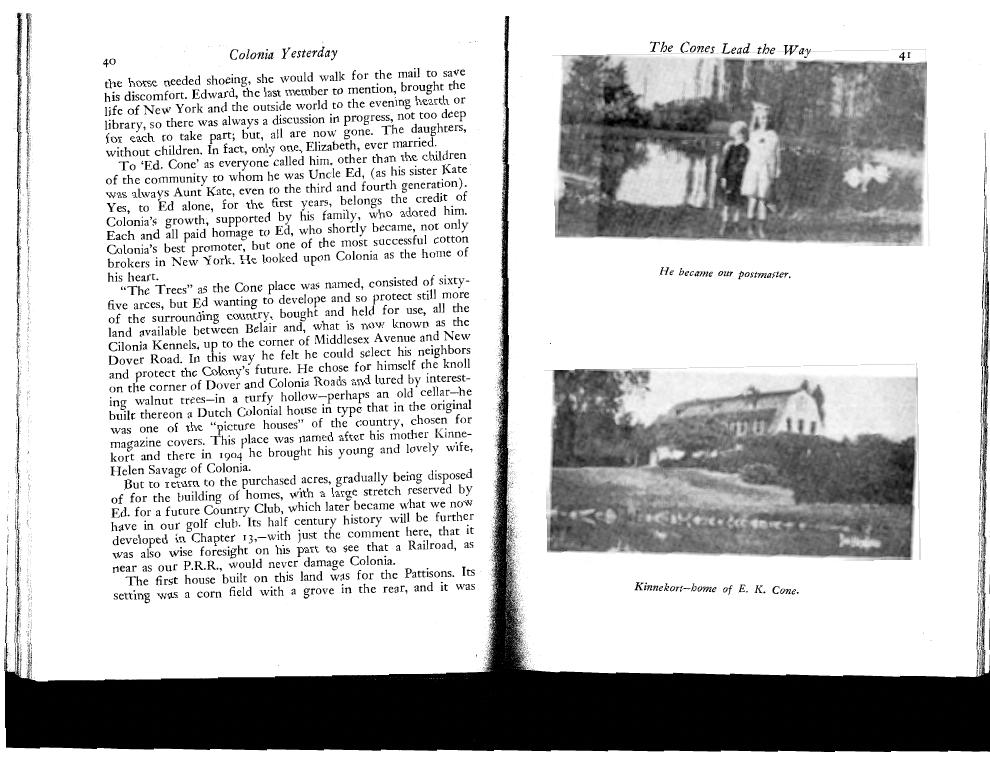
To ‘Ed. Cone’ as everyone called him, other than the children of the community to whom he was Uncle Ed, (as his sister Kate was always Aunt Kate, even to the third and fourth generation). Yes, to Ed alone, for the first years, belongs the credit of Colonia’s growth, supported by his family, who adored him. Each and all paid homage to Ed, who shortly became, not only Colonia’s best promoter, but one of the most successful cotton brokers in New York. He looked upon Colonia as the home of his heart.
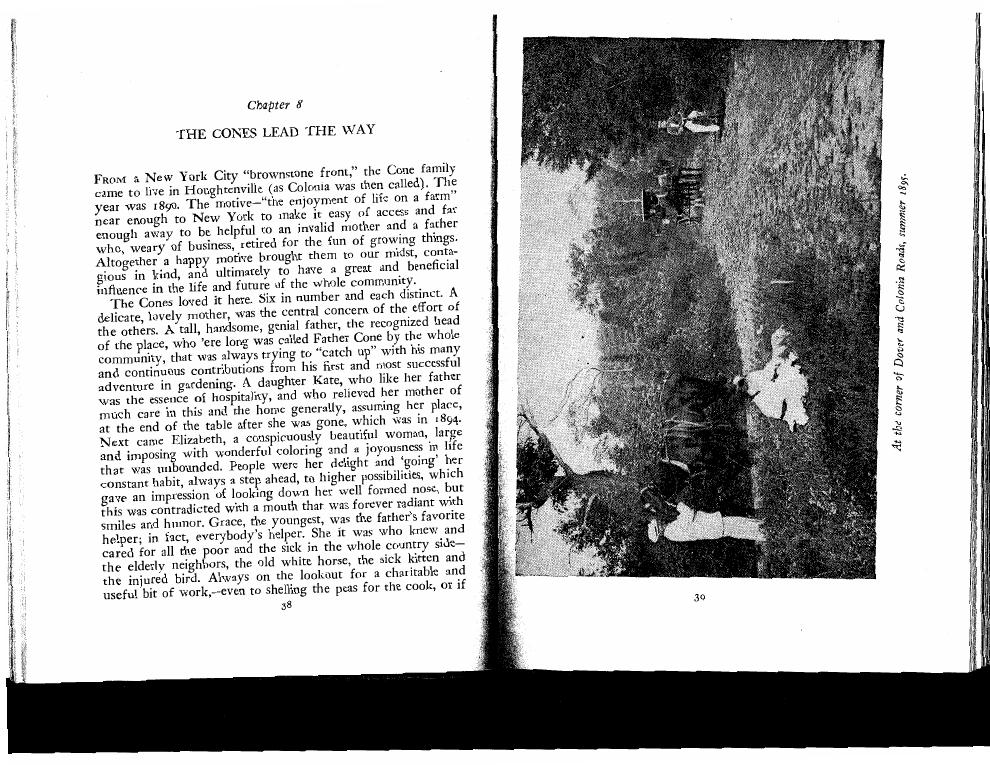
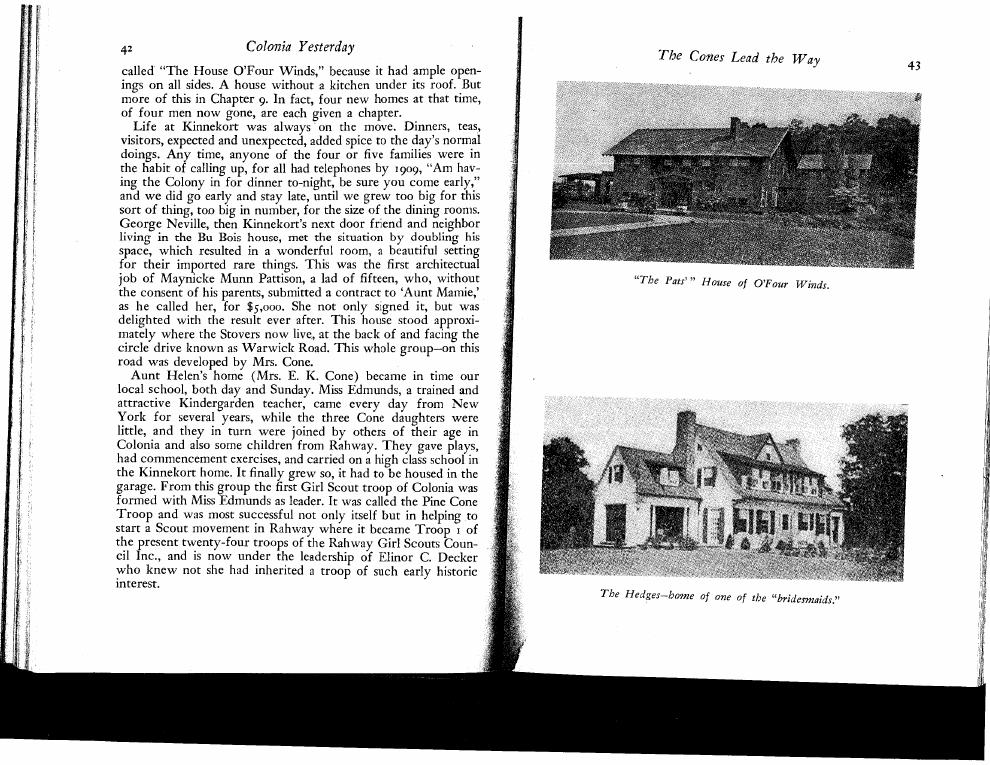
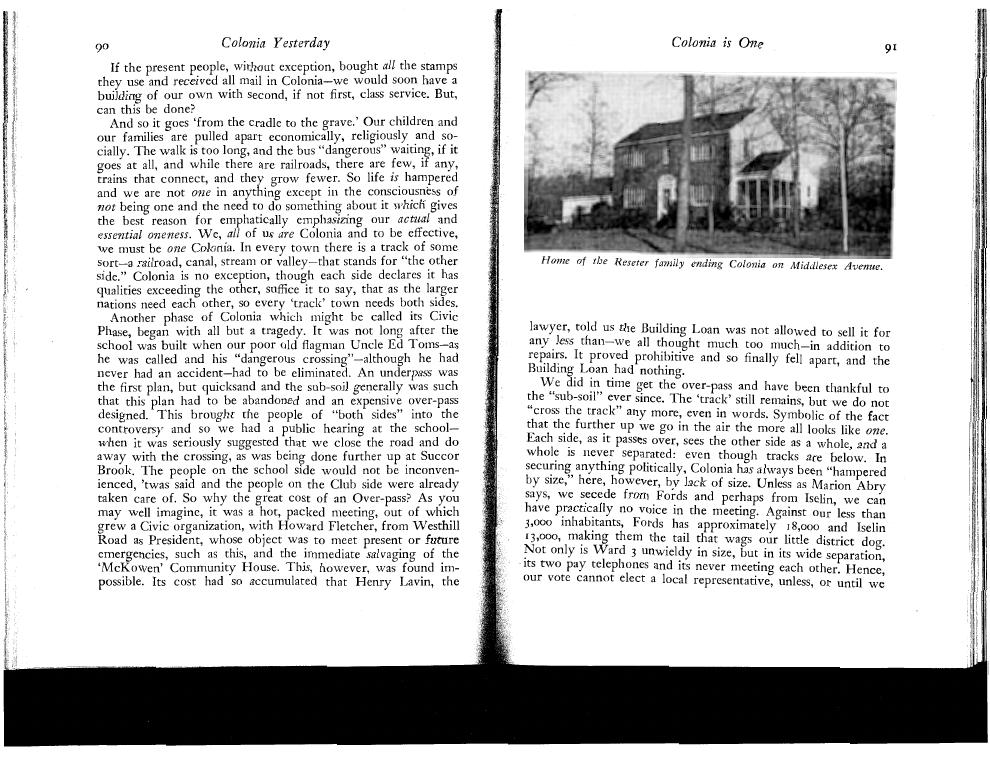
“The Trees” as the Cone place was named, consisted of sixtyfive arces, but Ed wanting to develope and so protect still more of the surrounding country, bought and held for use, all the land available between Belair and, what is now known as the Cilonia Kennels, up to the corner of Middlesex Avenue and New Dover Road. In this way he felt he could select his neighbors and protect the Colony’s future. He chose for himself the knoll on the corner of Dover and Colonia Roads and lured by interesting walnut trees—in a turfy hollow—perhaps an old cellar—he. built thereon a Dutch Colonial house in type that in the original was one of the “picture houses” of the country, chosen for magazine covers. This place was named after his mother Kinnekort and there in 1904 he brought his young and lovely wife, Helen Savage of Colonia.
But to return to the purchased acres, gradually being disposed of for the building of homes, with a large stretch reserved by Ed. for a future Country Club, which later became what we now have in our golf club. Its half century history will be further developed in Chapter 13,—with just the comment here, that it was also wise foresight on his part to see that a Railroad, as near as our P.R.R., would never damage Colonia.
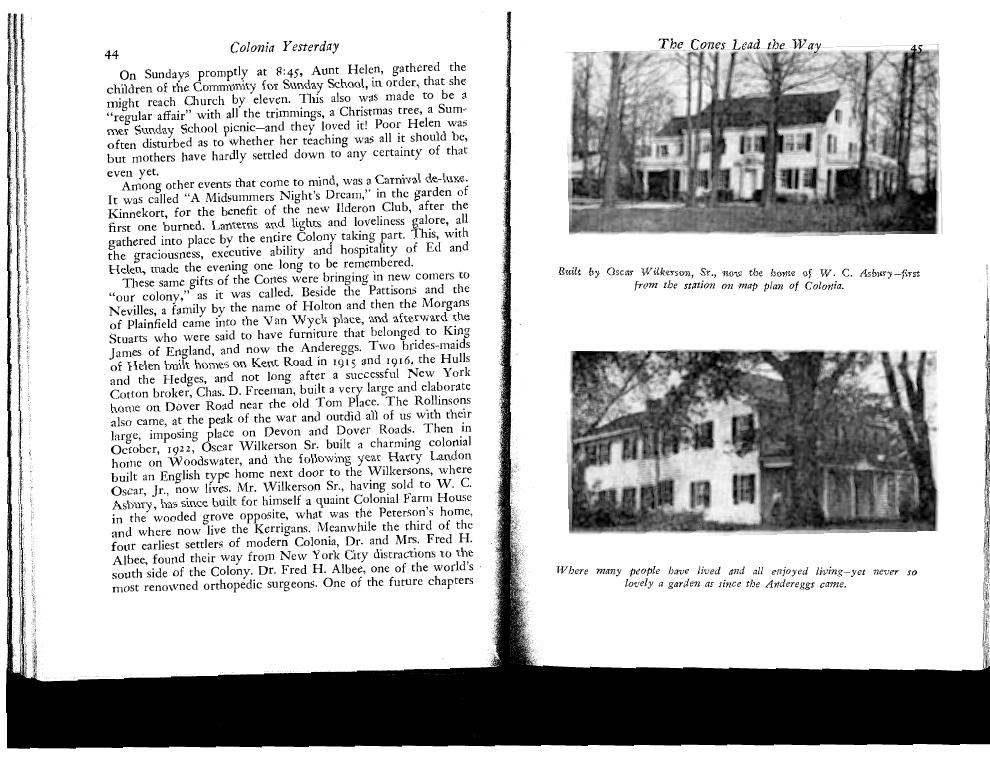
The first house built on this land was for the Pattisons. Its setting was a corn field with a grove in the rear, and it was
He became our postmaster.
Kinnekort—home of E. K. Cone.
called “The House O’Four Winds,” because it had ample openings on all sides. A house without a kitchen under its roof. But more of this in Chapter 9. In fact, four new homes at that time, of four men now gone, are each given a chapter.
Life at Kinnekort was always on the move. Dinners, teas, visitors, expected and unexpected, added spice to the day’s normal doings. Any time, anyone of the four or five families were in the habit of calling up, for all had telephones by 1909, “Am having the Colony in for dinner to-night, be sure you come early,” and we did go early and stay late, until we grew too big for this sort of thing, too big in number, for the size of the dining rooms. George Neville, then Kinnekort’s next door friend and neighbor living in the Bu Bois house, met the situation by doubling his space, which resulted in a wonderful room, a beautiful setting for their imported rare things. This was the first architectual job of Maynicke Munn Pattison, a lad of fifteen, who, without the consent of his parents, submitted a contract to ‘Aunt Mamie,’ as he called her, for $5,000. She not only signed it, but was delighted with the result ever after. This house stood approximately where the Stovers now live, at the back of and facing the circle drive known as Warwick Road. This whole group—on this road was developed by Mrs. Cone.
Aunt Helen’s home (Mrs. E. K. Cone) became in time our local school, both day and Sunday. Miss Edmunds, a trained and attractive Kindergarden teacher, came every day from New York for several years, while the three Cone daughters were little, and they in turn were joined by others of their age in Colonia and also some children from Rahway. They gave plays, had commencement exercises, and carried on a high class school in the Kinnekort home. It finally grew so, it had to be housed in the garage. From this group the first Girl Scout troop of Colonia was formed with Miss Edmunds as leader. It was called the Pine Cone Troop and was most successful not only itself but in helping to start a Scout movement in Rahway where it became Troop 1 of the present twenty-four troops of the Rahway Girl Scouts Council Inc., and is now under the leadership of Elinor C. Decker who knew not she had inherited a troop of such early historic interest.
“The Pats’” House of O’Four Winds.
The Hedges—home of one of the “bridesmaids.”
On Sundays. promptly at 8:45, Aunt Helen, gathered the children of the Community for Sunday School, in order, that she might reach Church by eleven. This also was made to be a “regular affair’ with all the trimmings, a Christmas tree, a Summer Sunday School picnic—and they loved it! Poor Helen was often disturbed as to whether her teaching was all it should be, but mothers have hardly settled down to any certainty of that even yet. |
Among other events that come to mind, was a Carnival de-luxe. It was called “A Midsummers Night’s Dream,” in-the garden of Kinnekort, for the benefit of the new. Ilderon Club, after the first one burned. Lanterns and lights and loveliness galore, all gathered into place by the entire Colony taking part. This, with the graciousness, executive ability and hospitality of Ed and Helen, made the evening one long to be remembered.
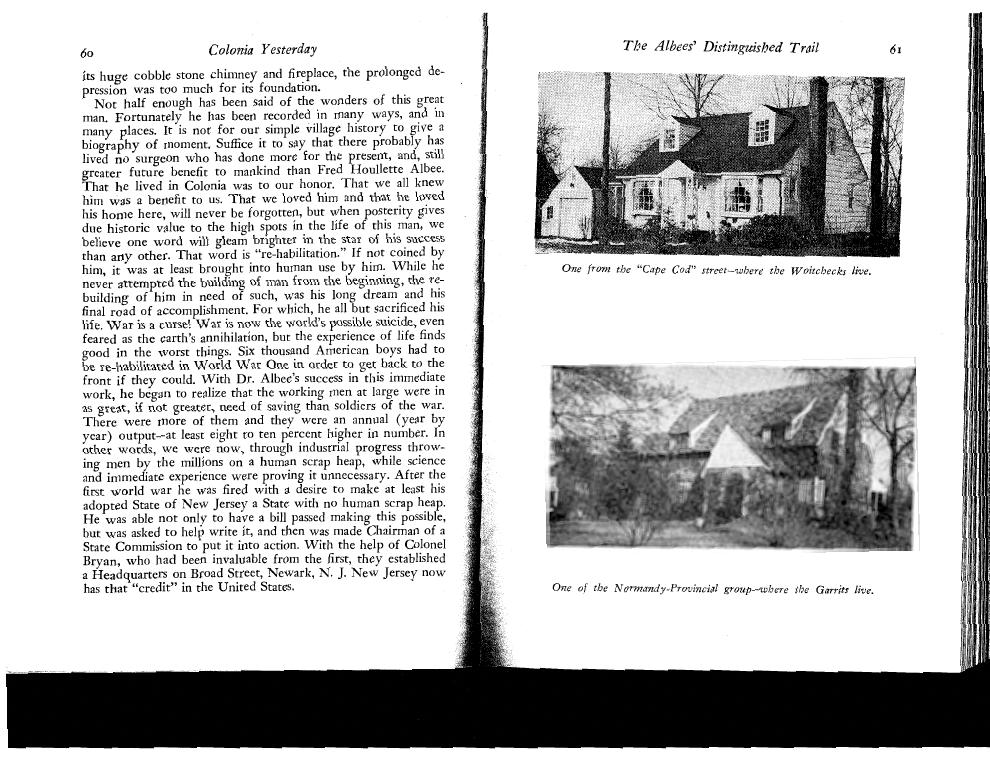
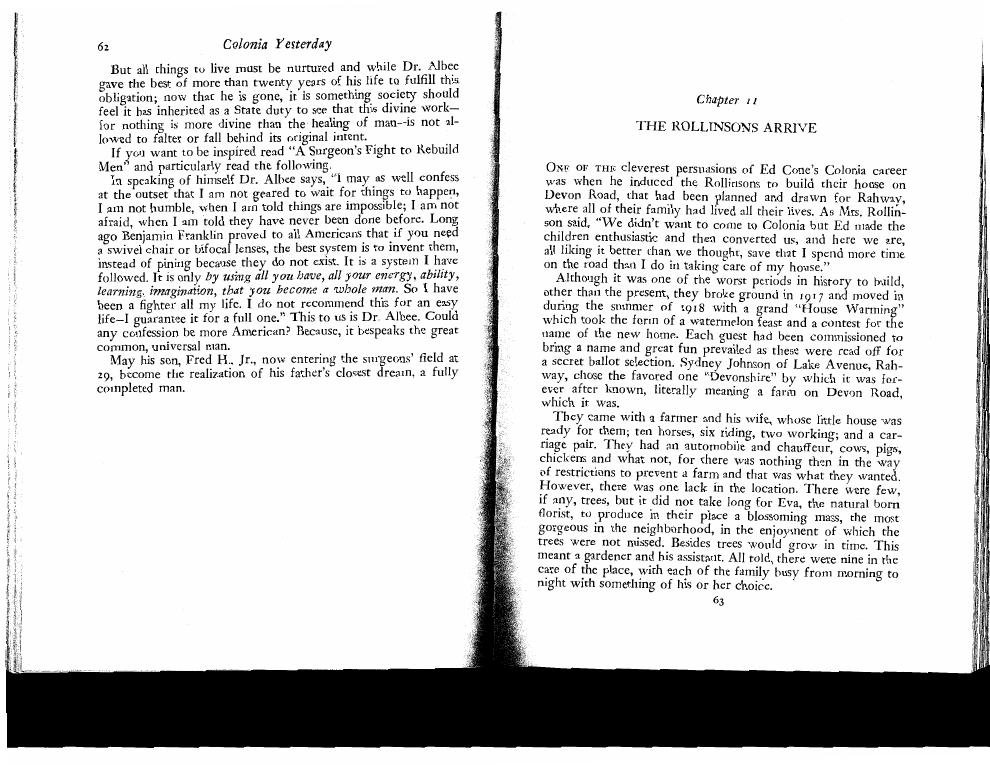
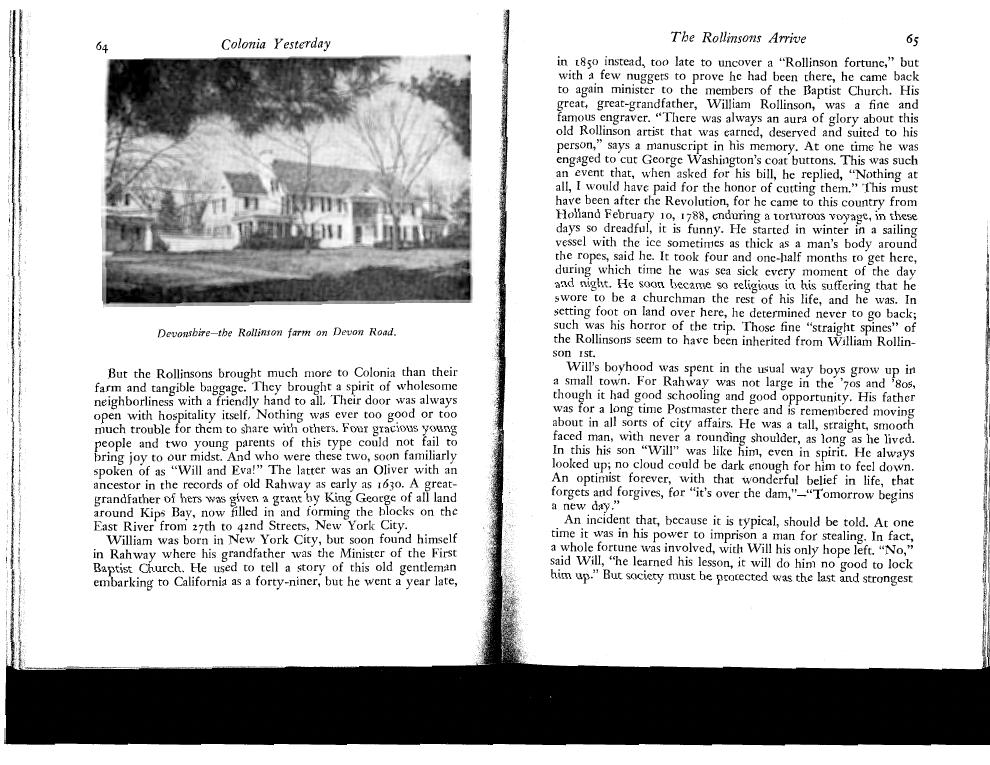
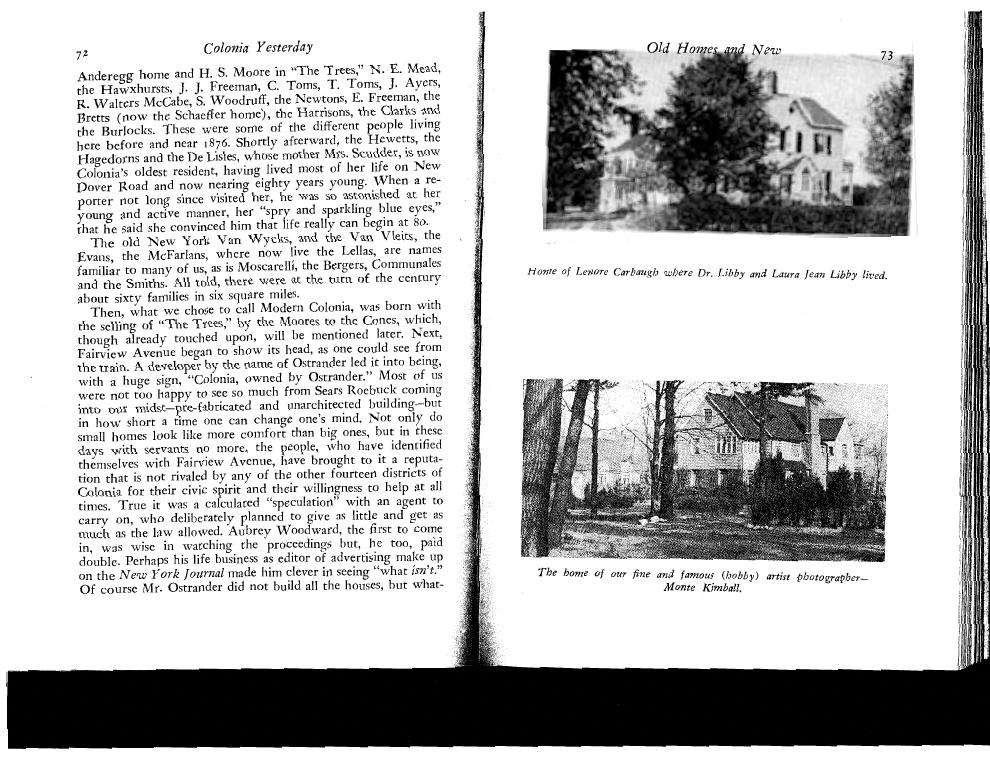
These same gifts of the Cones were bringing in new comers to “our colony,” as it was called. Beside the Pattisons and the Nevilles, a family by the name of Holton and then the Morgans of Plainfield came into the Van Wyck place, and afterward the Stuarts who were said to have furniture that belonged to King James of England, and now the Andereggs. Two brides-maids of Helen built homes on Kent Road in 1915 and 1916, the Hulls and the Hedges, and not long after a successful New York Cotton broker, Chas. D. Freeman, built a very large and elaborate home on Dover Road near the old Tom Place. The Rollinsons also came, at the peak of the war and outdid all of us with their large, imposing place on Devon and Dover Roads. Then in October, 1922, Oscar Wilkerson Sr. built a charming colonial home on Woodswater, and the following year Harry Landon built an English type home next door to the Wilkersons, where Oscar, Jr., now lives. Mr. Wilkerson Sr., having sold to W. C. Asbury, has since built for himself a quaint Colonial Farm House in the wooded grove opposite, what was the Peterson’s home, and where now live the Kerrigans. Meanwhile the third of the four earliest settlers of modern Colonia, Dr. and Mrs. Fred H. Albee, found their way from New York City distractions to the south side of the Colony. Dr. Fred H. Albee, one of the world’s most renowned orthopedic surgeons. One of the future chapters
Built by Oscar Wilkerson, Sr. now the home of W. C. Asbury—first from the station on map plan of Colonia.
Where many people have lived and all enjoyed living—yet never so lovely a garden as since the Andereggs came.
will be devoted to them. As time moved on Ed Cone was making his way upward as one of New York’s successful financiers. He was president of the Cotton Exchange and a member of the financial firm of E. A. Pierce & Co. He was a modest and retiring type. Little show or pretense was ever the character of Kinnekort, always a kindly and charitable intent, a gracious neighborliness and a_ parental guardianship of the whole community. When it needed anything, lights, gas, a fire company, Zoning, Ed it was who took the lead and the responsibility. Our first fire engine was purchased by him and housed in his garage, with Charles Ayers, or Charlie, as everyone called him, the first Fire Chief. By the way, Charlie is a member of one of the oldest families in Colonia, living as he did in the Hagadorn house, New Dover section.
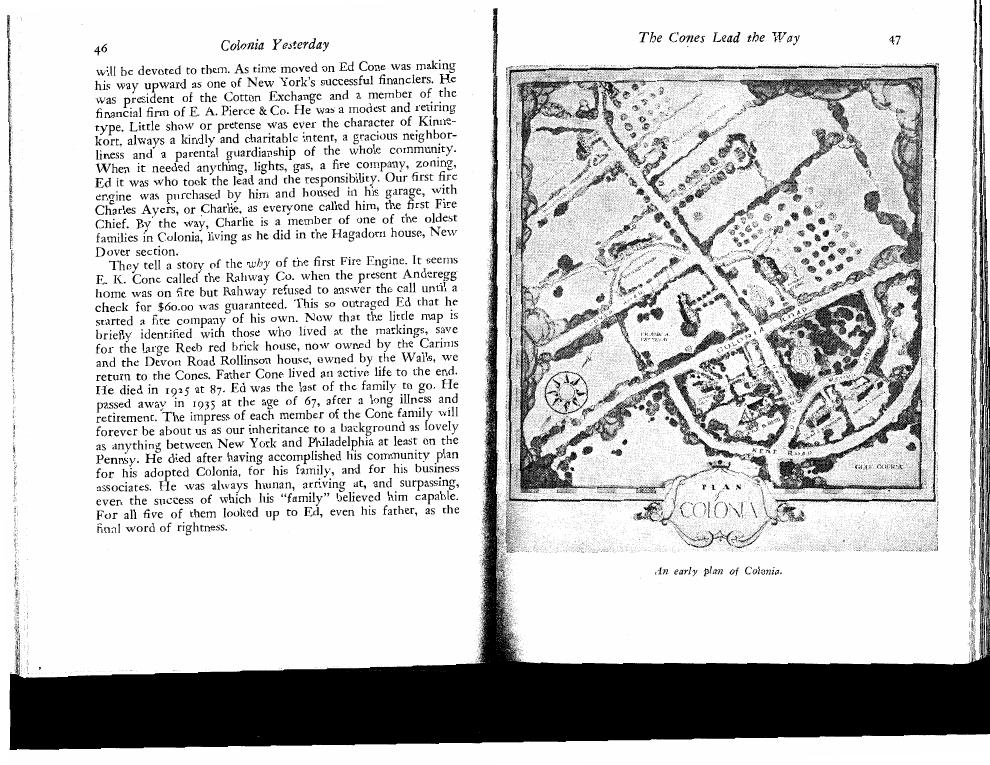
They tell a story of the why of the first Fire Engine. It seems FE. K. Cone called the Rahway Co. when the present Anderegg home was on fire but Rahway refused to answer the call until a check for $60.00 was guaranteed. This so outraged Ed that he started a fire company of his own. Now that the little map is briefly identified with those who lived at the markings, save for the large Reeb red brick house, now owned by the Carims and the Devon Road Rollinson house, owned by the Walls, we return to the Cones. Father Cone lived an active life to the end. He died in 1925 at 87, Ed was the last of the family to go. He passed away in 1935 at the age of 67, after a long illness and retirement. The impress of each member of the Cone family will forever be about us as our inheritance to a background as lovely as anything between New York and Philadelphia at least on the Pennsy. He died after having accomplished his community plan for his adopted Colonia, for his family, and for his business associates. He was always human, arriving at, and surpassing, even the success of which his “family” believed him capable. For all five of them looked up to Ed, even his father, as the final word of rightness.
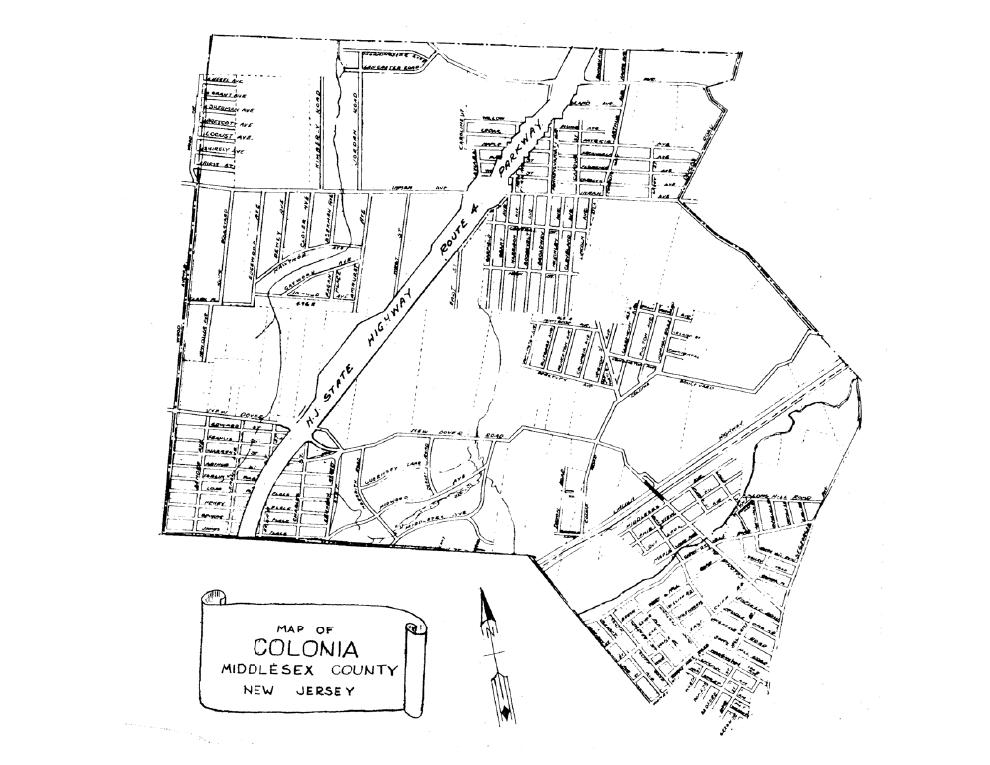
An early plan of Colonia.
Chapter 9 THE PATTISONS FIND A PATH
Tuat ERA called the “bicycle Age” in the middle of the ’9o0’s was when the Pattisons first found the path to Colonia. They had known of Houghtenville while passing by on the train from Metuchen, where they both lived as children and where they began their early very early courtship, he from the Pattison homestead that still stands on the top of Rose Hill. She from where now is housed the Metuchen Inn. While Colonia has always been here as far as land and location can testify, no sign of life at that time was evident from train or highway to attract one to turn or stop. It took a trip on wheels, in 1895, to Plainfield, N. J., where, as was their habit, they were cycling for a simple drink of soda. Imagine fifteen miles on wheels for a glass of soda water! This happened to be a fairly hot Saturday afternoon, the roads none too full, as usual, save with crowds of cyclists like themselves, when suddenly the high step of horses was heard round the bend. The bicycles made way on the road as a fine team with a high cart of considerable style caught up to them. One look, and Ed Cone descended from the driver’s seat to greet his Seventh Regiment friend, Frank Pattison; Each asking the other, “Where did you come from?” Meanwhile, the three sisters, in gay attire, were introduced. So after a little roadside visit, and the amazing discovery that these men lived but three miles apart, a promise was given to come to tea at the Pattisons, the following afternoon—Sunday,—to continue the pleasant meeting.
From that day, the Pattisons and the Cones dined with each other at least once a week through the rest of the Summer. The Pattisons learned to see, know and love Colonia as well as this friendly family of six Cones. By the following Summer they really became intimate, which intimacy continued the rest of their lives. While Ed was unfolding the future of this community, Frank was keeping close to his newly established New York firm of Pattison Bros., which became outstanding in its achievements, and also to his newly acquired family. But from the day on the Plainfield Road, ’tis said, neither of these men did anything of moment, at least as far as Colonia was concerned, that each did not consult or “talk it over” with the other.
Then about 1906, Ed began to talk of the wisdom of the Pattisons moving here. In fact, the whole Cone family picked up the idea, though it seemed to the Pattisons an impossible proposition, with a house and a mother attached to Metuchen, where they all expected to spend their lives, although Molly confessed it was not her 100% choice. It took two years of planting the seed before fulfillment, when, after building a house of unusual character, the Pattisons moved in, with Governor Silzer to be—and his wife, helping to cart their belongings. The choice French clock, that Molly bought when she was supposed to buy an icebox, and a few other such bits she felt needed special care. She had never liked Metuchen’s careless and unbeautiful ways. So, when fate seemed to decree that she live there permanently, her best bet, she thought, was to try to make it more to her liking—knowing others could not fail to enjoy it too—even if it did disturb them in the process. For example, Metuchen had a bad public habit of throwing anything and everything in hand, not wanted, into the street, so that waste paper, fruit skins and lunch boxes were an accompaniment, as one moved from side walk to side walk, particularly around, and in front of the school, Post Office and Station. So she organized a tiny group of three young brides, and unbeknown to all others, save the printer, stuck up, after dark one night, quantities of 12 x 20 card board signs, reading in large letters—“WHO WILL PICK IT UP?”
The sudden impression the next morning on the storekeepers, the commuters and the scholars, in seeing what looked like a town shower of great mushrooms, was the beginning of street cans and an improvement association, leading ultimately to the Borough Improvement League. Then, a new high school, voted down five times by the so called “tight-wads,” led by a wealthy resident, but each time rescinded by what the Press called “the Pattison Pipe Dreamers,” until the school, now standing on Middlesex
Avenue was achieved. A tiny but lovely library was all but her sole effort, perhaps for this no one cared enough, to get up a “fight,” which to a degree was the case with the abandoned school now the League House, tho not altogether. After Horace Greely appeared in this old hand-built school, on until 1906 they had in Metuchen a place of filth and fear to the passer by. That, Molly wanted to get rid of, to “marry” this menace for that purpose, was a shock to the public ear. “A lighted match is its only remedy.” “Why it will be lovely to have that old place remodeled!” But, “marry it to get rid of it” they did—and there now stands in the B. I. L. home on Middlesex Avenue the first separate Woman’s Club House in New Jersey.
In going to Colonia all this would be left, and although it was finished and furnished, who would carry on? This was a serious condition from the fact that it was involving an ethical question. What right, thought she, has anyone to voluntarily forsake a thing of their creation and saddle it upon others? To continue from Colonia was her private solution, but a meeting and a day had another answer. The day was June 14, “B. I. L.’s annual,” the meeting, an extraordinary happenstance between Professor Hunt, the English professor of Princeton, and Mrs. Dawson, the beautifully gowned outgoing president of the New Jersey Federation who were the two chief guests. The professor publicly complimented the B. I. L.’s president, Mrs. Pattison, on her excellently worded speech, embarrassing Molly to the extreme, particularly when he turned and told the audience that he knew whereof he spoke, because he had just completed the criticism of over a thousand English essays at Princeton and in his opinion there was not one comparable to your president’s address. (He, a short time afterward, gave the League $5,000.) Meanwhile Mrs. Dawson, the State President, was “saying to herself”: ‘Here could be our next State President, a woman who not only dresses well, appears well, but can speak well, as Professor Hunt testifies.” This was known to Molly long after she became president of the New Jersey State Federation of Women’s Clubs, where she won the election at Atlantic City in 1909, though she always said she won by Elizabeth Cone’s personal campaigning, and the fact that she was the “dark horse.” No one knew either of these women, but took them on face value as “Iwo beautiful women from Colonia,” as they were later called at the General Federation Convention in Cincinnati. As president of the Federation, it was none too easy to travel all over the State and back to Colonia on time. Every day was a new uncertainty. Their Oldsmobile, one of that Company’s first models, which they said could make eighteen miles an hour on the level, was a help for the places that were near, but although she was the first woman to drive a gasoline car in New Jersey (with eleven things to do in its starting) she never felt as safe and sure in it as on the train.
The days in Colonia soon proved to be as full as those in Metuchen. A house of twenty-two rooms and frequent guests, gave plenty to think about, particularly as the French couple, for whom they had built a separate service home called “The Maisonette,” were cabled to return to France. Whether to try to get someone else or to face it out alone was the question.
This was a challenge to Molly and she soon knew it was intended to be. Could any woman do both? If not, then what? So she made up her mind to quietly try it. From that day in 1909 to this, they have never had a servant, or even one in by the day or hour. This accomplishment became of international interest as well as personal satisfaction. (But more of this in Chapter 15.) Frank Pattison had lived in Metuchen all but the first year of his life. He used to say he was born in the middle of Lexington Avenue, New York, which was where the house literally stood, of English, Scotch and Irish descent. One of his ancestors was given a grant of land in 1620, extending from Princeton half down the State of New Jersey, but, he was a Tory, so it was taken away from him and he died without half of New Jersey being his (Quite properly—Mr. Pattison).
A more direct antecedent, however, is recorded in a passport dated July 26, 1774, now hanging on the Pattison wall. His father was a member of the Grain Exchange in New York. His mother was a Hitchcock and the daughter of a minister of the Universalist Church in New York, where years after Molly Pattison was engaged as the leading soprano. His great-grandfather, Abraham Kershaw Pattison had a beautiful farm in Canal Street, New York City. His door plate is still in the possession of the Pattisons. Frank’s education began at the Marshall’s private school and continued there until with a year at ‘Prep’ he entered Rutgers, where he had a brother Charles two years his senior. Frank was graduated from Rutgers in ’87 with high honors and a Phi Beta Kappa key. He was a noted ball player and an excellent amateur actor, coaching many a show. He afterwards was made president of the Alumni of Rutgers, and honored in 1936 with the Hardenberg award for his “vast amount of personal sacrifice and devotion to Rutgers.” On completing his engineering course at the same university, he went into the New York Edison Company and laid the first underground cable. From there to the Boston Edison and shortly after was given charge of the Edison Company in New Orleans and gained a double reputation for his ingenious stage lighting effects in the theaters, and the running of the station without “shut down” during the big New Orleans flood when the water in the street was car seat high. He came back to New York both to induce his brother to start a firm of their own and to get married. On his way up he ran into the Johnstown flood, but came through with nothing more than a terrible fright, a wet train, and no food, save some candy that had been rescued.
He and Molly had a beautiful wedding in St. Ignatius Church, New York City. It was her idea to have all the “thrills” because she would be married only once.
The first years of their married life were spent in New York, summering in Metuchen. From there they moved in 1908 to the House O’the Four Winds, Colonia, and in 1937, to The Little Blue House on Chain O’Hills Road.
Through all these years, the Pattison Bros. had made wonderful strides. They had practically all of the engineering work of New York’s best architects, and those of many other cities. It was said you could step from the Woolworth Building to 42nd Street on their skyscrapers, besides hotels, banks and theaters as side steps, also churches, clubs, the museum of the City of New York, the New York Public Library, Saint John the Divine, the Metropolitan Museum, the Vanderbilt homes, both in New York and Newport, C. P. Huntington, J. Gould and many others.
Frank was the initiative, the ingenious member of the firm;
Charlie, the steady plodder. Frank, it was, who designed and put into operation the first electrically controlled traffic lights in New York, those lovely little towers that first appeared on Fifth Aveune. The revolving up and down stage of the New Theatre was his creation, which he was engaged to duplicate in Paris and San Francisco, but the war broke out and this was cancelled. One would think that this New York firm would have made so much money that both partners would have died rich men, even under the professional fee system. But the war, the great depression and unexpected losses left him penniless. He went, said Molly, leaving nothing but our great love for him which grew deeper and stronger as the years passed by and we saw the courage with which he took his last eight years of paralysis. Money is certainly not everything.
This Colonia resident will be remembered as the life of every party in which he found himself. No group was too inactive for him to pull it together with vivacity and vitality. Even, often depleted himself, he would always rise to any occasion. His ready wit and humor were delightfully refreshing with a kindly manner that included all he met. He and Ed were inseparable in the activities of Colonia. They seemed to work together in all things, with perfect accord.
Here our chapter closes and we have given little or nothing to the lineage of Molly or her contributions to life in Colonia. Some of our future chapters will of necessity include somewhat of the latter. The former can be told in few words. In submitting her lineage for membership to the Colonial Dames years ago, it was found she only required a small percent of the ‘ ‘sce aene™ at her disposal. So instead of going back to Adam, the search was stopped at Charlamaigne. But as Molly says, “What’s in a lineage? A man of fine courage is a gift of God; a lineage but the leavings of men. What we are is our gift to posterity; what we claim to be, but the husks of the self. Molly is a ‘pathfinder’ in the hope of therein finding not only herself, but her God.”
THE ALBEES’ DISTINGUISHED TRAIL
Our First meeting with the Albees was in the late Fall of 1909 when we heard that a brilliant young surgeon and his wife had taken over the Smith Farm on the Hill. He was from Maine, born and bred in the village of Alna, where he had attended the little red schoolhouse—the proverbial great man’s start—and from thence, in due time, he was graduated from Bowdoin College and Harvard Medical School. He took his internship at Massachusetts General Hospital; from there he became associated with the Post Graduate Hospital in New York City, and was a member of its staff until his death. His father, Frelinghauysen Albee—’tis said— was a strong, stoic character, who took his hardships in his stride and expected his family to do likewise. From what we learn of his mother, she must have been the balance wheel in bringing life to a pleasant flow with her laughter, humor and tact.
The Albee family had been identified with Alna since the settling of Maine by the English. Doctors far back grandmother, Margaret Parsons Albee, had part in an early land grant by the King in 1630. Fred married, in 1907, Louella Berry of Williamsport, Pa., where she was born and reared, but, she was the sixth generation of the Berry family of Gardiner, Maine, the same family with whom, in Woodbridge, we associate Cap’t Nathaniel Berry, and the making of brick from Woodbridge’s famous clay. A direct ancestor was a member of Washington’s Life Guard. A man of “vigorous mind and body.” He was a great hunter. For “measured” fact, he could leap ahead seven feet at a clip. Lydia, his wife, was the first white child born in Gardiner, August 22, 1765.
Dr. Albee and Louella Berry were married in Grace Church, New York City, and lived in New York for the first two years, while performing his duties at the Post Graduate Hospital and getting a hold in his profession. He was, however, interested in real estate in general and to the point of wanting a farm of his own, a brave desire after meeting the hardships of Maine—but, perhaps, New Jersey, in contrast, seemed child’s play. After a leisurely search of months, they found themselves on St. George Avenue, Colonia, en route perhaps to the Woodbridge cousin, where fertile fields, streams and lovely trees were so enticing that they seriously considered buying on that Avenue, but were saved through the advice of her father, Everet Berry, who urged looking a bit further for more that might be uncovered. And so they were led to the Smith Farm. Here, seemed the spot where they could get away from New York’s close confinements and have a place in which they might expand as destiny would have it.
Their coming seemed an accident, if there be such, but it was more like an unknown star of destiny.
The quaint little house on the hill had earmarks of having been there for many years. Back of the Smiths the Bancrofts were the owners, and back of them one Jacob Cannon, who died June 10, 1813, leaving many heirs. When the Albees bought the house, as some of us who saw it can testify, there were no improvements and little comfort, save a marvelous well that had been blasted through shale to a depth of fifty-six feet and still is famous for its magnificent water supply. Possibly this water is what clinched the sale, for coming from Maine with its great waters, we who vacation there know that pure drinking water determines our camping. Other than this, nothing made it easy to live here, except imagination of what could be and inspiration of what was to be. The only other note of comfort was a huge fireplace and a hole in the chimney for a stove. The house was located where afterward lived Charlie Mitchell, then Russell | Feakes, Johnson & Johnson’s Chief Comptroller, and now _ Assistant Treasurer. Then the Nadlers came.
Meeting Dr. Albee, as we did for the first time, one was im- _ pressed with the two extremes of his nature,—a boyish, laughing, inquiring, friendly face, but with a positive footing and a walk _of determined purpose. He was sure of himself, even to the point | of impatience with others. His, was a hand that only good sur- _geons have, delicate, sensitive, fine and firm. We must not forget
Blithmore—the Albee home.
On way to the Glen.
that the hand is the member that expresses the mind—as feet suggest people’s feelings. He never outgrew these strong characteristics, these opposite tendencies, but suffered greatly under the conflict, although appearing to have a “bully good time” always and generally getting what he wanted; from the stopping of fast western expresses for the sole purpose of letting him on or off to gaining consent of the Federal Government for the establishment of a United States hospital in Colonia.
It didn’t take Dr. and Mrs. Albee long to become a part of the Colony. They fitted in from the very first to the “doings” and “goings” of the little community, where they were themselves happy in finding just what they wanted—the fields, the trees and a wonderful glen, famous for many grand times for guests, children and grown-ups,
Dr. Albee very soon built for himself across the road, upon barren but beautiful land, their first home, around which sentiment always plays for any young couple. However, it soon proved inadequate and so was added to and altered as we see it today. Here was finally the dining room of the Colony, the largest in Colonia and, in addition, it looked into an expansive conservatory of rare and beautiful plants. Whether they sensed at that time that this room was to figure internationally in the lives of many great men, is not known. True it is, however, that the plan was prophetic and realistic of this. Men like Dr. Adolph Lorenze, Dr. Vargas—son of the president of Brazil—Dr. B. Boyd —Ex-president of Panama and many others, following this great man’s work, have dined there. Sometimes as many as fifty guests were comfortably seated for dinner, a rare tribute to Mrs. Albee’s executive ability, for we have never heard of a moment, although mayhap there were such, when she calmly could not meet every emergency, not only at once, but with what seemed her choice in the case.:
Of their beautiful glen and garden, one has a memory all one’s own. From formal walks—filling in time with some great doctor from Chile or Russia, to most informal, but grand, chicken and corn roasts, at which we must have overeaten in none too polite fashion. These roasts were great fun, with lively conversation and song; whether at the Cones, the Pattisons or the Albees,
The Albees’ swimming pool.
so long as it was moon-light. The children of the community too, have long and happy memories of their fun with Ted, Jr., a second Tom Sawyer, who with them loved the swimming pool, unrivaled by anything hereabouts. Also, a grand time was guaranteed for grown-ups who could swim. There were squash and tennis courts, games in which the doctor became most proficient, and, the great house organ. All these lent themselves to real and royal good times, to both local and foreign folk.
Dr. Albee had not been here very long before he was drawn into the community happenings, taking part in everything as it came along and ultimately helping the scouts, both boys and girls, a movement in which he was always concerned, on to the initial work of establishing the great United States Government Hospital, further described in another chapter.
The strenuous life that all this suggests, interrupted by S.O.S. calls from who knows where, or when, made one feel it was no wonder he instinctively wanted to find a place in the fields and under the trees. In fact, even Colonia in time, was not sufficient retreat, for in 1916 he found a still greater haven in Nokomis,
Florida, where he camped under the pine trees for much needed recreation. This became his escape, enjoyed as well by Mrs. _ Albee who kept pace with him in her own way and was never - loath to join him in his. So sure were they that Florida was their _ safeguard, that in 1922 they built a beautiful home there on the Gulf of Mexico and divorced themselves for a while from Colonia. But this proved the beginning of more strenuous effort, not only in the keeping up of two homes with their vast potential possibilities, like the growing of real florist stock and the canning of tree ripened fruit juice for the market, but soon it was determined Nokomis needed a hospital. So both Dr. and Mrs. Albee saw to it that it have one, in the form of a large well _ equipped medical center. All of which, including the home, has _ been taken over by the Government, and Louella Albee is now, _ we are happy to say, a permanent resident of Colonia.
One of the doctor’s first “real estate” enterprises here was to _ bring a New York lawyer friend, a Bowdoin College mate, into a project which they named the Colonia Hills Corporation. This Company was composed of another New York friend and a new -neighbor near the famous well, Charlie Mitchell, who had built himself a home where the “Smith House” burned down, as it did, shortly after the Albees left it. Their purpose was to build attractive homes for attractive people. For lawyer McKowen, he built a large house next door to his own, now standing as built, occupied by Dr. Ralph Siegel of Perth Amboy. This Colonia Hills Corp. put up the group of houses known as the Cape Cod Settlement on North Hill Road, but the war took a heavy toll, even after the McKowen experiment which was to try to hold the group together with a community club house or Centre on Midfield Road, in order to entice these comers to closer personal contact. The whole venture soon came to a dead end, largely, as it seems to have been proven, because it was a commercial rather than a self-initiated social need. While some people worked hard for it, and the house really was lovely and beautifully situated, others complained of their output and would not support the results, making it difficult for anyone to carry on. So in spite of many good times under that pretty roof with its huge cobble stone chimney and fireplace, the prolonged depression was too much for its foundation.
Not half enough has been said of the wonders of this great man. Fortunately he has been recorded in many ways, and in many places. It is not for our simple village history to give a biography of moment. Suffice it to say that there probably has lived no surgeon who has done more for the present, and, still greater future benefit to mankind than Fred Houllette Albee. That he lived in Colonia was to our honor. That we all knew him was a benefit to us. That we loved him and that he loved his home here, will never be forgotten, but when posterity gives due historic value to the high spots in the life of this man, we believe one word will gleam brighter in the star of his success than any other. That word is “re-habilitation.” If not coined by him, it was at least brought into human use by him. While he never attempted the building of man from the beginning, the rebuilding of him in need of such, was his long dream and his final road of accomplishment. For which, he all but sacrificed his life. War is a curse! War is now the world’s possible suicide, even feared as the earth’s annihilation, but the experience of life finds good in the worst things. Six thousand American boys had to be re-habilitated in World War One in order to get back to the front if they could. With Dr. Albee’s success in this immediate work, he began to realize that the working men at large were in as great, if not greater, need of saving than soldiers of the war. There were more of them and they were an annual (year by year) output—at least eight to ten percent higher in number. In other words, we were now, through industrial progress throwing men by the millions on a human scrap heap, while science and immediate experience were proving it unnecessary. After the first world war he was fired with a desire to make at least his adopted State of New Jersey a State with no human scrap heap. He was able not only to have a bill passed making this possible, but was asked to help write it, and then was made Chairman of a State Commission to put it into action. With the help of Colonel Bryan, who had been invaluable from the first, they established a Headquarters on Broad Street, Newark, N. J. New Jersey now has that “credit” in the United States.
One from the “Cape Cod” street—where the Woitchecks live.
One of the Normandy-Provincial group—where the Garrits live.
But all things to live must be nurtured and while Dr. Albee gave the best of more than twenty years of his life to, fulfill this obligation; now that he is gone, it is something society should feel it has inherited as a State duty to see that this divine work— for nothing is more divine than the healing of man—is not allowed to falter or fall behind its original intent.
If you want to be inspired read “A Surgeon’s Fight to Rebuild Men” and particularly read the following.
In speaking of himself Dr. Albee says, “I may as well confess at the outset that [ am not geared to wait for things to happen, I am not humble, when I am told things are impossible; I am not afraid, when I am told they have never been done before. Long ago Benjamin Franklin proved to all Americans that if you need a swivel chair or bifocal lenses, the best system is to invent them, instead of pining because they do not exist. It is a system I have followed. It is only by using all you have, all your energy, ability, learning, imagination, that you become a whole man. So I have been a fighter all my life. I do not recommend this for an easy life—I guarantee it for a full one.” This to us is Dr. Albee. Could any confession be more American? Because, it bespeaks the great common, universal man.
May his son, Fred H., Jr., now entering the surgeons’ field at 29, become the realization of his father’s closest dream, a fully completed man.
Chapter 11 THE ROLLINSONS ARRIVE
ONE OF THE cleverest persuasions of Ed Cone’s Colonia career was when he induced the Rollinsons to build their house on Devon Road, that had been planned and drawn for Rahway, where all of their family had lived all their lives. As Mrs. Rollinson said, “We didn’t want to come to Colonia but Ed made the children enthusiastic and then converted us, and here we are, all liking it better than we thought, save that I spend more time on the road than I do in taking care of my house.”
Although it was one of the worst periods 1 in history to build: other than the present, they broke ground in 1917 and moved in during the summer of 1918 with a grand “House Warming” which took the form of a watermelon feast and a contest for the name of the new home. Each guest had been commissioned to bring a name and great fun prevailed as these were read off for a secret ballot selection. Sydney Johnson of Lake Avenue, Rahway, chose the favored one “Devonshire” by which it was forever after known, literally meaning a farm on Devon Road, which it was.
They came with a farmer and his wife, whose little house was ready for them; ten horses, six riding, two working; and a carriage pair. They had an automobile and chauffeur, cows, pigs, chickens and what not, for there was nothing then in the way of restrictions to prevent a farm and that was what they wanted. However, there was one lack in the location. There were few, if any, trees, but it did not take long for Eva, the natural born florist, to produce in their place a blossoming mass, the most gorgeous in the neighborhood, in the enjoyment of which the trees were not missed. Besides trees would grow in time. This meant a gardener and his assistant. All told, there were nine in the care of the place, with each of the family busy from morning to night with something of his or her choice.
Devonshire—the Rollinson farm on Devon Road.
But the Rollinsons brought much more to Colonia than their farm and tangible baggage. They brought a spirit of wholesome neighborliness with a friendly hand to all. Their door was always open with hospitality itself. Nothing was ever too good or too much trouble for them to share with others. Four gracious young people and two young parents of this type could not fail to bring joy to our midst. And who were these two, soon familiarl spoken of as “Will and Eva!” The latter was an Oliver with an ancestor in the records of old Rahway as early as 1630. A greatgrandfather of hers was given a grant by King George of all land around Kips Bay, now filled in and forming the blocks on the East River from 27th to 42nd Streets, New York City.
William was born in New York City, but soon found himself in Rahway where his grandfather was the Minister of the First Baptist Church. He used to tell a story of this old gentleman embarking to California as a forty-niner, but he went a year late, in 1850 instead, too late to uncover a “Rollinson fortune,” but with a few nuggets to prove he had been there, he came back to again minister to the members of the Baptist Church. His great, great-grandfather, William Rollinson, was a fine and famous engraver. “There was always an aura of glory about this old Rollinson artist that was earned, deserved and suited to his person,” says a manuscript in his memory. At one time he was engaged to cut George Washington’s coat buttons. This was such an event that, when asked for his bill, he replied, “Nothing at all, I would have paid for the honor of cutting them.” This must have been after the Revolution, for he came to this country from Holland February 10, 1788, enduring a torturous voyage, in these days so dreadful, it is funny. He started in winter in a sailing vessel with the ice sometimes as thick as a man’s body around the ropes, said he. It took four and one-half months to get here, during which time he was sea sick every moment of the day and night. He soon became so religious in his suffering that he swore to be a churchman the rest of his life, and he was. In setting foot on land over here, he determined never to go back; such was his horror of the trip. Those fine “straight spines” of the Rollinsons seem to have been inherited from William Rollinson Ist.
Will’s boyhood was spent in the usual way boys grow up in a small town. For Rahway was not large in the ’7os and ’80s, though it had good schooling and good opportunity. His father was for a long time Postmaster there and is remembered moving about in all sorts of city affairs. He was a tall, straight, smooth faced man, with never a rounding shoulder, as long as he lived. In this his son “Will” was like him, even in spirit. He always looked up; no cloud could be dark enough for him to feel down. An optimist forever, with that wonderful belief in life, that forgets and forgives, for “it’s over the dam,’—“Tomorrow begins a new day.”
An incident that, because it is typical, should be told. At one time it was in his power to imprison a man for stealing. In fact, a whole fortune was involved, with Will his only hope left. “No,” said Will, “he learned his lesson, it will do him no good to lock him up.” But society must be protected was the last and strongest argument. “I tell you he’s learned his lesson. Society is better off | with such a man free, than supporting him in an institution.” From all we know, he was right.
This was Will at his best. He could see the other fellow’s side. So nothing ever defeated him. He held his head high to the last through many a test and trial that only life seems to know how to bring. He was a grand host, an enthusiastic player of golf, as was and is the whole family, a great enjoyer of all fun, social minded to a degree and very proud of his family. One of the local pictures in memory was that of him and his only daughter Charlotte, going horseback riding together. Two gay horses and two gay, happy smiles, contagious enough to be an uplift to — anyone who saw them. Charlotte in many ways was very like her father. She covered a good bit of ground with her personality—in common with her brothers. She had a vast number of friends for she was an attractive and really beautiful girl. So, naturally, when the time came for her marriage to Chas. H. Whitney, a Yale boy, just from the war, who had a charming mother and friends galore, nothing was too good for the affair. “No railroad tickets needed. A private car on the P.R.R. will bring you straight to Colonia,” was a note on the invitation. Distant guests with the Rahway and Colonia people, all but filled the big house to bursting. It was truly a gorgeous affair, where, it seemed, everyone had a grand time. The sad part came when Charlotte left us for her own new home in Short Hills and was no longer in our midst.
As we used to go to Kinnekort for fireworks on the Fourth of July, served with ice cream and cake while you watched the display, and to “The Trees” as long as Father Cone lived, for the New Year “Brew,” which in time was adopted by Kinnekort, so we loved to dance the New Year in at the fine, great house of “Devonshire.” Although this sounds a bit formal; it was really as informal and friendly as if called the Rollinson Farm, their farm on Devon Road. When these streets were laid out, with no reason to call them one thing or another, English names not only sounded quaint and different but in themselves are lovely and most suitable for our first England and New England settlers.
No Indians seemed to have tae stamped this spot, and no other motive apparent.
Will and Eva gradually gave up farming after the big barn burned, and a terrible fire it was; although they were able to save the animals, the rest all went to the ground. Then in 1923 we were zoned against farm animals. After that, the children all married and left home so they did not need as much farm produce. Eva, I am sure, was relieved, for she was faithful and fine in her contacts, assuming as she did the responsibility of everything on the place, as well as the care and comfort of each one in the family. A busy life for a woman, even without the vote, which she assumed when it came in responsible spirit, even though she never wished it to come. She was a devoted wife and mother, so much so, it was characteristic when she was heard to say, “I have found Will to be always right, so now I agree to whatever he says.”
It was obvious that Will was a very successful business man. He knew quality and he knew goods. He was “to the manner born” and could meet all kinds of people and, besides his unquenchabie optimism, he had a kind of diligence that sometimes makes genius in people. As Henry Ford said—“Hard, continuous work is the way of all success.” And Will was a man of action, not of contemplation. He succeeded in moving himself upward to the presidency of his firm, the well known New York House of A. T. Baker & Co., Fertile manufacturers, where he served most of his married life. He died in 1944 leaving two sons and two grandsons, Charlotte’s two boys, now grown to manhood and living with her in New York. Devonshire was sold and is now the home of F. J. Wall and Eva is living in the Pattison house, converted into apartments by Lyle Reeb. She perhaps is lonely, but she has three fine children, besides her grandsons, her many friends and her lovely memories.
OLD HOMES AND NEW
THE OLDEsT home in Colonia now standing, we believe to be that of the late Miss Sarah Toms, opposite the Den Bleyker Dairy on New Dover Road. The Toms and the Forbs were among the first settlers in 1709. Four roads seem to have been here from the earliest settlement—The Pike or County Road, King George’s Road, now St. George Avenue, Queen Ann’s Road, or Chain O’hills as we know it, and New Dover Road. Two each way of the compass. New Dover is the only one to hold the same name to this day. From Wood Avenue to the turn at “The Trees”— now the Deshler’s—more of the oldest homes are recorded than in any other section. How lovely it would be to redeem all of that past in Colonial type, particularly in the Dover section. Here, says history, lived Sam’! Willis, a continental soldier, one of Cap’t A. Fitz Randolph Company in 1775, “In Houghtenville up on New Dover Road.” Just which house and whether it still stands is a mystery. Suffice it to say, we do know from ~ Miss Toms herself that her grandfather built their home in 1774, just prior to the Revolution, in which her great-grandfather, Michael ‘Toms, was commissioned an ensign at the time of Colonel Webster. Sarah had the parchment Certificate to verify this, as well as one made out to this same Michael before New Jersey became a State in 1767. It was signed by William Franklin, Esq., Benjamin Franklin’s son, who was England’s last Governor and Commander-in-Chief in, and over, his Majesty’s Province of New Jersey and Territories; and it granted him power of administration over the estate of his father, Charles Toms, who died intestate. Michael’s grandfather, also a Charles—with probably but one generation between, died in Woodbridge in 1728. Cap’t William ‘Toms who came over in 1664 discovered in 1669 the attractive little river that now bears his name, ““Toms River.” For his tact in dealing with the Indians, he was given Tinicum
Joseph Toms’ old home—almost in the original.
Island in the Delaware. Here was a family that had come to New Jersey as early as 1664 in the person of an honorably discharged Captain, direct ancestor of Miss Sarah. Have we not then lately lost about as old an American as can be found recorded at least in New Jersey? Sarah also had a record of her father’s Uncle, Joseph ‘Toms who settled in New York and became a Senator, “This place,” said Miss ‘Toms, “used to be called Dumplingtown, because the women used to make such grand dumplings. But that was before we had a church or even a schoolhouse. Both of which were built, in what was then, Woodbridge township and not New Dover. My father, Joseph Toms, a religious man, thought we ought to have a church near us. So in 1847, it was decided to build one on the top of the hill, the first and only church in Colonia, and my father, not only helped it to the finish, but carted all the sand and other material for it with his own team from New Brunswick.” “Two neighbors gave the land,
David Wood and Geo. Post and it was built by the neighbors and finished in 1849, mostly with the aid of candle light and plenty of ‘good’ cider.”
This little white Methodist Church is still the nearest Church that Colonia has. Its denomination must have been her father’s choice, rather than the church of England or Rome, yet Sarah Toms always suggesed the Quaker, of whom there were many in this locality to the point of originally naming Lake Avenue, Quaker’s Road.
The next oldest home now standing is that of the Pinkhams, on Chain O’Hills Road, or, as that deed declares, Queen Ann’s Road. Here as the Dam, The Mill and The Landing period testify, one can see floor beams roughly hand cut or adzed in hard wood twelve inches square holding the first floor, and three by twelve inches, holding up the second floor. They certainly intended that it should not fall down or burn up very easily; the wonder being that the weight of itself hasn’t thrown it down, except that it is set on great stones held together with what looks like mud but is a strong form of lime, then in use. There is reason to think that the Bishops probably built this old house, though the first name we are sure of as having lived there is Jas. McDaniel in 1875. From the deed that Mr. Pinkham has, Saml. W. McDonald, the actor, left it in 1899, after which it was sold to the Cranstons and then to Sydney Pinkham in 1914.
Some other old homes were in the Locust Grove Section at the head of Quaker Rd. or Lake Ave. There was H. Ritter, on the present Airport Property, and Thorn, J. Riker nearby, then Rayne and Judge Laing on Inman Ave. Also J. Cole, B. A. Vail, Crowell, Brown, Perry and Smith, where now John Brennan of St. Gertrudes’ Cemetery lives and Brent Good, the Carter Pill people, opposite the Rahway Cemetery, where Jack Ballard has his Lone Star Ranch Riding School. On down to the Bramhals and McKenzies on Bramhal Rd. All of these lived here more or less time. Then J. Campton (Colonia Kennels), where formerly the William Pratt family lived and the Misses Joyce, fashionable dressmakers; B. F. Libby, the father of Laura Jean, where now Lenore Carbough lives, and Kelly and Bailey and Larsetti, J. Jeters, E. Jaques (the Jaques of Jaques Avenue later), J. Mershon, H. Adams, I. Toms, Geo. Gordon, E. H. Williams in the
Old Homes and New a1
The Ballard “Lone Star Ranch” Riding School.
Old McKenzie home on Brambill Road (bordering Rahway).
Anderegg home and H. S. Moore in “The Trees,” N. E. Mead,. the Hawxhursts, J. J. Freeman, C. Toms, T. Toms, J. Ayers, R. Walters McCabe, S. Woodruff, the Newtons, E. Freeman, the Bretts (now the Schaeffer home), the Harrisons, the Clarks and the Burlocks. These were some of the different people living here before and near 1876. Shortly afterward, the Hewetts, the Hagedorns and the De Lisles, whose mother Mrs. Scudder, is now Colonia’s oldest resident, having lived most of her life on New Dover Road and now nearing eighty years young. When a reporter not long since visited her, he was so astonished at her young and active manner, her “spry and sparkling blue eyes,” that he said she convinced him that life really can begin at 80.
The old New York Van Wycks, and the Van Vleits, the Evans, the McFarlans, where now live the Lellas, are names familiar to many of us, as is Moscarelli, the Bergers, Communales and the Smiths. All told, there were at the turn of the century about sixty families in six square miles.
Then, what we chose to call Modern Colonia, was born with the selling of “The Trees,” by the Moores to the Cones, which, though already touched upon, will be mentioned later. Next, Fairview Avenue began to show its head, as one could see from the train. A developer by the name of Ostrander led it into being, with a huge sign, “Colonia, owned by Ostrander.” Most of us were not too happy to see so much from Sears Roebuck coming into our midst—pre-fabricated and unarchitected building—but in how short a time one can change one’s mind. Not only do small homes look like more comfort than big ones, but in these days with servants no more, the people, who have identified themselves with Fairview Avenue, have brought to it a reputation that is not rivaled by any of the other fourteen districts of Colonia for their civic spirit and their willingness to help at all times. True it was a calculated “speculation” with an agent to carry on, who deliberately planned to give as little and get as much as the law allowed. Aubrey Woodward, the first to come in, was wise in watching the proceedings but, he too, paid double. Perhaps his life business as editor of advertising make up on the New York Journal made him clever in seeing “what isn’t.” Of course Mr. Ostrander did not build all the houses, but what-_
Home of Lenore Carbaugh where Dr. Libby and Laura Jean Libby lived.
The home of our fine and famous (hobby) artist photographer— Monte Kimball.
ever happened, the people on Fairview Avenue, possibly from living so near together, have always seemed to make the most of whatever was in their neighborhood and in many wide awake ways. Poor Mr. Ostrander didn’t profit in the end. He was seen in Colonia looking terribly distraught, so much so that it seemed as if tragedy were hanging over him. It was discovered afterward he was trying to salvage what he thought he might have left here, for he purchased in the beginning a very large tract. It may have been the day of the camel’s “‘last straw” for within twenty-four hours he threw himself from the eleventh story of a New York hotel. Poor fellow! Whyfor did it mean so much?
The Klein Realty Company was the next developer. Also a speculation, but it was not so spectacular. It was that known as “The Little Garden District” down Water Street and around in the Woodland. This was in 1915, after William Farr, Sr. and Charley Ayers had tried out the district with a few others, who had built for themselves, for the Klein venture was with land, not with building. Here again was gross overcharge. He had purchased two farms in the back, the Libbys and the Knause, which extended as far as Locust Grove, but began cutting up around Water Street, where people paid $500 a lot with absolutely no improvements, just trees and a watery bed that bubbled up at the slightest provocation. Water Street was well named. Almost the first people to come in were the Christophersens with a growing family of five. Mrs. Christophersen often speaks of the marvelous times all the children in the neighborhood had at Cone’s Pond, where they boated, fished, learned to swim, and to skate, and had picnics and races, to boot. But “Boys will be boys,” ’tis said, wherever an apple tree is involved, and while Father Cone approved all these good times, he would leave them by saying, “Now boys, don’t pick any apples off the trees—I don’t—you may have all you want from the ground—that’s what I eat.” No sooner was he out of sight than these good little boys would hop into the trees and help themselves a-plenty. Did Father Cone know it? We think he did. He may have hoped to keep them from too great pillage and it may have had that effect, but not only the apple trees had broken limbs, but the lower part of the grape arbor was generally thinned, and the pears and
‘paap ajquiwaw qsapjo ays qim—asnoFy 4ayhaqg Ua 24.1.
peaches showed signs of frequent young visitors. But it was less for Father Cone to basket and give away. Fruit was good for the children and we are quite sure they ate more that way than when mother supplied it at table. Because of its depth, this pond had a record for fun and frolic, as the Van Wyck Farm had a record for work. “Uncle Bill,” as Wm. Van Wyck was called, frequently had “picking times” and need for extra helpers. Here the children, mostly boys, though girls were not excluded, voluntarily ganged themselves into a band of local “sharecroppers” and after gathering tomatoes and beans at perhaps a quarter a day, were taken by Uncle Bill to market and treated to ice cream and cake. But they loved it and so did he. The great truck loaded with tomatoes and children was a scene that should have had a photograph. But Monte Kimball was not with us then, they came in 1937 and shortly afterward in 1939, Lawyer Harold De Pew built the dream of his life. He called it—“The Five Chimneys’—on Devon Road and the golf links. Just why a man had a dream of “five chimneys” is beyond the records. But ’twas said he dreamed much and died early, a very charming person. There were several other individual homes built from time to time but the next development was one of quite another character. It is known as the 34-Acre Project of Mrs. Cone and of Mrs. Rollinson, Sr., with Oliver Rollinson and his wife as agents. Already honored and intimate members of the community, their object was to bring to it chosen friends through the chain method, so to speak, of each friend telling another. Of course, they wanted to sell the land and build houses. Who didn’t after the Depression and all that went with it? But, they also wanted to continue living here themselves and not just ‘build and run.’ So they went about it very carefully. Each house was in appearance an individual, custom built order. The home that the owner wanted and would continue to want, not just a place to put up with, as many a speculator plans. It, of course, had to be a money making occupation—nothing can live on nothing—but instead of a sale “speculation,” it was more of an assembled creation that gathered as it grew, until now since 1939 “Oliver and Eve” Rollinson, with the interest later of Wm. Endter, have to their credit as well as to the credit of Colonia, nearly thirty lovely —
The Colville home—one of the Rollinson development.
One of the Carregher family homes—now nearing one hundred.
houses, in which the owners are so satisfied that there have been few changes. This is the kind of development that Colonia wants and should have, not necessarily costly or large homes, but one’s own kind of a “cot” where living and giving is precious. This cannot be done by the man who ‘runs’ or who doesn’t live here himself. Some homes, both old and new have been omitted, we are sure. If so, it is because we have no record, or have not been able to get such.
Just when H. Adams came to the Club House it is hard to tell, or who built it. But Adams was there in 1876 and sold it in 1898 for a Country Club.
The Den Bleyker place, now the Colonia Hills Dairy, has the oldest deed we could discover. We find reason to think Joseph Toms built it, for he had a farm at that spot before 1800. Ellis Ayers’ farm was not far away, where Charley Ayers was born.
The present Schaeffer home is also an old one. Our earliest names there are N. E. Mead and Butts and across the street where Walton Smith lived, now Garrett Dubois of Plainfield, we know goes back to 1796 and perhaps earlier, with its Dutch oven and old fire-place. It served as Red Cross Headquarters after the first World War—before that, it was the Hunt Club with a private little race track back on the Freeman estate, and in 1874 N. Hawxhurst lived there, as already stated. Mr. Knause also gave his home over to the Red Cross at the same time for a recreation hall, where afterward lived the Tiffany family, now owned by Bennett Ciesla.
Another contemporary development although quite different from the Rollinson group, is that of the Carragher Brothers, who now have about all of the most desirable and available land on the Library side of town and have already put up more than eighty small homes. They differ from the usual speculators in the fact that they first made this their home. The whole Carragher family now live in Colonia and “like it so much” as one of the brothers said, “you can’t drive us out.” The senior member of the firm built himself a charming little home on Chain O’Hills Road and one next door. The hope is that conditions will lift so that more like his can be scattered about. We need them. So many desirable people can find no houses here and how they
Old Homes and.New 79
The old Hauxhurst home—where Garrett DuBois now lives.
aant them! In these days of all but prohibitive building we have many self-built owner’s homes—a charming example of this is that of Vargo on Dover Road.
“Old Homes and New’—the newest are not yet finished—a good half dozen are in the making even though ’tis still difficult to get planks and nails. These too, with time, will grow old and be recorded by someone in a different age, perhaps as curiosities slike alji2: by 127 log floor. But they each and all bespeak the home life of a family, a family with the challenge of Life, more interesting to the future than dead dates and deeds. How did they live? What were their aspirations? How. far were they realized? What skills did they have? What knowledge? Did they help to build a beautiful town? And did they live as brothers in the doing? Above all things, did they realize that the best is yet to be?
D’Ambrosa house—said to be over 200 years old!
Chapter 3 THE COLONIA COUNTRY CLUB
AFTER WHAT seemed an endless time of talking, visiting, calculating, soliciting members, etc., it was decided by the Board of Governors to have a formal opening of the Club House on May 30, 1899. An afternoon reception was the final choice. It would not, they thought, require a difficult meal, though food a-plenty they must have, but that could be supplied with sandwiches and such. The steward could easily handle that and if a drink was wanted it was there. But with ladies present, of course, there would be little or no drinking. Already a rule had been passed to prohibit smoking in the dining room and reception room.
If only a picture could have been taken of the very dressy, stately gathering of more than a hundred of the most distinguished people within a radius of five miles, that being about maximum driving distance. It would be without doubt the picture of the book. But nobody thought of it in those days, few had cameras and people were not so photo-minded. As one approached the grounds one could see many ladies with plumes, gloves and trains, but far more conspicuous were the many gentlemen, who under the trees near the east porch, suggested a Currier & Ives print. Most of them wore huge silk hats with long, very long, Prince Alberts, that called for a black or near black tie with patent leather shoes. No funeral group could have looked more sombre, dignified and quaint, although they were there to celebrate Summer sport for the fun, health and happiness of the countryside. The amusement was added to, when hearing a chunk! chunk! in the distance (twas only two guests arriving) one of the most discreet and wealthy of the officers was heard to declare, “I wouldn’t ride one of those gas road engines. for anything you could offer me.” Though he did afterward in a beautiful one with a chauffeur. No sooner was this excitement over, than what sounded like a bigger and more terrifying sound
Sin suosun{ mou mM sw—qniy
AK4IUNOT) vIN0I0)
~The Colonia Country Club 83 came clanking up the hill around the bend, and all but turned into the Club. This was too much! “He must have been going at least ten miles an hour,” agreed the men. “Too fast for my vehicle.” So the police was summoned and a constable stationed at the top of the hill to stop these “fearsome contraptions, frightening horses in their stalls as well as the party on the lawn, and if any more should come, bring them down to at least seven miles an hour, for in going so fast there was great danger of losing control.”
This innovation, together with the stringed instruments that had arrived, and the serving of a delicious though strong lemonade punch, seemed to take some of the ultra-stiffness out of the group. The ‘steam engine’ providing a lively subject of conversation with the music and punch as a reason to move. To our knowledge no one was smoking, or even sitting, for there were few if any chairs. Although most of them were enthusiastic members of this new pet project, the first golf links anywhere about, and one of the first in the United States (hearsay has it among the first ten); yet in this day of its opening, they played no golf at all. Possibly, like the auto, it was something too new to be quite understood, at least for exhibition. But from then on all had a fine time. Refreshments were served and several groups stayed on for supper and to talk it over, with thankfulness that the day and the affair had been such a “howling success,” in fact, “perfect in every detail,” “really wonderful!”
One of the quaint stable rules that was early established was, “Don’t order your horses until you are ready. If they come to the door and you are not there, they will be taken back to the stable.” If the reader remembers, there was a terrible fear, among high spirited horses, of the first “wagons that ran alone.” Or, perhaps, stable boys were scarce. Who knows?
Another amusing record is the concern given as to how to dress on the links. The best way they knew was the bicycle garb. This simplified things for the women, but many men were trouser minded. It was easier, and so they would go on the links in shirt sleeves—yes, even suspenders. This troubled Ed Cone and others, and so they spent hours of their meetings, trying to work out a costume or coat that all would adopt, but the strong indi-
That gas “road engine” that summoned the police—that fearful contraption that frightened the club members in 1899.
vidual American would have nothing put over on him. It all came to naught until gradually “sports clothes” became the fashion and so took care of the situation.
Another concern that consumed much time at the meetings, was the buying and selling of horses to keep the grass cut and so on. These had to be found in the spring and sold each fall, making them on the hunt for horses or buyers most of the year. It was said it cut down the meeting time considerably when horse trading stopped, and the fearsome gas contraptions that ran alone were adopted for cutting the grass.
Other early and long discussions were concerning the need of a telephone and whether they were not better off without electricity. These modern non-essentials were both an expense and a risk. We find, however, at the meeting of the Governors, November 26, 1906, it was finally decided to wire the house.
From May 30, 1899, real golf playing began. There were very soon not only some skilled golfers but tournaments were booked and looked forward to by both men and women. Even the caddy boys had a turn annually, and silver cups were won quite often in Colonia.
Dances were held, dinners were in vogue, and many private parties were added. There have been wedding receptions, and now the men’s Business Clubs, the Rotary, and such seem to find it a good meeting ground. A quiet, peaceful spot, to which trees and good air contribute; a place to both think and relax while being excellently served.
The Colonia Country Club, as we know, was the dream of Ed Cone and his family, supplemented and supported by “The Pats” as they were called, who had had experience persuading Metuchin in 1895 to a nice little nine hole course in and around Woodwild Park, near the Episcopal Church, and were instrumental in its making.
Because it was thought a majority of the members would come from Rahway, a meeting was called December 16, 1898 at the home of Edward S. Savage, Milton Avenue, to discuss and organize the new club. Those present were Edward S. Savage, Charles B. Squier, Edwin M. Squier, J. Blanchard Edgar, Charles D. Freeman, Frank A. Pattison, John Correja, Jr., Robert B. Macpherson, Edward G. Cone and Edward K. Cone, five from Rahway and five from outside, At this meeting the Board of Governors was elected, consisting of the above names with M. D. Valentine, F. F. Annes, Frederick Dunham and Dr. W. C. Cladek. The owners of the so called ‘““Adams Homestead,” after repairs were made, offered this property, including as it did the large house and 50% acres for $8,500. I'welve and a half acres of which were on the East side of the Pennsylvania Railroad and 38 acres on the West side, to be used for the purposes of the club. For the purchase of which it was decided to issue $12,000 worth of bonds at $50 each. In 1923 fifty-five more acres were added to make an eighteen hole course.
The first officers elected were Charles B. Squier, President, J. Blanchard Edgar, Vice-President (both of Rahway), John
Correja, Jr., of Iselin, Treasurer, and Edward K. Cone of Colonia, Secretary, in which office he served almost until his death.
It was decided from the beginning to have three classes of membership: Active, from Union and Middlesex County, to pay twenty dollars initiation and twenty dollars dues annually and associate, and non-resident, five dollars a year only, with the limit of membership fixed at one hundred.
On February 24, 1899, Thomas Benkelow, an expert, was engaged to lay out the nine hole course. The deed of the property was turned over on June 30, 1899, after the Secretary had applied for membership in the U. S. Golf Association which reported the Colonia Club elected on March 23, rgor. It now is also a member of the New Jersey State Golf Association and the East Jersey Golf League.
Through the years, with little growth in Colonia and with reactions and depressions to meet, this Country Club has held its Own in most unusual manner, and now is in better condition than ever before in its history.
We are proud of our links. In some ways there are none better. The standard is “tops,” the equipment for their care new and of the best. Were it not that a National Tournament type requires more natural hazards, we would root for our local Stanley Szymanski, Helen Meseroll, H. D. Leonard and Percy Platt, versus the visiting team of Byron Nelson, Ben Hagan, Babe Diderickson and Samuel Snead, right here in Colonia. What an event that would be!!
In the house the meals are as good as the times allow, under the excellent stewardship of John Hulsburg. The kitchen has been equipped lately with up-to-date machinery, tables, ovens, etc. The whole house is newly furnished and decorated. As many as seventy-five lockers have been added for a membership of three hundred and fifty; more than three times the number of 1899.
If we could, as a whole community, evaluate and appreciate what we have and make the most of it and the best of it, not only in. relation to this Club but to all our other advantages, it would accomplish much in our midst. For while we cannot all play golf, nor do we want to, we can herald the fact that we have a
Golf at the turn of the Century—May 30, 1899.
Golf in 71950.
carefully kept course and a very comfortable Club, the inheritance of pioneers in the effort, as well as much unselfish service all down the line.
Credit is certainly due to the modern and present Officers and Directors who are now engineering its growth. They are doing a fine piece of work as did the ancient order of management, each in its time.
Following is the list of Presidents from the beginning and the Governors and members of now:
D. W. Bartholomew, President John E. Mossman,
Vice-President Rudolph G. Sauer, Treasurer R. G. Drinkuth, Secretary
Directors
R. C. Bauer Robert K. Miller Roger H. Clapp Louis Neuberg W. J. Dietz James Smith
B. W. Fox Emil Stremlau
F. Gerald Hawthorn William C. Hoblitzell N. A. Kenworthy
Charles B. Squier Edward S. Savage Simeon A. Cruikshank Frank A. Pattison M. D. Valentine Edward G. Cone George W. Neville C. D. Ward
F. C. Squier
C. A. McCormick Dr. Fred H. Albee
Duncan A. Talbot Daniel A. Thorn
Past Presidents
C. A. McCormick F. C. Squier Edward Morris
J. J. Brown
C. D. Snedeker Oscar A. Wilkerson Edward K. Cone James Smith William C. Hoblitzell Duncan A. Talbot D. W. Bartholomew
Chapter 14 COLONIA IS ONE
This “Note” must have a chapter all its own, because if we do not emphasize it, think it, speak it and act it, it bids fair to be our Menace No. 1—for the simple reason that we are too large to feel ourselves one. We are scattered, separated and isolated. Unconsciously we are being pulled that way.
From the beginning of the laying out of the Woodbridge Plantations, the fact of relationship seemed never to have been thought of, even for practical and civic convenience. There was no transportation or connection between what really are—but the parts of one whole. Even now, if you want to go to Woodbridge you better own a car. Wards 1 and 3 are not impossible, but Ward 2 (our ward) is run by opposing neighbors. Colonia and Iselin might have, geographically, things in common, but Fords, which has grown from a ‘corner’ to all but a city in population, and who elects whom it wants and has what it wants and is practically so far away that seldom, if ever, do we see our selected Committeemen, is a separate unit that looks after itself first— quite naturally. This and the fact that Iselin is growing so fast that our difficulty of communication as well as transportation increases daily. We have four telephone stations, it matters not which is yours, you must pay extra for the others. As everyone knows, our transported children are handicapped and a plague to schooldom—costing more than the law allows. Our mail goes to New York before reaching our nearest neighbors and our express and freight may be anywhere. Even Colonia incoming mail, in large measure, is distributed from Rahway, the place of most of our marketing, church going and social contacts. In 1931 while making a house to house survey, there were many families who did not even know they lived in Colonia, but insisted they lived in Rahway—as the little lady insisted she lived in New Dover. |
If the present people, without exception, bought al] the stamps they use and received all mail in Colonia—we would soon have a building of our own with second, if not first, class service. But, can this be done?
And so it goes ‘from the cradle to the grave.’ Our children and our families are pulled apart economically, religiously and socially. The walk is too long, and the bus “dangerous” waiting, if it goes at all, and while there are railroads, there are few, if any, trains that connect, and they grow fewer. So life is hampered and we are not ove in anything except in the consciousness of not being one and the need to do something about it which gives the best reason for emphatically emphasizing our actual and essential oneness. We, all of us are Colonia and to be effective, we must be ove Colonia. In every town there is a track of some sort—a railroad, canal, stream or valley—that stands for “the other side.” Colonia is no exception, though each side declares it has qualities exceeding the other, suffice it to say, that as the larger nations need each other, so every ‘track’ town needs both sides.
Another phase of Colonia which might be called its Civic Phase, began with all but a tragedy. It was not long after the school was built when our poor old flagman Uncle Ed Toms—as he was called and his “dangerous crossing” —although he had never had an accident—had to be eliminated. An underpass was the first plan, but quicksand and the sub-soil generally was such that this plan had to be abandoned and an expensive Over-pass designed. This brought the people of “both sides” into the controversy and so we had a public hearing at the school— when it was seriously suggested that we close the road and do away with the crossing, as was being done further up at Succor Brook. The people on the school side would not be inconvenienced, "twas said and the people on the Club side were already taken care of. So why the great cost of an Over-pass? As you may well imagine, it was a hot, packed meeting, out of which grew a Civic organization, with Howard Fletcher, from Westhill Road as President, whose object was to meet present or future emergencies, such as this, and the immediate salvaging of the ‘McKowen’ Community House. This, however, was found impossible. Its cost had so accumulated that Henry Lavin, the
Colonia is One gI
Home of the Reseter family ending Colonia on Middlesex Avenue.
lawyer, told us the Building Loan was not allowed to sell it for any less than—we all thought much too much—in addition to repairs. It proved prohibitive and so finally fell apart, and the Building Loan had nothing.
We did in time get the over-pass and have been thankful to the “‘sub-soil” ever since. The ‘track’ still remains, but we do not “cross the track” any more, even in words. Symbolic of the fact that the further up we go in the air the more all looks like one. Each side, as it passes over, sees the other side as a whole, and a whole is never separated: even though tracks are below. In securing anything politically, Colonia has always been “hampered by size,” here, however, by lack of size. Unless as Marion Abry says, we secede from Fords and perhaps from Iselin, we can have practically no voice in the meeting. Against our less than 3,000 inhabitants, Fords has approximately 18,000 and _ Iselin 13,000, making them the tail that wags our little district dog Not only is Ward 3 unwieldy in size, but in its wide separation, its two pay telephones and its never meeting each other. Hence, our vote cannot elect a local representative, unless, or until we become a separate Ward, Ward 4 would fit us beautifully, on the way to becoming an independent borough,—Why not reader? Why not?
This brings up a funny border-line story. Bernard Gordon in planning his new development on Colonia Boulevard and the Six Roads found the County line bisected his houses—so a compromise was suggested to Rahway and Woodbridge to alternately take over each a place. Picture the difference of the political opinion of the block with not only two parties but two towns and two counties comingled.,
Perhaps we may find a subject of interest, in our Colonia border line in general. Where it meets another county or township, of course Colonia ends. Otherwise, the only “official” dividing line is that of voting.
Where the principle frontage is in Colonia, like the Westfield Airport, Colonia claims the Airport and all its functioning part, at least to Clark Township and Rahway, or the County line. Then down Lake Avenue, both sides past the riding school on right— to the upper or right side of Dukes Rd. on to the junction of Bramhal and Inman Avenue, down Bramhal, right side on thru the triangle and the right side of Colonia Boulevard to and thru the Gordon houses to Lincoln Highway and the Six Roads. From here, under the PRR and all the right side of St. Georges Avenue toward the shore, including the Colonia Golf Driving Range, Frystocks Shell Service, The Middlesex Bus Company and The Clover Leaf Memorial Cemetery, on down past the old Kelly home to the only disputed point, the abandoned fast trolley;— whether it be this or the Reading Railroad. In either case it includes the Walter Reid Outdoor Theatre and Howard Johnson’s Restaurant. From thence bearing right on an imaginary line to the end of Harrison Avenue and passing the Comunales and the 200 year old D’Ambrosa house at the Iselin border, continuing to a point under the P.R.R. just below the end of the Colonia Golf Links and Colonia Rd. skirting the lower end of the Reseter place to Midwood Avenue and James Place,—then turning right at James Place and Wood Avenue with all the right side of Wood Avenue, straight thru, in front of the old Robinson home to Lake Avenue and the point of starting.
If the reader notices a difference between this our outline of responsibility and the Plan of Colonia on page 47; remember there is half a century between them. The first was the starting of a nucleus after Colonia was named, a feeling at that time of community oneness in community purpose. Which, while it may perhaps have had the appearance of smugness in its isolation, was essential in the development of a larger vision. At that period, a picture of the future, was a kind of Tuxedo Park—a group of small estates, with no store, church, or public building of any sort. The station, of course, was inherited from Houghtenville, even so, one man of this “small estate” mind, preferred Iselin always for his family mail and train service. Perhaps the answer was that it took more money, leisure and uselessness to live that exclusive life, than most of the people of Colonia really wanted. Those that have not gone have truly the feeling of a more completely co-operative Colonia and those that have passed on gave themselves in large part to this end.
Chapter 15 THE HOUSEKEEPING EXPERIMENT STATION
In 1909, four distinct conditions became obvious. That we in New Jersey were one of only three States in the Union with no Woman’s College; That the labor and capital conflict, so called, was beginning to affect seriously the world of servants; that the dirt, long hours and drudgery surrounding traditional housework was turning girls and their mothers away from home interests and that the home was far behind the standard of other industries and, most important of all, its old order of management was obsolete as well as unnecessary from almost every angle. This never seemed to have occurred to anyone.
Women were organized in the State Federation to promote better conditions in the world. But what world? The world of child labor and long hours? The world of danger hazards in factory and shop and bad management generally in public affairs? In short, at that time it was in the world of man’s responsibility, the world of law and legislation, where she, woman, had no ~ vote and no part of importance to play. This was becoming her field of operation with but scanty knowledge of what she was trying to do and how. (We wonder if she would have liked men to so meddle with her affairs?) While with immense traditional intelligence of her own sphere, she stood helpless before. its demands, believing a renaissance in her own domain an impossibility. Where duty was strong she stayed tied to the spot—so that even the most able could take on no more than the amount required in the endless routine of the home.
This was in the days when the Dean of Bryn Mawr wrote us that “culture and domestic science are fundamentally opposite— the one is of the mind, the other purely manual in type.” (But she changed her mind before she died.) This decision from the highest woman educator of that time made us coin a phrase—The |
‘uolwig qjuauusadxg Suidaayasnopy hassafl MAN 02 IIUDAIUT
Cultural Value of the Common Task—and look forward to the creation of a college where this would be its code.
To this end, the New Jersey State Federation of Women’s Clubs established at The House of the Four Winds, Colonia, in the “Maisonette,” a State Housekeeping Experiment Station for the purpose of first, the college; second, to find out what was wrong with “capital” and home-labor; third, to put housework and homemaking on a scientifically aesthetic basis, and fourth, to do away with the drudgery, dirt and long hours that made woman’s work “never done.” The scientific side was the equipment; the aesthetic, the art of performance.
With all the causes of “servant trouble,” as it was then called, we found just one thing its common denominator. It was not drudgery, not long hours, not ignorance and not Jack of anything—but simply the form of contract. It was the owning of a man’s or woman’s personal output and time. The twenty-four hours a day under the same roof and being ‘on call’ at all times. A part of the family yet, anything but a part. It was, in this slave contract, of owning a soul by the month. No matter how fine her surroundings, no matter how skillful her work, no matter if given six days off a week and housed in luxurious quarters, or sent to school at night, no matter what she was paid, or had, that form of contract had finished all free sense of American home labor and soon immigrants were succumbing to the same feeling that the household servant, particularly the general houseworker, was the lowest strata of society in the country, next to the criminal. Hence she was becoming extinct.
Prophecy was easy. A little more time and there will be no household servants. Women will master the art of homemaking and all else will be done by experts who have made it their business and profession. We are en route to both. Not only has science put most of our needs on a scientific basis, with scientific mechanical aids, but schools will soon be formed in every community where students, as workers, will become skilled in their use. Just as nurses have come into their own, housework and even the care of children is becoming a profession for trained hands, that come in by the hour or day. As Mrs. Allen of the ten children said—in speaking of her oldest and tired out daughter,
“She doesn’t care how long or how hard she works in the public laundry, so long as it is in the nature of business and not menial housework.” The child sensed the “common denominator.” And as to the Mistress—through the science and art of motion study, through care in the choice of things, through planning just what, why, and how, and experimenting with, say, a day’s laundry work in one’s best evening gown, and making your head keep your hands clean—she is on her way to the ‘art’ that makes for as beautiful a kitchen as a drawing or music room. The Station was a ‘pathfinder’ in ways and means of this sort.
The art and science side, for they were combined in our efforts, was the one best known to the public. The lovely ladies in pale, blue classic robes that distinguished the walls of the laundry—the broad loom carpet to match, extending from wall to wall— the striking bands of blue in formal design and the comfortably cushioned Philappino chairs, suggested a setting of unlimited loveliness for any machines that imagination could build. The other three rooms and even the bath, were also “models of beauty.” The kitchen in a soft, steam grey, with more lovely ladies assembled with iron and fire tones mingled. The dining room was small and so lent itself to perhaps the first breakfast or alcove furniture then known. This was designed and built to order in beautiful craftsmanship style and could stretch itself to easily accommodate from one to ten. At times there were as many as twenty people in that tiny room. The bath was a watery “bird and lily” effect—one of the first picture designs for bath walls. All was chosen and painted to order by the N. Y. artists Manley and Bowdoin for the National Lead people. No wall papers existed for such use. Oriental rugs in kitchen and dining room (still in use, with never a clean). The fourth room was the one of moment for it was the laboratory or Experiment kitchen, where appliances were tested, motion study proved, food guaranteed, and records made of time, space and value, relative and single. This was decorated in onion color with busy laboratory costumed ladies in tones of cream, and butter and cheese, with much silver and a bit of black, suggestive of the newer electrical appliances. Heavy wiring was brought in, so it mattered not whether we had one or five stoves going at once. We must mention the sink, which was a large jewelled—stone shell—from an ancient cathedral, ’twas said. Much too lovely to even suggest housework as a daily routine. You just wanted to turn the water on and practice the beautiful handling of dishes, for in handling alone, there was proven to be both a science and an art that all but eliminated breakage. But, back to the stoves and their reason. It was just after the California earthquake, where people had to improvise immediate ways of cooking through the hot stone method. ‘This suggestion, as old as the world, was soon taken up commercially, and a hot plate fireless cooker placed on the market. This we found worked and worked well, but before the station was opened, electricity was added by a Toledo man of vision, who saw to it that the first one completed should be demonstrated by the New Jersey State Federation at Colonia. Here it remained for the duration.
An interesting event on the way was a telegram addressed to the president of the Federation, reading “Stove will be at Manhattan Hotel, N. Y., with Mr. Blank, Tuesday morning. Will you show it from stage at the National Food Convention, Madison Square Garden at two? You know as much as I what to say.” The reply was “Yes” and the speech an epoch maker in arousing cooking curiosity. With this automatic affair and the simple stone fireless, in hand, we carried out our plan even better than we thought. That electric cooker became the original Westinghouse range.
Our experiment was based on four energies—or heats—fitting as well the one room simple housekeeper, or the most elaborate establishment. These energies were alcohol, coal, gas and electricity. The most approved utensils on the market were selected and used to accompany each. With tremendous acquaintance, at that time, with the Manufacturers, it was learned that Modern inventions for the home reached a dead-end before the sale. Nobody wanted or would have them, so long had habit controlled. Even the scrubbing-board had to be demonstrated over and over as a waste motion in time, body and clothes. Still the answer was “But nothing else will get things clean.” We took twenty-nine vacuum cleaners apart to prove which was most scientific. The Hoover, though heavy, and the “Little Dog” as we called it (now the Electrolux) we found best in power machines. The hand ones are no longer of great interest, but they were varied and numberless then.
We must not go further, the above is but a sample of the many and varied tests ratte during that one year, for it was limited to one year, or we all might have died, such a constant strain it became. Two or three little things, perhaps, could be added, though none too relevant at this point. A speedometer was used on the knee to know how far one walked in an operation. The Federation president found she walked 10 to 12 miles a day, just in routine household duties such as, in making a bed or a pan of biscuits. We soon discovered there were three motives in every motion, accomplishment, health and beauty or culture, from which consciously or not, one reaps like reaction. We also found the base meaning of the word “apron’”—‘‘A weapon of defense.” It was immediately discarded. Of course, in the cultivation of motion, breakage was all but eliminated and it made no difference when visitors came, one was always dressed to receive. The classified “house dress” was no longer needed nor was a dust cap.
By raising the standard of house work, we not only put it on a cultural basis where it belonged and has since been moving, but colleges and schools, writers and lecturers came by the score to see and approve (on several occasions the President lectured at Columbia and other universities. When asked the stale question “But how have you managed to elimunate dirt, drudgery and the long hours necessary in housework? The reply was “They are automatically controlled by the conquering of all else.” It is our background, every time, that counts. This should always be our first concern.
Don’t think, dear reader, for a moment that we wanted to narrow the woman back into the home—for nothing less than the world is her normal home. Rather, it was through the mastering of the management of her “scientific self” in the art of her immediate surroundings, that she could compass the larger and incoming world.
Two thousand people,—visitors, registered in this Experiment Station, during these twelve short months, with extremely poor train service and cars none too plentiful. Strange to say, fully one-half were men. Light was thrown on this unexpected happening, however, when Professor Voorhees, head of New Jersey’s Agricultural Station, was not surprised at all. He declared how impossible it was to get the men—farmers—to listen. It was through the wives that there was any result. The owner of the farm knew it all. “Them guys down in New Brunswick can’t teach me nothin’,” they said. “They don’t know my farm!” So with the women, thousands of questionnaires were sent to them with one question well remembered. “What is your greatest waste?’ In every case but two the answer was, “There is no waste in my home.” The two were not sure, though they didn’t know where.
A book was published with the findings of this station in 1915 by Mary Pattison. The title ‘“ ‘Principles of Domestic Engineering’.” Her training under Fred’k W. Taylor, Harrington Emerson and others, made her a member of the Taylor Society of Engineers. She also was graduated from the incorporated School of Human Engineers in New York. Her book, to our knowledge, was published in Belgium, Czechoslovakia, Italy and France. Permission was given for a German edition, but the war and the need to hold women to the Haus Frau Status postponed and later prevented its printing. The author was honored by being the first woman ever asked to write an article for the Scientific American. She afterward wrote for the Scientific Annals, Phila.
The local host for the Experiment Station was a small group of women, calling itself the Colonia Civic Circle. Elizabeth, Kate and Grace Cone, Jenny Cockran, and Helen Cone, Mamie Neville, Louella Albee, Sarah Krug and one or two others who were here at that time. This group, each and all proved invaluable. In that big house it was impossible for anyone to receive all the guests, demonstrate, talk, serve tea, and answer the innumerable questions and interruptions that seemed to come at all times from the most unexpected places. But as the members were none too strong for Clubs, it was disorganized after the year was over and the immediate need was no more.
Practically all was or is now being accomplished that we — started out to do. After long and hard work, by the Federation, the College was achieved, even if a bit academic. The prophecy _of no servants is gradually bringing about a better service day. _ The consciousness and practicality of beauty in the kitchen—for the idea was laughable at that time, sprang directly and undeniably from Colonia, gladdening the hearts of the Manufacturers. For a year or more, every newspaper, magazine, library and domestic science class, as well as the home appliance business man, heralded the news of the “magic Alladin in Colonia’s beautiful kitchen that produced, by the touch of a button, your each and every desire.” Unfortunately, it was narrowed in vision by the public to the wonders of the then new “electric appliances.” To this date the people who speak of it say—‘I remember how you touched a button and the ice-box came up from the floor at your service.” “The most weird of instruments!”
A bit of a shock came to the State President when in a large church meeting of the Federation in South Jersey, an important looking woman rose, faced the audience and said, “When I went to Colonia, I made up my mind not to come back to my club until I found out for myself what that woman really was doing and whether the things were all true.” “So,” said she turning around and raising her voice, “I visited every square foot of her house, every room, every closet, and almost every drawer. I even put my head in the ice box. The wonder is, I found nothing but order. Not even a speck of dust under the beds, and there were ten of them. (Unfortunately that was the reputation of but a year—to prove it could be.) Even Oriental rugs in the kitchen on a waxed parquet floor.” (On that day, it certainly paid to get ready for them.)
Mail came to Colonia from all over the world, ’till little Mrs. Allen said it was “nip and tuck” whether Dr. Albee or Mrs. Pattison had the heaviest mail.
To this date, in many a way, we hear of people who visited us then and who remember the Silver Butler and the Silver Auto Dinner Server. The large monogram paper napkins and plates, made specially for us by the Dennison Company, (horrifying linen and china lovers) the Thermos Platters and pitchers and the $65.00 garbage basket and, above all, the eight course, self-service dinner given to sixteen formal guests, when all was served, both hot and cold, with no one getting up from the table. All was cooked, placed and completed by the President of the Federation, with this immense satisfaction, that several of the men, who were seated, were heard to say afterward, they had not been aware of how they were served. They forgot they had served themselves.
Floor service butler—capacity three times the largest tea cart.
Chapter 16 COLONIA SCHOOL
CIVILIZATION STARTS with the birth of each child. Each has come to produce from his visible and invisible self the wealth most needed at the moment. John Stuart Mill, the classic economist, had a notion that the world was a reomierd basket of fruit. The number of guests and the amount each consummed would exhaust the supply in time, as obsolete an idea as the “flat earth,” with danger of falling off.
The brain, the hands and the initiative, or self, of each child born, is a fountain of wealth forever. In fact, there is no other wealth than that produced in this combined contact with the forces of mother nature, whose supply is inexhaustible if and when properly used.
Another obsolete notion is that education should be emphasized at the “finishing school” age. When natural law tells us the right start in all things is all important. A careful selection and preparation of the soil is the first essential, with the beginning of culture at the first dawn of life. Here is when voice, speech and above all movement should be carefully watched. Education is what might be called, discovering and developing the capacity to bloom, then helping that bloom to its best. The freeing of the self to choose wisely and well and to face each day with courage and constructive conviction. Self-will and self concern must give way to the intuitive and creative forces—(the-let-be-done, of the spirit), an understanding relationship. This begins with the first determined cry of the youngster who gets what he wants— in most cases, when he has cried long enough. The “self-will” so easily diverted from the creative is the basic wrong of our culture.
No child looks back on a school with affection and satisfaction where he has not, through right guidance, been allowed to be himself. He has been cheated in some unconscious way. It 1s at
Our first Colonia grade school.
the nursery or pre-school age, that the great teacher is essential. With that period cared for, a child can almost teach himself, so sure is he of what he wants, and, why, and so well has he learned how to get it. It may not be too long before Basic English and the influence of Semantics may be useful here.
The personal, the community and the universal should be each child’s responsibility, in accord with his age and his talents. The discipline of “give and take” teaches balance and without balance there can be no sense of justice—and only destruction lies in the wake of injustice.
Education was talked about in Woodbridge Township as early as 1640, when the first settlers came from New England, but it was 1698 before John Fullerton, the supposed first teacher, came to Strawberry Hill, where was built the first school. From then to 1923 Colonia had no public school, other than three little “district” types. One of these district schools was near the Six Roads in Demorest, on the Hill, now Avenel; one in New Dover and one at Locust Grove near the Raritan line and the Brozanski Farm. The pupils were taken in farm wagons or they walked. These had their day until proven inadequate. Of the three, the New Dover is the only one now standing. This was built twice and then re-modeled into a residence that stands on the upper corner of New Dover Road and Wood Avenue—now Raritan Township. So that the coming of the present large building in 1923 was truly an historical event. Our first Colonia grade-school. Prior to that, the Colonia children went to the one nearest or they had private instruction. The New Dover and North Western Section gravitated to Iselin. The other side to Rahway and Woodbridge. In fact, the Colonia school was organized in Iselin after a petition was submitted to the Board of Education in 1921, for better school facilities. This was sanctioned by the voters February 14, 1922, the ground, furniture, equipment and building to cost no more than $53,400. The final cost was $58,300 and the building was opened for use October 22, 1923. It was built to educate to the seventh grade, the children of Colonia, from whatsoever section they came.
At the dedication excercises where the newly appointed principal, Minnie W. Compton of Metuchen, presided, there was great optimism that Colonia’s school problem was solved. It was during this ceremony that a large American flag was presented by the citizens of Colonia; a Bible by the J. O. U. R. M. Council of Metuchen and a bell by the school’s first Janitor, B. F. Ellison,
_who officiated until Sidney Pinkham took over, save for a short _ period. The first year’s enrollment was one hundred pupils, in a building designed for two hundred, which were classified in five grades with three teachers: Minnie Compton, Mildred Ludlow and Katherine Donnally. The sixth grade and one more teacher Sadie Miller were added the following year. The teachers since
_ then have been: Minnie Compton—principal and teacher to 1945 _ succeeded by Mary Mullen, Mildred Ludlow from the beginning
_ to date, Katherine Donnally for the first three years, Sadie Miller, three years, Esther Goldfarb, two years. Esther Sackett, four _ years, Helen Mullen, Grace Dunn, Dorothy Nussbaum and _ Dorothy Gilhuly one year each. Helen Mazeika from 1932 to date, Dorothy Dietz seven years, Kathryn Chalker from 1941, to date. Jean Rice and Mittie Reynolds for Library Kindergarten with Helen Chalmers, Anita Donovan, Louella Haggard, Kath- erine Picaroni, Marie Pellegrina and Shirley Shannon added under | Miss. Mullen to now, 1949. In the twenty-six years the school has had but two principals, with Minnie Compton for twentythree of them. Here was a wonderful record of faithful efficiency.
In September, 1941, the fifth and sixth grades were sent to Woodbridge, so the school has been “Primary” since that time.
Through the untiring efforts of Margaret Soule, Dr. Robert Soule’s wife, and other Colonia citizens, it was early equipped with a school library, a piano and victrola, and after Mrs. Soule founded the Parent-Teacher Association in 1924 other essential equipment was gradually added as need arose. And now, since her death, a department of books has been installed in her memory, called “The Soule Shelf,” sponsored by the P. T. A.
Arbor Day activities included a memorial tree planted for the late County Superintendent H. S. Willis, a testimonial tree for the former supervising principal, our late John H. Love. Ivy was planted in memory of Mrs. W. Byrnes, a deceased P. T. A. president. Pine trees for two deceased pupils and a spruce tree, given by B. F. Ellison in commemoration of the George Washington — Centennial. These Arbor Day plantings have continued to date. In fact, all holidays have been and are suitably celebrated.
The school has had many interesting celebrations from time to time, in the form of drama, music and sports.
One of the best plays attempted was Snow White, given by the Colonia eae in the Woodbridge High School Auditorium and directed by Dorothy Deitz and Maynicke Pattison—with Calvin Johnson a grand helper.
The school has had a flourishing P. T. A. for twenty-five years needing only the regular attendance of the fathers to make it quite perfect, and has helped in the planting of flowers and vegetables throughout Colonia. The boy or girl with a seed-packet is an early Spring caller. It made an excellent record in the buying of war stamps and was one of the first schools in the Township to fly a Minute Man Flag. We are therefore proud of our school and its many fine accomplishments but, now again it has proved inadequate for the present year enrollment of three hundred. Practically all our children from the sixth grade up, have to be transported, costing an immense amount in money, time and in
$5012 qainb 49q pup uo0jduso,) ss energy, as well as permitting poor conduct and misfits generally. No wonder the Board of Education is distraught to know just what is best to do. Again we are too large and too far apart for the usual method of schooling. But the right answer is on the way, at least for the moment, the results of some fine co-operation brought about by the P. T. A. with Dorothy Kimball president and the group of men members whom she appointed.
A committee consisting of Oscar Wilkerson, Jr., Bob Wilkerson, John Swinton, William Sparks, Jim Sutherlin, C. Clark Stover, W. J. Wilck and Christina Taggart. The purpose of this was to plan and present to the Board of Education a model building (and they even made a model) acceptable from every possible angle. This building is to be ready for occupancy by September, 1940.
We do not want to leave the P. T. A. without mention of its wonderful gift of projectors, both movie and still, and a piano for the new building. Just why P. T. A.’s are harrassed by the need of buying what seems to be essential school equipment, constantly raising money, instead of raising the relationship of the child thru programs of better and better education, consultation and discussion is not quite clear. The afternoon seems not long enough for both interests. The bringing of such people as Robert A. Pfeiffer, the television commentator and member of the U. N. Secretariat, was a star performance for Colonia. He gave us something of greater value than any mechanism that could be paid for. Adelaide Rohde, meanwhile, led the idea of the Colonia Library housing an experimental kindergarten, both to prove its worth to the rest of the Township and to house approximately fifty youngsters who had no place to go.
Again, however, the shadow of inadequacy still follows on our “heel,” for children are coming in faster than space is being built, with a disturbed citizenry asking “What next’? But, to keep up with Mother Nature in the best civilizing education we can conceive or initiate, is to have our future-prosperity in democracy, realized.
Meanwhile we miss the voice of the late Minnie Compton at the other end of the telephone pleasantly replying—“Colonia School”? It sounded so satisfying to her.
Chapter 17 WE ARE HOST TO A HOSPITAL
CuarLes D. FREEMAN was a young “Cotton King,” for forty years a member of the Cotton Exchange, and a friend of E. K. Cone. The latter was the reason for his coming to Colonia to live. We have left him and his huge place of three hundred acres and all it contained, for this chapter, because now, as far as Colonia is concerned (Mr. and Mrs. Freeman both having passed away, and the home gone) he is historically associated more closely with the hospital built in Colonia in 1918. Without doubt he was the initial pin that, in combination with Dr. Albee, brought to Colonia the greatest institution of its kind in the country, The United States General Hospital No. 3.
The first thought was for five hundred beds as an experiment, but before it was finished, this was extended to two thousand, and, as was said, “took on gigantic proportions,” one hundred and ten buildings were scattered over more than two hundred acres; a half million dollar heating plant installed; a Pennsylvania R.R. spur brought in to the power house; huge laundry provisions made; a Fire Department organized; a telephone service installed, with eighty extensions; a swimming pool, fifty by one hundred feet, constructed; and all else in proportion. More than three and one half million dollars was finally spent for this most - complete hospital, with the largest orthopaedic military surgical service in the United States.
All has been razed to the ground, gone forever, save the natural roadway entrance that was there before it came.
This new venture, or adventure, was not only for the reconstruction of men’s bodies, but also for their minds, and their psychological functioning powers, for which purpose every imaginable occupation, as well as therapeutic process, was introduced as a means of recovery. The whole Government attitude had changed, from one of merely getting the soldier back to o 8 8 &O Ph ~~ % me % = s Be % s ee iS s i) ‘S aa o SS x § a % AR Pe a S$ * FY a 8 Q is) " i) S N + iS <a)
We Are Host to a. Hospital 111 private life with something of a pension—to returning him home when he had been made as capable as possible, to take his normal place in family and civil life.
Their success was phenomenal, not only here in Colonia, but in extending help and new hope to the whole world. Surgery had shaken hands with religion—without intending to do so—and the art of healing the whole being of a man, and equipping him with trade-craft, or profession, was being practiced here in our Colonia woods. The “seed” of this inception was so tiny, with the result so magnificently far reaching, that we are going to let the planting speak for itself.
SCENE (Two commuters and the morning train) actors—Charlie Freeman and Dr. Albee—(both “accidentally” finding the last one seat in the car) pocror—‘I all but missed this!”
CHARLIE—“All but is your habit, Fred, but you never do miss.” poctor— [his morning it was important not to miss, for this train just makes my connection for Indianapolis, where I am going to investigate the possibility of constructing a general hospital for the return of the wounded.”
CHARLIE— Indianapolis! Why way out there, when the entry port is largely in New York?” poctor—“True, but there is nothing here to begin with.”
CHARLIE—‘What do you mean? What do you want to begin with? How much space does it require?” pocror—‘“That depends on what we do. Nothing is definite yet.”
CHARLIE—“ Well, I haven’t been able to help by being im the war —maybe I can do something by giving my place for a hospital; a big home, several other houses, and surely enough land for anything needed. Before you get on that train for Indianapolis, telephone Washington, and say that you have my power of attorney for the use of my total holdings in Colonia.”
END (on arriving in Jersey City)
Dr. Albee did not go to Indianapolis, neither was Mr. Freeman’s home accepted (they wanted something different), but the rest of his property was, and the “seed” for Number Three was planted. Newton D. Baker, the then Secretary of War, accepted Mr. Freeman’s offer, with Surgeon General William C. Gorgas in charge; who, in turn, appointed General G. Jefferson, R. Kean, and the Red Cross, as aides, with Dr. Albee the Chief Surgeon in charge. He was the first civilian ever given full power to step into the Army and organize a General Army Hospital. In this he was given carte blanche to do what he had in mind to do.
A quarter of a million boys came home in 1918 and 1919. While many Army Hospitals were scattered throughout the country, “Number Three” was the only one doing this unique human reconstruction work. Naturally, they all wanted to come to Colonia. And did they come? By the hundred! From everywhere! From the first of the year, 1918, Dover Road was a busy highway. A long line of trucks and cars were passing, it seemed, night and day, but when, and after, the boys began to arrive on July sth, 1918 (although one appeared on June 3rd, an epoch making moment), Broadway, or Fifth Avenue at noon, was no harder to cross. You waited on the lawn until you could “Jaywalk” through the traffic. Green lights, and Traffic Officers were unknown here at that time.
Perhaps the best introduction into just where these lads were going, and for what, is contained in a letter written to Col. Birmingham in 1917:
June 13, 1917 Colonel H. P. Birmingham, War Department, Washington, D.C.
My dear Colonel Birmingham:
I have just returned from Canada, after making a careful study of the provisions for the care of the returned invalided Canadian soldiers, as exemplified in the system finally established for the purpose of ascertaining how we may best attend the surgical, vocational, and re-educational needs of our wounded. Since we feel that most of the difficulties encountered by the Canadian commission were due to the fact that they were caught unprepared, that, for example, several hundred were sent to Toronto without any previous provision for their needs—I believe that we ought to profit, if possible, by their mistakes and unpreparedness and act accordingly.
The establishment of a sort of medical and surgical “clearing house” hospital, at port of entry seems imperative. Here the cases may be sorted out on the basis of their surgical or medical requirements and sent to the respective military hospitals for routine care.
The need of a purely Orthopedic Hospital is apparent when we consider that from seven per cent to ninety per cent of the returned wounded have orthopedic lesions coming under the following heads:— (Classification of Orthopedic conditions as recognized by the Canadian Government)
A. Derangements and disabilities of joints, simple and grave, including ankylosis.
B. Deformities and disabilities of feet, such as hallus rigidus, hallus valgus, hammer toes, metatarsalgia, painful heels, flat and claw feet.
C. Malunited and ununited fractures.
D. Injuries to ligaments, muscles, and tendons.:
FE. Cases requiring tendon transplantation or other measures for irreparable destruction.
F. Nerve injuries complicated by fracture or stiffness of joint.
G. Certain complicated gunshot injuries to joints.
H. Cases requiring surgical appliances.
The above table is the index to the sort of cases which the Canadian Government requires shall be entirely committed to the care of the Orthopedic Surgeon in the Military Orthopedic Hospitals.
The patients are best cared for in units of at least five hundred men. A most important feature of a unit such as this is that it should include under the government supervision, a factory for the manufacture of braces, artificial limbs, and so forth, which are made, fitted and adjusted under the same group of surgeons who are treating the stumps which are to receive the artificial limbs.
It is extremely wise to keep the ambulatory patient mentally and physically occupied and as early as possible to prepare him for his return to the front or to civil life. This hastens his convalescence, and courses are so arranged as to lead to the vocation he is most adapted to pursue after his discharge. The decision as to what vocation he is to be re-educated for, is a most important one, and a vocational bureau working in connection with the hospital may arrange courses of which the following are examples:
Care and operation of automobile.
General courses in electricity.
Machine Shop Practice.
. Telegraphy, traffic orders, train rules.
. Testing of cement and steel.
Cabinet making. Wood turning, Construction carpentry. Commercial course, Bookkeeping, Typewriting, Shorthand.. Courses for those wishing Civil Service Preparation.
. Power machine operating.
Shoemaking and repairing.
. Drafting (architectural and mechanical).
. Plumbing and steam fitting.
. Pottery Making.
. Painting and Decorating.
. Lettering.
. Designing and Illustrating.
. Clay Modelling.
. Steam and Gas Engines.
. Short course in Chemical Analysis.
. Assaying and Milling (for former miners especially).. Poultry farming.
. Flower Growing (two men only).
k Sanitary Inspection. |
. Other courses to be added later.
ae eae FN oe ce "Sa > J > ee ater Se tS OY ts BONO 00 Sh Urricta OF ramet
N N Ne»
NN i WwW
In this way, the patients occupy their convalescence to the best advantage and more quickly and easily merge into civil life.
A distinctly different phase of effort is therapeutic re-education. Therapeutic re-education used -in conjunction with regular hospital care, attempts to restore as nearly as possible to normal, certain types of physical and mental disability. Hydrotherapy, electricity, and massage are adjuncts to regular hospital treatment; but special apparatus and training by individual instructors to encourage physical movements or mental processes, interfered with through injury or shock, are also required. Such work can also be carried on during Orthopedic Convalescence under the direction of a psychologist appointed for the hospital.
We believe that at the Freeman estate, Colonia, New Jersey, such an Orthopedic Hospital, with the above-mentioned orthopedic vocational and re-educational facilities, can be established in working order in eight weeks, with accommodations for from 500 to 1,000 men.
These three hundred acres are of easy access to New Jersey by the Pennsylvania Railroad, and are subject to the disposal of the Government as described in my letter of June 7th.
Trusting that the above recommendation may meet with your approval, and assuring you of my earnest desire to cooperate in any such endeavor, I am
Very truly yours, Fred H. Albee.
To say that Colonia was moved to action is putting it mildly. In anticipation, and then in reality, everyone was bestirred. All kinds of local aid was suggested, planned and provided, the most conspicuous of which stands out as the New Jersey Mercy Committee. This was truly a wonderful group! It was formed of women from all over this part of the state, from points as far distant as Princeton and Orange. The object was to supplement the Red Cross, and give to New Jersey its separate credit for war work. The declared purpose was “Emergency relief in time of war, pestilence, famine, and other human tragedies at home and abroad.” This was a big purpose, and it proved to be a big committee. Organized May 4th, 1915, with sixteen present, it grew to sixteen hundred before the hospital closed. They were prominent, able and active women, who did a magnificent job. Mrs.
Charles Freeman was made Chairman at the first meeting, and continued to hold that office as long as the committee functioned, with Mrs. Albee and Mrs. Cone as her chief local aides. They did a huge amount of work, and raised a huge amount of money, for any one committee of any one state, yet it never spread much further than this one small section. Perhaps it did not live long enough.
Before the hospital, the first work was some foreign relief in Serbia, Poland, Belgium and France, England and Italy, and then for the Halifax Harbor Explosion. The first “home” emergency was the Morgan disaster, an explosion of T.N.T., October 14, 1918, at the T. A. Gillespie Loading Plant, at Morgan, N. J. For twenty-four hours refugees poured by the thousands out of Morgan, filling the roads in every direction, with a large number arriving in Colonia. A relief kitchen was immediately opened in Woodbridge by The Mercy Committee, for these poor frightened wanderers, and much good was accomplished through it.
Before “The Morning on the Train,” the chairman of The Mercy Committee had offered her home with one hundred cots to Governor Fielding, and again to Governor Edge, for a hospital for the wounded, in case of need. But apparently nothing resulted until that momentous morning—when, instead of going to Indianapolis, Dr. Albee went to Washington, where a decision was rendered that all war preparations were in the hands of the Federal Government, and therefore, the State of New Jersey could not accept Mrs. Freeman’s offer. However, ultimately, two hundred acres of open ground were accepted by the Federal Government, on the other side of the road, and leased by Mr. Freeman for one dollar a year; and the one hundred cots in time were included to be placed, instead of in the Freeman home, in a ward of this U. S. Army Hospital; an unheard of service from any committee. From then on, their gifts were many and abundant. All sorts of things of kindly meaning, from little personal conveniences, to a fully equipped Athletic Field, or a Recreational Training Field, as it was called. For this, about fifty thousand dollars was collected and spent by The Mercy Committee, in order to add to the comfort, pleasures and well-being of these wounded boys.
We Are Host to a. Hospital 117
The Freeman house offered to the United States Government for hospital use—afterward burned.
In time, as many as two hundred officers were stationed in Colonia all under Lieutenant Colonel A. P. Upshur, Commanderin-Chief of the Post, assisted by Colonel J. H. Ford. Colonel Upshur was one of the youngest of Colonels. He lived where now resides the Tuttle family. One evening, after we had instructed a truck driver where to find him, the driver returned, saying, “A young fellow came to the door, so I asked if his father, Colonel Upshur, was in? When he replied, ‘I am Colonel Upshur,’ I could have dropped in the pond!”
Dr. Albee and his wise associates, including Mrs. Josephine M. Swenson, Head Nurse; Mrs. Wheeler Jones, Occupation Supervisor; Major Franklin N. Johnson, Chief Educational Service, who founded a school with one hundred on his staff; Major H. D. Corbusier of Plainfield; Capt. E. P. Weigle, now Dr. Elmer
Weigle of Plainfield, but who was then Dr. Albee’s partner;
James C. Elsom, M. C. Chief of Physio-Therapy; and Maxim A.
_ Maximoff, sara many more, established something even more progressive than occupational work, the curative process through entertainment and amusement. The latter with the idea of loosen- ing nerves and muscles, and the former to let go the emotional “orip.” Phenominal dancing was done by boys with one leg, wooden legs, or no legs. One boy in particular was an armless wonder! Curtis G. Culin, Jr., managed the theatrical work, and held a “Colonia Day” in the Broad St. Theatre, Newark, N. J., on April 15, 1919.
Vocational and recreational libraries were established, and a little of everything that was unusual was attempted, in the year or more of “Number Three’s” life, before it closed on October 15, 1919. It was said that Caruso and David Bishpham were scheduled to sing for the boys, but we are not quite sure whether this was ever carried through. Over Here, the journal of the camp, stated that they were being dated.
Two other important happenings of the Mercy Committee should be mentioned before we close this chapter. One, the placing or selling of the beautiful things the boys made, which gave them great encouragement and joy; two, the enormous and present-laden Christmas tree, with suitable ceremony, managed by Mrs. Albee, in which all took part. One soldier voiced its success by saying, “It was as near being home for my own tree as I could think myself!” This was in 1918. In 1919, we of Colonia hoped they each and all were in the home of their choice. In our midst, there was left but a desolate and deserted spot, of 200 acres or more, now however being made alive again by many new home builders.
Chapter 18 ORGANIZATIONS WITH MEANING
BACK OF ALL ACTION, we find emotion, and under emotion its two main roots, love and hate. While the latter, it would seem, is leading the world to wholesale destruction, the spiritual force of love, because it is permanently more powerful, must and will win. To lay waste, or to lift are great opposing functions. Man alone is not man unless he attaches himself to others. In fact, he cannot become himself in isolation. Organization is the natural answer to this “get-together” instinct and “to lift” is the universal purpose of most normal groups.
We lift by example. We lift by precept. We lift by word. We lift by having a common purpose and we also lift by vying with each other as to how this purpose can best be achieved. Even though a large body may seem more clumsy than a small unit and accomplishment is slower, to lift oneself in combination with others, is surely the way of this natural social law.
For organizations to have meaning in a community they must be looked upon as essential organs of growth. Live, active groups —that need fostering and nurturing until their life is complete and each gives way to a newer and better form. The modern “nonstatic, non-formal functioning committee” type, is to be distinguished from the old standing committee ‘pattern,’ that ties itself up in its own red tape and dies of its own routine.
Our organizations in Colonia take on a happy mien somewhere between these two. There are none over active, yet not one so dead as to be forgotten or defeat the purpose for which it was in good faith designed. To organize in groups is a custom as old as history itself. Religious and political “Committees” were _ formed wheresoever something had to be done, the regrettable side being that such forms have not kept pace with growth in other directions and so are not sufficiently dynamic. Wasted _time and waste motion, off the track thinking and talking with 119 interest in non-essentials and unproductive planning makes one ofttimes doubt the hours with others well spent. Yet gather together we must—if but with those “two or three” of Bible mention.
Colonia would not be Colonia today had we not had these various groups. They cannot be cut from the body social if it would live to desired ends. Hence, it may be wise to understand them in their real and best modern meaning—as a part of and so helping the social make up. They unify and enrich the whole. They mean our fraternity. They mean our democracy. They mean our liberty in that free and abundant life that can be had only through individual variety and voluntary cooperative effort.
To list those we have and have had, we might start from three different angles, the youngest in age, the earliest in date or the one accomplishing the most. Yet this is not a right valuation, for children begin to organize clubs as young as they know how to play. They “make believe” they are a grown up group almost from babyhood. The earliest in date is difficult for no one knows where to begin. Perhaps in Colonia they organized for the killing of wolves or the fighting of native Indians. The records tell us not. As for the one accomplishing most, who can never be sure how far reaching is but a simple word or gesture, or what it completes in its creative round? Or, again, what act of lasting and lifting effort looms largest in the present horizon? It hardly seems fair to thus compare what we clearly know not of. Just to list them in historical fashion somehow seems to us meaningless. Yet they are history in the making. There is, however, a classification in the organic functioning of the body social. Not in cliques or class as much as in personal gravitation to the one most desired. We, in Colonia, probably have the usual share and variety of these group gatherings, although few in the way of national and international scope. What we have and have had, are of like kind in a local and simpler way. They are a part of our own community life that desires expression in some local form all its own, although related to others of similar kind.
We find, in any healthy community about twelve basic aspects in its social relations, assembled in the human being through that integrity each calls his own. To classify them is to clear their meaning and their value. One cannot join all these groups. Many may prove a waste of time and a scattering of thought. Hence, the choice of those most important to each is worthy a bit of considering. So let us take them as we have them—alphabetically, and try to prove their basic and personal worth. (Remembering that good, not gossip, of which they are oft accused is their general approved background. The word gossip “intent to injure” practically no sane group would support.)
ASPECTS OF THE Bopy SOCIAL
1. The altruistic aspect that might be called the foundation of all that is human in that its real meaning is “mindful of others.” But again we find a word with perverted use. It has entangled itself with humiliation—the “Beggar and Benefactor” relation. The world’s patronizing and the unreal “charity-basket” without enough /ift in its life. Although members of such are often most sincere in their service.
2. The Aspect of Art. The expressive and creative qualities in action. The universal language of beauty. Nature felt and so understood. The real leaders. ‘The great aesthetic element that unifies all peoples and to which we should all be attached. The very heart of the human world.
3. Civics. A social aspect of broadest inclusions. Often shinatin
: vague. However, if limited to activities not included as functions of the body politic, it simplifies itself. Such things as should and can be, to make the public happier and healthier that so far are not guaranteed by government. A sort of pre-program for the perfecting of politics and the improvement of community life. _ The citizens’ cooperative responsibility in a system (parallel in form to government) of social management, the healthy action of which within the citizenry guarantees a sound civilization in a sphere of security. 4. Economics. The aspect of everyday living as it affects our food, shelter and clothing, with the principles, policies and practices thereof, the what, why and how, of our daily demands and desires, the very corner-stone of personal and international relationship.
5. Education. The aspect of education is the guardian of civilization at its very roots. Little need be said further, save that every day is anew day and now and always its fundamental purpose is —to set free the individual to live a useful and happy life. To be sure, facts must be faced, but always with a challenge of the mind in their solution as to the truth back of each—as each sees it, thus finding oneself, one’s talents, and one’s own place and vocation therein.
6. The Aspect of Patriotism. Patriotic organizations in the “body social” are meeting perhaps their biggest shift in meaning of any group in the world. To be a defender of liberty and an upholder of law is intended for the public good. But the spirit that originated in my country right or wrong kind of love, that limited allegiance to one’s own is, in the interest of that very country, being made to include all the earth in that great Christian lore of “Love thy Neighbor as Thyself” or lift thy neighbor as thou would’st lift thyself. The present body of one’s “own country” has become nothing less than society-at-large. The one great humanly related family. Hence, the giving of one’s life for the lifting of all life—and not, the building of the sovereign power of self against neighbor—has become the big challenge to the real patriot. None is ever great, until he merges his life in greatness.
4. The Political Aspect of a Community Speaks for Itself; as does the voice of the human being. It is no better and no worse than the people themselves. It is the people. It bespeaks the people in their collective “un-lifted” desires. To integrate our political groups with the healthy and, if could be, holy body-social, would mean to charge each individual with the responsibility to raise or cultivate himself to the nth degree and in so doing become a helpful unit of the real body-politic, in which he was born, a cell. To improve this body politic is his collective obligation.
8. Recreation Aspect. As every day is a new day, so normal growth demands that we re-create our selves from moment to moment. This function is akin to the organ of breathing—that first gives the babe its new life. It is basic. All youthful recreation enters this field and in truth the aged are in perhaps more need of such than the young; remembering always, there is no
Organizations with. Meaning 123 aspect, however good, that cannot have its intemperate side if “over done,” when balance is our goal.
9. The Aspect of Religion is a tragic as well as a tremendous one, Perhaps in the body-social the conflict has been, that as religion is of the soul—that individual emotion or feeling of contact with one’s Creator—it should maintain within, throughout all time and space, and not be limited to creeds, churches and Sunday celebration—when, in reality, it belongs in the market place all six days a week as well. For, because it is that universal power supreme—if and when misdirected, it plays havoc with the whole. Religion and economics appear to be our major conflict from which war arises—yet, in reality these two should be faced as two halves of the same theme—Life and how to live it.
10, Science. The scientific (study) aspect of life is revolutionizing our every thought. To know whereof we speak, to know before we act, to know what is within and what is without and how these may be united or fused to advantage, and to know and so not to fear, seem unlimited needs of man himself, in which his main field of neglect is himself. The present power of his inventions cry to heaven for a balance of power in spiritual comprehension; that philosophical understanding (because of its base) of that Invisible Force called man’s Inner God.
11. “Society” Aspect. Within the body-social there is a phase of organization that is purely pleasant, just as useful in its way as the serious or thoughtful aspects; in fact, an essential complement to such, where much good results in casual contact and relaxing enjoyment as and where one’s taste directs. Some of the finest accomplishments have sprung from just such casual meetings. In playing Bridge, for instance, or dancing, we may think of a way to sell the world much needed joy. Hence, pleasure is to be reckoned as one of life’s important ingredients. The right “pursuit of happiness” is the flower of all good government.
12. Youth. Organization of youth is an essential in every community, a means by which those in the teens and younger can do, have, be and withal enjoy, the responsibility of their own attainments—guided by counsel but not by coercion.
Within these twelve aspects we find the fundamental purpose of the ideology of various organizations—at least of Colonia.
Probably not one is wholly conscious of what it really might include, but certainly enough so to have come into being and lived. Nor do any probably realize how dependent each is on the other. If they did, instead of quibbling about “over-lapping” and “stealing one’s thunder” they would concentrate on competing with themselves and cooperating with others, in finer community spirit. They would not want to claim all as their bit.
Hitching one’s wagon to a star does no harm. The danger in organizations is they are oft times hitched to nothing—too unenlightening. They just seem to happen without much plan and are held together thru habit or official prestige. When in reality, officers should feel themselves carefully selected servants, with no special privilege save suitable performance in serving a public purpose. Time and energy, perhaps our most precious of earthly possessions, are conserved by intelligent planning and not by too much left just to “happen by itself,” for there is danger in power —un- or mis-directed.
By weighing the reason of things—what we want—why we want it and how the best way to attain, a large part of that, that seems important would probably go “with the wind,” making it easier to “keep to the point” in our meetings, methods and means. As a small community suggests a unit in the relationship of the great community, so its many types of organizations reflect the preferences of man; his love of the aesthetic, as the heart of the whole; his hunger for knowledge or science—the guiding head; his mindfulness of others in his struggle to achieve, with love and appreciation of home, health and welfare. Added to this, he wants that youthful enjoyment of life which is the result of voluntary participation and a freedom to cooperate in what he considers worth while. Organizations with meaning mean this. Organizations with meaning mean citizenship with meaning, the core of the peace of the world—provided the Good God be not forgotten and we lay waste none of His gifts, but rather “lift” all into as high a law of relationship as our mortal comprehension can conceive or devise. One world and one non-war world government is but the realization of this. We face a new birth in the centre of this century—the birth of the body of Peace—in which all thinking souls have a powerful part.
Organizations with. Meaning 125
Some past and present Colonia organizations since 1900, for you, good members, to determine the aspect and meaning of each:
American Legion Post No. 248
American Legion Auxiliary Post No. 248
Bible Sunday School Group
Card Clubs—several
Coffee Club
Colonia Associates
Colonia Building & Loan Association
Colonia Catholic Mission
Colonia Citizens, Inc.
Colonia Civic Circle
Colonia Civic Improvement Club
Colonia Community Club
Colonia Club
Colonia Consumers Co-operative, Inc.
Colonia Cooperative Council—branch
Colonia Country Club
Colonia Hills Development Co.
Colonia Estates Tax Payers Association
Colonia Fire Company
Colonia Parent-Teachers Association
Colonia Public Library
Colonia Tax Payers Association
Colonia Scouts—Boy, Girl, Cubs, Brownies
Colonia Women’s Charitable Association
Colonia Women’s Republican Club
Farmers Association
Henry George Group
Inman Estates Progressive Association
Ladies’ Auxiliary—Fire Company
Mixed Deal
Mothers Club
Needlework Guild
New Deal
New Jersey Mercy Committee of Colonia
Recreation Groups _
Rosary Society
Sport Groups—man
St. Paul’s Colonia Sunday School
Teen Age Groups—several
The Junto
The Players
The Way of Leadership Group
Woman’s Auxiliary Confraternity Christian Doctrine
Woman’s Club
Woodbridge Township Civic Conference (covering all districts):
Note—There is a movement afoot to federate or connect the local civic objectives for strength of purpose. This, it is thought, could well be done by and thru the most inclusive one now active, the Colonia Associates, open as it is, to every Colonia citizen and organized for general Colonia betterment. As its apt slogan declares—
“Active and informed local residents are the Architects of a better community.” |
Chapter 19 THIS AND THAT
ANOTHER GREAT OAK in Colonia, could it speak, has a memory all its own, with its many happy happenings up in the branches— not underneath, as is wont. Near the great arbor on the edge of Father Cone’s garden, was a huge and dignified tree. It was so large as to be ample for a good sized tree-house. Instead of the usual sort, with enclosure, it was built from step to step in the open, so could only be used in clear weather. ‘There were benches with backs and cushions and places for table use. There were lanterns and cozy corners and all one could think to have in such an adventurous spot. A spiral stairway led from the ground to the main sitting space, then steps from there out and up as the tree itself invited. A fascinating picture it was when peopled, but no photo, as far as we know, was ever taken of its festive scenes. It was finished in time, we remember, to use in order to announce the engagement of Billy Peterson, as he was called, and Harriet Collins, both of Rahway, and well known to the Cones. A beautiful celebration supper, on what proved to be a moonlight night, was held in this tree parlor, where about forty guests drank health to these two happy young people, never thinking at that time that they would become a part of our Colonia life and its history. The tree-house was not only useful for parties, but for one’s private doings as well, writing, resting, mending and such. It was a lovely place for a cozy talk, for afternoon tea or for things more formal. One afternoon, we remember, Mary Sandall gave us—most informally—one of her internationally known psychology talks. One again was given by Nell Nelson of Plainfield, the newspaper woman who made the first fast record round the world before the days of the airplane, and who afterward married S. S. Carvalho, the business manager and creator of the coast to coast extension of the New York Journal. 127
Colonia Yesterday
Our friendly “Pete”—son of a wonderful father and father of a wonderful son.
Everyone who visited the Colony was fascinated with this “Tree House.” Even the servants seemed never to object to the novelty and extra service it meant, and were often amused when callers came, and were told “Miss Cone is at home in the Tree House!” You can imagine the surprise in hearing that one or more of these large women were receiving up in a tree!
Much enjoyment as well as personal mzsery came from an idea of the Pattisons, who needed two vases or “vdzes” to complete their front porch entrance. (The difference in pronunciation is credited to be only in contour or outline, just as a pond is a pond because of its puddle shape, while a lake is a lake by reason, not of its size, but its design in outline or its contour.) The artist friend who helped Frank to make them, insisted that these were “vazes,” but it was simpler for the rest of us to call them just plain vases. The design was sculptured in wood and molded in concrete set with Volkmar tile in centre and band, with tulips in stone, forming the base. They really were classic in appearance and very lovely when they came from the work-shop completed. So a formal placement was planned and the Colony invited to the House O’ Four Winds on Sunday afternoon to celebrate the “Unveiling of the Vases” on condition that each one would present an original ode on some old Grecian vase. George Neville immediately offered instead of an ode to furnish mint juleps. A southerner adept in this, he was allowed freedom in his choice provided he offered the “Toast”—but when each and all of the others seemed to want to barter away their talents and right to the prize—for everything that one could imagine—none other was allowed to do so. “If you come and vote, compete you must, or there will be no one to play audience.” So here’s where the misery began. They said they suffered, they said they couldn’t and wouldn’t and weren’t coming, that was all there was to it! But those mint juleps, we believe, won the day. It’s funny—but everyone who saw that enormous tray of sparkling icy glasses as it moved slowly but steadily with George across the street, is still impressed with the picture. And, finally, the odes to those two vases were worth a book of their own. In fact, a booklet was made of them—but, alas, it was lost in the moving. We remember Mamie Neville won the prize, but while she was a
“pIUOjO,) Ut st yt fo und solvus agi sof “Uuw1I am—JL0dup pjat{isa YM native poet, the rest came up in good shape. Helen Cone, who had sputtered the hardest, was Mamie’s next competitor. The huge vases 22 x 29 inches were indeed splendidly “unveiled” and are still standing and useful after forty years.
In those days, and after, Colonia used to be subject to some terribly heavy snow storms. Sometimes the snow was so blinding it was hardly safe to walk from the station, particularly on the south side of the track. One particular night when it was too bad for our faithful friend Pete to light the lights, Louella became very fearful that Doctor, coming home on the late train, might step off the bank and be hurt in the gully. So, she donned his clothes so far as she could, and rolling a barrel in front of her, lighted the eight lamps to the station and so felt secure to wait. Doctor did some sliding, but being used to Maine’s icy storms, made the grade with thanks to the lights and the lighter and frequently told the story of his brave and thoughtful wife.
Another perhaps more dangerous and at least more exciting time, was when a friend of Doctor’s, Neil Jewett, persuaded him and Mrs. Albee to ride on a testing tour of the chassis for Percy Rockefellow’s new Pierce Arrow. At Rahway a gray racer caught up with them. This was Neil’s opportunity. “Do you mind?” said he. “Go ahead,” said they. Sitting on hard board and hanging on to everything they could reach they went ahead and without a stop of any sort, until they reached Elizabeth and won out in the race. Imagine any road as clear as that today. We wonder how fast they went? No record.
_ Sometimes one would think that Colonia is a sort of spider web for a stranger. So difficult is it to find one’s way to the place one wishes to go, that after repeatedly running around as directed, one finds himself back where he started, or knows not where he is. Miles and hours of gas and patience are spent in this way each day, to no purpose. Nameless streets in most cases, no land marks to speak of, no business centre, the station closed and the Post Office hard to find, makes one feel hopelessly caught in a mesh. In truth, it has been the reputation among delivery people of being one of the hardest spots in the State to find the place that is wanted. Delivery men seem always trying to help each other while we take it for granted. Why? This, as a preface iR2 Colonia Yesterday
“Harry Jr.” teaching the way in the air.
to our Westfield Airport, half of which, with all its frontage, is located in Colonia, but listed as Clark Township, where, it is true, half the rear acreage lies, with phone, freight, mail and R. R. facilities in Rahway, where but a small back corner of its 128 acres is located. Never popularly thought of as Lake Ave. Colonia, where it actually stands. And it is called “Westfield,” because it was originally built by a group of men from Westfield. It is listed as a first class airport by the State Aviation Commission of the Civil Aeronautics Administration. It is the largest flying school in New Jersey with 300 G.I.’s besides many civilian students. Flying guests may reach us right here at our own “port door.”
It is also known as the “Gordon Air Ways” (acquired as it was by Harry Gordon) and is one of the few airports near the Metropolitan area.
It was recently awarded a certificate for “Good Operation Practices” by the National Aeronautics Association of the United States. It has also received an award of Merit from the Aircraft Owners and Pilots Association, as well as an approved Air
This and That T
Agency Certificate for the operation of a school from primary to most advanced flight instructions.
The head of the corp of instructors is Harry Gordon, Jr., a veteran pilot of many years’ standing, having seen service over seas with the Army Air Corps and completed 204 successful missions over the “hump” in India. Their work, as stated above, is from student to Air Line Pilot, and altogether is the best Airport in the state for private flyers. It is operated for the benefit of the public with no charge for landing and other minor seryices. The advantages of this airway are taken by flyers from all over the United States and Canada. In fact, they might light from all parts of the world. An Airport and a school, with the workshop for building and repairing on the ground and the classroom in the sky.
As far as is known Molly Pattison, in 1929, first conceived the idea of a park in Colonia. When such a waste of our open fields was considered quite un-sane. Iwo things, however, prompted the thought; the fact that at that time there were but 80 acres of public park in New Jersey and because the background of this community seemed then to be ideal. A stream that might be reverted into a small river and the hundreds of old gorgeous trees along its banks. One in particular was a favorite, an old and beautiful willow in total possession of the one well shaped island, near the bridge—opposite the library, now long since dead. But there seemed too little to work with and so proved too late to save. Metvgl
An unofficial planning board was coming into being the chairman of which was Henry Jeffries of Walker-Gordon Farms. An appointment was made to meet him, with the national park advisor Russell Van Ness Black, at the Farm and discuss our plan. So, Molly persuaded George Merrill to get in her little Oldsmobile and go down there. The result, however, was negative, but the seed was planted. Mr. Merrill was delighted, particularly as we found a legal way of beginning the work—with- — out submitting it on the ballot.
_ This plan she agreed to carry out—briefly—it was to secure _ from the land owners, gifts of certain parcels in exchange for the ~ enhanced value a park on their property would net them. While
Succor Brook Island—where willows grew now skaters build their fire.
he was to draw a plan which was or was to be filed in the County Headquarters, New Brunswick, but here is where the “too late” came in. Before Mr. Merrill could sanction the campaign for acquiring the land—the Depression took our man, our minds and our trees. Both County and Township were hard pressed for immediate placement of men and for family fuel. So the first were hurried to Roosevelt Park and other ready-to-go spots and the second took all our best trees. As this continued thru the Depression, it was thought best to postpone the campaign. Roosevelt Park had gone so far that in George Merrill’s estimation it should be finished first. Chain O’Hills could wait. Then he died and our work was carried on thru the W.T.C.C., and had to begin at the A.B.C. end again, with Leon Campbell the present County Chairman of Parks. Mr. Campbell was not easy to interest—with too many other important plans on his mind, and other big work started, until, about the time of the Woodbridge Kiwanas sponsoring of the Swimming Hole, between Iselin and Colonia, a number of officials were automatically enthused with the whole of Succor Brook and its possibilities, then at a big county planning convention at the Roger Smith Hotel, New
Brunswick, our park as presented by Mr. Campbell was endorsed.
Imagine, Colonia readers, what a setback it was to receive from the Trustees of the Free School Lands, a rejection to the request that this land be used for park purposes. We wonder if they do not believe recreation to be educational?
It seemed the State Highway Department agreed to build the necessary bridge in the plan, really its vital connecting link, but the women said NO and now, whether the river ever sees a park or not hangs on a thread. How little we all know of the Whole— when we live but a sovereign part.
One of the most important institutions in Colonia is The American Legion, both because of its National Association and because it has a local home of its own, built and paid for by its own members, Colonia Post No. 248. In 1947, it was said “The American Legion was enrolling members nationally at the rate of one every eight seconds for twenty-four hours a day and three hundred and sixty-five days a year. The 1946 enrollment of 3,226,556 in 15,975 posts averaged a member for every ten seconds, and in 1949 it is still going strong. This is important history even for us of Colonia, from many angles. "Tis the first time of women veterans, which will and should make a difference, we cannot help but believe for the good. Men and women— boys and girls—as we call most of World War II veterans, who have been willing to serve and die for their country, are mag-
-nificent material for the building of a world for which they will never have to die. A community of order and fairness, of justice, right relationship and beauty. To work for their own disabled, and for all needy children, as it does is certainly a right technique upon which to build great doings. The kind of new members, tis said, that are wanted, are those “willing to work their heads off for the opportunity to help their fellows, their home and the world community.” America needs you, every one. America is proud of her veterans! Colonia is proud of her Post. And doubly
_ proud that this home is being shared with our Boy Scouts.
And this brings us to another hopeful group, from history’s standpoint. The various types of Scouts, Brownies, Girl Scouts,
Cubby boys, on up to the Master. Thousands and thousands of them. Another national, yes, international organization. An asset v 3 ~ = = = &D Y rm a Ss & ~ ae eo BB <. ~ s ~ = $ ~ > ~ 6 to any community, no matter how small. Supplementing the home, the school and the church, the Scout movement, with its long term program, builds character into youth training, appealing and stimulating as it does to highest ideals. The program is available only through a sponsor group. In Colonia it was sponsored by the P.T.A. but now the American Legion.
We cannot leave the Colonia Scouts without a word of their origin. The movement began with the girls, when Mr. and Mrs. Calvin Johnson moved in. A young and energetic couple who soon organized such older girls as were then here, into the first Girl Scout group—other than that of the “Cone School,” who were nearer the “Brownie” age. The following year Calvin became the first Master of the first Boy Scouts. Both served for a number of years and were succeeded by none who gave of themselves more devotedly.
Another international happening of more quiet importance, is the school of Henry George, the father of fundamental economics and the author of Progress and Poverty, (the second largest selling book in the world) a classic for all time in economic democracy. A class was formed at the Library of a group of men and women, in order to study these basic principles, founded on international law that affects both our homes and our national life. ‘The class has passed progressively through three successive courses, with a few becoming teachers, and the hope that it may evolve into a permanent institution in our midst, underlying, as it has done, the economic problems of civilization. As Abraham Lincoln said, “There never has been but one question, and there is now only one question, and there never will be but one question, and that is how to prevent a few men from saying to many men, you work and earn bread and we will eat it.” Even world government is for that and that alone, for in the last analysis it is the sovereign cause of all war. The World Almanac 1936, assessed United States land values, minus improvements at $125,000,000,000, the real value of which it declared to be over $300,000,000,000. At 4 per cent net $12,000,000,000 a year goes to the possessors of land in this country. No other privilege in the United States approaches this in importance and value. Says Henry George: Whoever, laying aside prejudice and
Scouts’ home in Legion House—Tommy Allerdice and Herbert McCarthney’s atten on signalling as explained by Scoutmaster Charles Nickerson.
self-interest, will honestly and carefully make up his mind as to the causes and cure of the social evils that are so apparent, does, in that, the most important thing in his power toward their removal.... Social reform is not to be secured by noise and shouting; by complaints and denunciation; by the formation of parties, or the making of revolutions, but by the awakening of thought and the progress of ideas. Until there be correct thought, there cannot be right action; and when there is correct thought right action will follow.
Chapter 20 DISTINGUISHED GUESTS
WHat CONSTITUTES a distinguished guest? In our country, perhaps, the President immediately comes to mind and he does qualify to the very root of the word “Distinguished.” He bears some difference. He is “marked off” from the rest. He does in high degree, carry a separate part. He is distinguished! Yet, this but proves again that all is relative, or, by comparison. What makes him, then, a guest? This whole country is his home—but, to stop as he does, here or there, for longer or shorter time, qualifies him as being a guest, in the deepest original sense. “An unusual one to have with us.” One we like to receive. Although a distinguished guest may be for good or for ill, he signifies another, “rather than the usual,” one among us, who is different, but — generally distinguished for something good. |.
This is the broadest sense, that is legitimate, in which we can ~ tell our story and at that, we must hold it close to the line, in the ordinary meaning of “notables.” Or we might find we are all Colonia’s guests, each distinguished for something different and — here for longer or shorter time.
Our earliest notables of the Revolutionary days have already been mentioned, also some of the guests of the Albee family in describing their famous dining room.
We might start our chapter with a young literary star who lived here for a short time in the Carbaugh home, noted later for its famous chicken dinners while it was for a few years our Colonia Inn. Miss Libby, or Laura Jean Libby, as she is known, was the daughter of the owner, Dr. Libby, who may have built the house, and who lived there in 1774. She was noted for her © love stories—“When His Love Grew Cold’”—“Lovers Once but Strangers Now’’—and such, appearing in the New York Ledger and other “story papers.” Her work, though well known, had — but slight literary merit. _
Distinguished Guests 14!
Then, Ezra Pound, the poet, we remember visited “The Trees,” and Vincent Lopez played on the Pattison piano when a number of New York notables were present, whose names have escaped through the years, save Dr. Benedict Lust—father of naturapathy in the United States and Goldwin Mayer who helped to launch the Society for Human Engineering Inc., with Clifford Cheasley as head. This society was created in Colonia, even to its name. The students came largely from New York and Plainfield, about twenty-five in all. The purpose of the group was the study of scientific management in relation to human beings, in order to properly appraise and put to use man’s potential powers and possibilities,
In relation to the Housekeeping Experiment Station, we had many renowned guests—too many to mention, except for a few, as is the case with the Hospital, the Colonia Club and the Airport. Mrs. Philip Moore, then president of the General Federation of Women’s Clubs, Rev. Antoinette Blackwell, America’s first ordained woman minister and sister-in-law of Elizabeth Blackwell, the first woman to receive the degree of M.D. in the United States. Dr. Anna Shaw, the great suffragist leader, Mrs. Margaret S. Yardley, the first President and Founder of the N.J.S.F., Pauline Frederick, Pauline Cleaver of radio fame and a writer; and journalists by the score, as well as many foreign folk. Indeed, Chas. Whitman, later governor of New York, Harry Burleigh, the Negro composer and singer, General L. W. Stotesbury, Colonel and Mrs. C. L. Gandy, later of Tokio, and President Theodore Roosevelt, while running for president in 1912, have all been guests of the House O’ Four Winds, as well as Eugene E. Spicker, America’s top portrait painter, Francis B. Lee, the historian and Mary Sandall, one of the leaders of the teaching staff at Town Hall for twenty-two years. Frederick W. Taylor, the father of Scientific Management, Prof. Benjamin R. Andrews, head of Domestic Science at Teachers College, Columbia, the leading man of the world in this subject at that time. Henry T. Bailey, America’s first artist of abstract Democracy, and Harrington Emerson, the man who saved the railroads a million a day through scientific efficiency. Frank Gilbreth and his wife. Then Dr. Hall, the first discoverer of vitamins in foods, and
Sir Horace Fletcher, the dietetic philosopher, whose name has been put in the modern dictionary describing mastication for health as “Fletcherism” or ‘“‘to fletcherize.” Not forgetting Alfred McCann, Sr., the pioneer in the chemistry of the food value of minerals or ash, as he first called these essential elements. Charles Ferguson, the author of “The Religion of Democracy” and the “Great News,” or the need to organize society to self-help. The playwright Lawrence Stalling was a gay visitor of The Four Winds, where his wife stayed while he was being rehabilitated at the Colonia Hospital. He had reason to remember his last visit to us there. Another frequent and internationally distinguished guest was the great opera coach Jessie Baskerville. Indeed she was married to W. F. Douthirt in the House O’Four Winds by Dr. Frank Moore of Rahway.
During the time of the Hospital, Dr. Albee entertained many notables. In fact, Blithmore became the Headquarters of practically all the visiting officials, so that they never knew from day to day who might next appear. Governor Edge, with guests, was a frequent visitor, also Judge Peter Daley, who officiated when any of the boys were made citizens and General J. J. Carty, one of the first to talk over the long distance phone from New York to San Francisco (a reminder that Mary Pattison, when a little girl sitting on Mr. Edison’s lap, was told by him that she was the only person besides himself to talk over his first wire to Boston). We also remember a beautiful luncheon Mrs. Albee gave the actress Amelia Bingham, just before she sailed on Henry Ford’s notorious Peace Ship “Cescar II” in 1915, and still another distinguished guest in the poet Edwin Markham, well known as “The Man with a Hoe.” Governor A. Harry Moore, was often their guest and it is said Pres. Cleveland visited in the Anderegg home when the Burns lived there—before he was president of course.
These are a few whom we recall, who have touched Colonia’s shore. Although in retrospect, it really seems many, to have had any reason to come to our ground, in the few years we have known it.
The Nevilles, too, had visitors of distinction. He as president of the Cotton Exchange and brother of Brig. General Wendall Neville, Commander and Chief of the Marines, and she, as the daughter of the U. S. Ambassador to Egypt, had guests from other countries. The whole Neville family came from the South and moved into Colonia bringing rare and beautiful imported things gathered from all parts of the world. They literally had a gold-plated, not brass bed, with a gorgeous crown at its head, and something other, we are sure no one else had, three very rare mummies, bewilderingly choice to Mamie, but the rest of us just couldn’t get enthused. It was not long before the Metropolitan Museum of Art claimed title, where now they may be seen. This was a bit of relief to the Colonia neighbors, who, as far as is known never really felt like seeing them again. When Geo. Neville died, everyone who knew him was broken-hearted! No finer fellow ever lived! The friends who gathered to mourn him were so many, the house would not hold them, and the flowers such as no one of us had ever seen to that day. An orchid wall drape and blanket and a room full of rare blossoms. There was the feeling throughout, that nothing was too good for George. And now, the three that are left, two daughters and their mother, are living in England. The girls both chose English husbands, and we hear they are “doing America proud” with their magnificent courage and splendid womanhood generally throughout the war and after. Said an Englishman, with no American preferences, “if the United States can produce women like Estelle and Mary Gracia, it has little to fear for the future.” Too bad their husbands do not prefer Colonia. But the house is gone, and they have gone, and only choice memories remain and the locality of the pleasureful home ‘“‘Sewania.”
Mrs. James G. Cochran and her daughter lived here a great many years, a niece and grand-niece of the well known New Yorker Jas. B. Cochran.
Mrs. Cochran’s lineage as a Huyck is one of unique interest. She was a direct descendant of the first governor of New Netherlands, before it became New York. Peter Minuit, then called Governor and Director-General of New York and New Jersey. He, it was who was commissioned by the Dutch to buy Manhattan Island, known as New Netherlands, from the Indians, which he did for $24.00 and immediately named it New Amsterdam. This was in May, 1626, twenty years before Peter
Stuyvesant had to hand the island over to the English. On the Cochran Scotch side, the men were all very successful, the later generation who visited Colonia were distinguished for the making of fine carpets. One of the sons, William C., an own cousin of Jennie, the daughter who lived in Colonia, was said to be the richest bachelor in the world. How this was arrived at and why Jenny died an old maid are genealogical questions unanswered to date.
So we say goodbye to those who from time to time have crossed our Colonia path. We wonder if they begin to remember us as we here remember them. Perhaps not having to boil water for their tea, they have not as much reason to punctuate the event as had the various hostesses. Yet imagination travels and we wonder how far any pleasant impressions of our little community have wandered.
RELIEF IN THE ’30’s
OvER THE RADIO in 1930, Herbert Hoover said, “We are in a nationwide depression where the people must save themselves, every community must preserve itself. The government is helpless to do so.” After all, who could save it, but itself?
We had at that time in Colonia about three organizations, the officers and representatives of which were invited to meet at The House O’Four Winds together with Mrs. Huber, the head of the Township Red Cross, Mr. Merrill, our engineer, and a few others. Dr. Albee, who represented the P.R.R. on that occasion, was made Chairman of the meeting and a plan laid before the assembly to this effect. To make a survey of every house in Colonia and find out how many people needed employment, then organize to raise a lending set-up-fund and proceed with a program. First, that of getting jobs if we could, but this seemed quite hopeless—so the idea was, to employ each other as far as possible and thus carry on a program of improving Colonia by employing our own, and having each project pay for itself.
For example, there were many old trees not wanted, some dangerous in position. Permission was gained to cut them and to sell the wood, that would in time pay the men; take down old discarded buildings and sell the lumber to pay the men; clean up the sewers, gutters, etc., from property where such was wanted and the Township not equipped to include.
In other words, to organize “The Colonia Citizens Inc.” for the purpose of meeting the Depression—with a capital D—in a self-supporting way, “self-support and a profit,” was our slogan (doing what was needed that the Township had not done and could not do).
After much debate, with the men all skeptical, until it seemed we had met for no purpose, Louella Albee moved to “so organize” and appoint a committee of two to make the necessary survey in order to know conditions. This was all sufficient for the time. Doctor was made president on condition that Mrs. Pattison would be Director and do the work, he having little or no time to give it. A drink was in order to celebrate and next morning work began, with the director who selected Mrs. Blackwood, a wonderful woman, completing the two.
They started at the Locust Grove section and carried through to Woodbridge. Not one home was missed, although it took some tact, at first, to get into many of them. Where the slightest hesitation was met, they were asked, “Do you know anyone in this neighborhood or elsewhere out of a job?” “There are so many everywhere,” said we. This visiting took one week of intensive work and was wonderful in learning to know our neighbors and so being friendly with them ever after.
The director did most of the interviewing, Mrs. Blackwood taking down the details, until they both became so enthused with their mission they were ready for almost anything.
The next step was to raise some money and then organize our crew. [his was not so easy. It, of course, had to be something costing little or nothing and in which each and all could be included. Here our new neighbor, Mrs. Gruber, brought sense into the field. “Have a Pageant” said she. “How can we have a Pageant,” said the Director, “with no one to view it? And, wouldn’t it cost a heap?” But the seed was planted, the start was made and the motif was the result of our survey by which we had found no income for 72 per cent of our people. Instead of a Pageant, we had a Fantasy, written for theatre production, and given in the rose garden of the House O’Four Winds, a perfect setting for this out door show. The large side door formed the stage and the terraces and garden the auditorium, with trees at each side for enclosure. (There was even a natural orchestra ‘pit.”) The broad lawn at the top formed the stage for Colonia with its homes, from which the actors emerged. These houses were lighted and living places from which each in turn would speak or be seen in action. The scene suggested that isolation was obsolete and dangerous, with community cooperation the only way out. The costumes were wonderful and the lighting, the color, the flowers and the audience as lovely as any outdoor show
Relief in the °30’s 147 could hope to be. Dr. Albee reigned as the King in a long sweeping robe of coral velvet, a gold crown and plenty of real lace, we remember. The tiniest one in the cast was little Bobby Pattison, in white satin and pale green silk velvet. He was a picture all by himself as he led the opening procession with the spot light turned on, while carrying the Readers Greatbook “Colonia, Past, Present and Future.”
_ While the play was going on, a local artist Carl Lella was drawing, life size, a lovely blond girl, Ruth Waite now Ruth Broom who appeared at the end as “Colonia” in the Tableau of what Colonia could be if the people would but cooperate. There were thirty or more in the cast with a chorus of Villagers.
This Pageant Fantasy cleared $300. With this, and a few contributions, we began the real work of relief. We portioned the number of days to work in relation to the size of the family. A man with ten children was entitled to three days, at $2.50 per day. The one child family, one day. This, however, was in-
_ creased in ratio as work was increased. It was, of course, apparent from the first, that wholesome food, a necessity, could not be assured on so little. So we opened a relief market in the billiard room off the side porch. Here all workers and the servers when they worked, could buy “essential nourishment” at wholesale. By contrast now, it was marvelous what a huge basket they took home for a dollar. In order to introduce this market plan all servers, helpers and officers were invited to the same “food” luncheon. Even in print it will not be believed (the many are still here who ate that lunch and so do remember it). It was served in six courses for about fifty people. Each course was delicious and beautiful in appearance, with decorations, candles, flowers, name cards and such, the gift of the hostess, but every crumb of food was counted with a cost of just six cents a piece. Mrs. Blackwood declared it “our finest achievement to date.”
But we had our depressing moments. A man was hurt in dismantling a house. How did it happen? Who was to blame? And what could be done about it? Great excitement prevailed. No one was insured. In fact if we had counted all the red tape involved in what we were doing, we never would have dared do a thing. But he recovered, surprisingly quickly—so all was well.
A more amusing situation was when a boss carpenter tried to run things with a seniority relief man rebelling. He had been there longer, he said. He had “instructed the other men what to do and wasn’t going to be ‘by-passed’ with a new comer.” So we separated their work, and they couldn’t talk.
In the Summer we took to gardening to pay the way of the men, with Charles Hubbard, who really knows how to garden, in charge. The field was on the corner of Dover Road and Fairview Avenue, where one could buy from the vines.
But by this time the Township had established a relief system and station where no work was required in return. This it was that broke up our morale and our purpose. After earning and spending, as it rotated, over $6,000, and educating ourselves to “self-support and a profit,” having gotten employment for many people and absorbed in the community the common slogan “Employ your own, where satisfaction warrants”—with the foundation premise that a town can support itself in a parallel line with political support. We gave up and took to weeping. No effort of ours could revive the old order. It was too much trouble, said Woodbridge, to carry on such a plan, and after all the County and State were their guide. We sold out and closed up shop, feeling all but defeated.
The Colonia Citizens Inc., was still alive however, for many things had come up in its wake. The scouts needed housing, many people not on relief needed help. Public meetings were not good in private homes, and so we discussed pros and cons and wondered how we might have a public center that would be selfsupporting. Here our president came to the rescue and a community center was planned.
Chapter 22 THE COMMUNITY CENTER EXPERIMENT
Wir Dr. Avser’s yen for building and for moving ahead, he suggested that he would give some ground near Succor Brook where attractive small houses could support a center for the whole of Colonia. A “self-support with a profit” example.
A model was made by Maynicke Pattison that sold itself to all who saw it, but in three different ways. ‘There were those who wanted it badly but who thought it all should be done by our local people and not a New York architect, for that was where he was living. The answer was “satisfaction did mot warrant employing our own in this case.” Next a rather powerful group thought $50,000 too great a cost for anything in Colonia. And, third, and really the finish, was that the man who had promised funds for half of it soon lost thru “Bank Closure,” all the money he had and so could not invest at all. Meanwhile, all around us the depression seemed to be gathering and growing worse. As Doctor often said afterward, “If we had only done it, right off the bat, it would have been the best thing that ever happened to us.” Postponement never suited Dr. Albee. His impatience was constructive.
Things then came to a standstill when nothing but failure seemed to prevail, while nobody wanted this to happen. So the Director persuaded Margaret Soule (our secretary) and Charles Hubbard to combine with her in starting a Colonia newspaper whose main purpose would be to scratch the field somewhere for a Centre. This paper, The Colonia Sun, the first to be published in Colonia continued without break for two years, and of all the jokes on one self this was the queen!” Early in the second year, it suddenly occurred to this same Director that a hay mow might make a centre, at least temporarily. ‘Vo this end she summoned, not only Mr. Merrill, but Mr. Louis Compton, head of the County, afterward Assistant Secretary of the U. S.
Vol. I—No. 1
February 7th, 1932
Pay Mades or Market PRICH FIVE CENTS
Wages Don’t Mean Nothing To Me
Its work our-men and women want—98 per cent, of them—not the handing out of food or charity or even government support but honest-to-God work to be done on time, Wages are no longer the main motive—just a job to get to in the morning and come home from at night—a self-respecting citizen—-“‘Wages don't mean nothin’ to me’’—sald one of our exUnion men, “It’s work I’ve got to have or I'll go crazy,”
Yes—a few poor misguided ones there are who never want to work but want all they can get for nothing—asking much and giving little—but we find such a very amall—if conspicuous—percentage of*the great army of would-be workers, upon which the integrity and the atability of the whole country rests. These want nothing ‘“‘doled’’ out to them for which they can give nothing. All they ask is for a chance to earn a living—as an inalienable American human right.
Forced un-employment fs next to forced imprisonment. All wrong! What can The Sun do about it—King Self-Support?
“*A Depression is a period where people do without things their parents never had.”
Build the Centre and give Depression a good sock on the nose.
Cc. C. I. In January
Get acquainted with the Market. It is open to all who serve the Community. In other words all Colonia citizens may BUY at @ profit to themselves and a small profit to the Market.
See how many things ycu can purchase in Colonia.
What do you want us to keep?
What things {n our midst would sell in the Market from samples?
In February
Think out how we can use our talents to bring in some money.
Getting on splendid by but need a bit more capita? to keep floating.
Having an essential food show similar to a flower show. |
Get busy on what you can do best with the “five essentials.*’
THD MARKET.
That no one may suffer from hunger, cold or want of covering, the Market exists.;
“WHERE IS COLONIA?”
What is Colonia?
Asked the Editor of one of our nearest newspapers only this morning.
Born from a bunch of Farms oalled Houghtenville on one side and the Cone Family on the other, it gave birth to the Golf Club as its first and oldest child,, After being christened in the present Post office SRT Tasty ears ago.
e
The Municipal Centre
No progressive, forward-lookcommunity today can stand still and enjoy its lethargy but rather, it must keep its weather-eye open and watch the regional plan of the whole territory, which plan usually eminates from several communities working together for one object, from State or Interstate enactment. If we do not conserve or enhance our natural beauties and civic rights by concerted civic effort, ugly blots will develop from piece-meal activities —that never sleep.
-Building up a community in which worth-while residents in search of natural beauty, quiet and peace, with leisure for a few friends of. their own, can live happily is not achieved without a plan. One friend after another joins the first resident and thus small social groups are formed of slow, tho sure, growth, which are characteristic of Colonia, Till now there has been no common enemy, no pressing condition, or Community project to cause the Community to move as a whole. But, even if the various groups differ in education, wealth, social outlook and culture, when once the Community in which they choose to live has become environed or zoned, anything that affects that zone becomes the business of all.
its residents.
It is reported in this week's Paper that the State recommends the temporary suspension of our State Highway construction program, the grade crossinf elimination also, and the Pennsylvania R. R. is postponing the operation of the electrified portion of its system here. A way out of these conditions, with its rising tide of upemployment, in even such a@ small Community as Colonia can not be found without such reascning and conference and the application of all our gifts of intelligence and good will, applied with careful adjustment of means to the end. If this proposed, self- (Continued on page 4)
Colonia’s first newspaper.
vages were here then and Adam, the.Cockrans, DuBois and McFarlands, the Hewitts, Smith, Burlock and Hagendorn families and others of renown. This when all was Houghtenville and where some hundreds more year back —the Father of our Country — none other than Washington himself, after— or before buying wheat at the “‘old grist-mill”—stopped at the house of Mr. Moore, known now as the home of Miss Cone — and warmed himself by the great log fire that to this day burns on that hospitable hearth—in the den. So a George Washington Celebration in 32 is fitting right here—and for Colonia too. Then changes came and the Berkholtz and Nevills moved in and on the 4th day of July the Pattisons slept first in the midst of what was an ample cornfield —then the Albees — who while here have achieved renown — the McKowan and Blackwoods, Hedges and Hulls with more changes—. wrought the next chapter in our rural’ habitat and’ so to the memory of the present citizens—with the same Post Office and the same R. R. Station from. scccsccceonesoKNOWS when. }
And now these scattered beginnings zoned into possibilities need every individual ability to help our values mature; for “zoning,” like. all other laws of the State, is effective only as the people’ stand back vf it. - (Continued on page 3)
Navy. In a conference of four hours or more, it was decided they would do what they could to help it through, but it was on personal property, therefore they were hampered.
Again Colonia Citizens took to raising money. We had a Town Market that filled the whole House O’Four Winds. The furniture was sent to the Barn, the walls all draped white sheets, stalls were set up and every room on the first floor given over to selling and entertaining for one week. Everybody took part in this, to us, stupendous venture. There was a buffet and cabarette and special afternoon classes and evening performances each day, with skilled instructors to lead. It was after the Pageant when all did get together and each produced his or her best. Because it was on our relief basis of “Self-Support and a Profit,” the cost was taken out first. Practically nothing was donated. We bought it all at market wholesale and sold for market retail. The prices for buying and selling were taken care of at each stall, by the head and her staff. We had a wonderful week, even though it was hard work. Again as at many other things too numerous to mention; while we did what we could to raise money, we had fun in the doing, until the day came when the last bit was done, and we opened an Experimental Community Centre nice enough for anyone. John Buel Tiffany was the architect and the Township and Community helped as it could. Most of the work, however, was done by volunteers, through barter, and, by the amounts raised through the Citizen’s group.
And here there should be put on record, permanently, not only some of the names of our own men who helped with the work —such as William Doll, W. H. Hancock, William Farr, Arthur Payne, Buel Tiffany and many others—but particularly Andrew Hacker who came from Avenel and alone did all the mason work in building the cobble stone chimney and fireplace and the laying of the tile entrance floor and the brick sunken terrace and porch. Without him, we could never have had a Community Centre— or at least, never so lovely an one. He gave his work and cheerfully for another town. Naturally there was no chimney in the _ haymow, nor anything but a rough floor. So we first built a cobble stone chimney, canvassed the walls from peak to floor, inserted a large studio window, a stairway and entrance to what rs2 Colonia Yesterday was the old ice house (for ice had to be privately cut when that place was built), a portable kitchen and an open fire-place where logs could be used and were, to the great joy of everyone. Deep low seats, cushioned and pillowed in a striking, striped monks cloth, with tomato colored hangings to match; gaily covered rattan arm chairs; a good piano and suitable tables with abundance of lamps, screens and oriental rugs, completed our second experiment, in a Colonia community center. The entrance hall or foyer was unique with a co-operative tile floor (each tile the gift of a citizen at twenty-five cents each, making a charming room where one could smoke or talk at pleasure, hold small meetings and such. At last we had a place for the scouts to meet, both sate and boys. Here, was carried on the first pre-school in Colonia attracting much attention in the press. Classes were also formed in handicraft, hobbies and various things for education, recreation and “pin money aids” during the depression. There was also included a “fix-your-furniture shop” and sales place for preserves and other items (an embryo Woman’s Exchange). Then, something happened that was most unexpected! We heard that Rutgers College, or some one of its staff, was promoting something called a Co-operative. About the same time a book fell into our hands (through Mrs. Soule) by Dr. James Wabasse of Massachusetts, title “Cooperative Democracy,” a book that intrigued us all and which had a profound effect upon the director.
To know more of the Consumers Cooperative, she, the Director, took the earliest train to New York just in time to meet and interest the famous, international, writer and lecturer—Bertrum Fowler who was sailing for Euorep that week. His book—Cooperative Democracy, had just been published and our problem so impressed him that he promised, even if he missed his boat, to give Colonia an evening before he went. He said “Woman, you're doing a world cooperative job and you don’t know it. I gave up the Editorship of the Monitor because this thing seems more important than anything a newspaper can do for the future peace and prosperity of the world.” This agreed with Dr. Wabasse, so between them they had us keyed to know more.
It seemed a group of executives in the Western Electric had
A partial view of the Community Center where the Colonia Co-operative was started.
‘also become interested and had started a store near Elizabeth. The final reason for all stores under cooperative principles is, that all ‘consumers’ go to the grocery more than any other one place. The grocery store is the base of the pyramid of consumption, and from a cooperative standpoint takes college trained minds to run it. Among these men was a Professor Marvin, an economic expert, who with others came to us to explain the big meaning of these little stores, until on Saturday July 9, 1933 we sold our first Co-op order to ourselves, and established a quality of supplies amongst us, which none of us ever wanted to give up.
This addition to our Center was taken care of by the Cooperative Committee (formerly the Relief and now The Junto) formed when the building was first open, who at one of its previous luncheons when the Secretary of the Eastern Wholesale was our guest, were told “Colonia is but the third Co-op yet formed in the whole State of New Jersey” (now there are more than ten times three).
Soon we installed Charles Hubbard as Manager and were looking forward to getting away from the “experiment” stage, when the building was sold and we had to move.
With no place to go, we tried again to build but met defeat. There was no clear title to the ground selected. With no time left, we moved quickly into oblivion—a tiny place in Avenel. But even there we grew and in going to the Clover-leaf, we grew still more, until the owners wanted the building and again we thought to build. The second defeat “An Act of God” came when we saw quicksand gushing forth in torrents thru our overpass foundation. This brought us trouble a-plenty and finally ended by the war stopping our going any further. Leaving the remnant of ruin now on the Station Road. We look upon it as our tombstone, but resurrection is possible. It has been done.
Again we feel, with Dr. Albee, if at this time we had not been stopped, it would have proven a gold mine ever since, for the income of that building was put at one-quarter—or less of what the past years would have produced. This, beside the Co-operative store’s profits.
A very sad dinner of twenty-five or more took place in the Little Blue House to decide what to do with the Colonia Citizens Inc. After a discouraging discussion, at a very fine meal, it was officially declared to adjourn at the Call of the President, Dr. Albee.
Chapter 23 UPPER COLONIA
By Upper Corona is meant that part of Colonia that until today was easier to reach through Rahway than in any other way, the District from the Cemetery to Raritan Township and from the Rahway line to the New Dover Section. Inasmuch as its vagueness was one of its weak points, for Inman Avenue is in three places, directly adjoining Rahway; hence, living there seemed to the people like living in Rahway, where they carried on their daily routine. This confusion of status was discussed one evening at a public dinner, when it was suggested to call that whole large section Upper Colonia, which is not only just what it is, but in line with other towns of distinction, and is, a euphonious name. So it was informally adopted on the spot and has since become what is known as a familiar “nickname.” “If it fits, it will stick; if it does not, it will not be wanted. Something better will relate itself.”
In 1876 this large section had about six farms, starting from J. P. Smith, Jr., where St. Gertrude Cemetery begins, to E. M. Brown and W. H. Perry, thence to J. IT. Crowell and Judge T. Laing, where now lives Charles Terzella, director of the school buses, R. N. Edgar (The Ritchie Nursery) and C. H. Clark (now the Fagan Farm) which had been owned previously by a good Quaker, Henry Wood, and in 1776 a man by the name of Badgley. The original home was burned to the ground on July 4, 1876, but later rebuilt. This completes Inman Avenue, until one reaches the border-line where T. A. Wood and J. Shaw were found in 1874, probably the Wood of Wood Avenue.
Again Lake Avenue, to the Locust Grove District, is also in three places—Rahway, Colonia, and Raritan—but has been simplified somewhat by calling it the “Westfield Airport Section”
_ which until lately was even isolated from Inman Avenue, de- _ pendent entirely on a Rahway and Raritan Township detour.
Not surprising that the people in 1931 did not realize that they lived in Colonia, not withstanding that they paid their taxes in Woodbridge.
If land is valuable and people imminently more so, then we should claim every family and acre we have and collectively see to its development, that nothing but a city of choice civic values can result. The finest form of art is the creation of what ought to be from what is. Why not? But who will do the job? Only our own civic selves. (Is the meaning of civics wanted? Then, it is, according to the basic English dictionary, “The science of the relationship of citizens to each other and their Government.”) A united body for individual free development, on the best possible collective or assembled plan. Words are deficient to use when popularly they have other and opposite meanings. “One man, one vote” is a free example of the democratic collective; while, “one vote imposed on the collected” leads to that “total” control we all despise. It is simple, but we have to keep awake and alive all the time to watch for that which tries to rule and rule alone.
While there were still but few farms on Inman Avenue, the one in which Judge Laing lived, where the Terzellas now live, was purchased by William Stillman of Rahway, son of the late Frank Stillman of the Jersey City Docks and a graduate of Rutgers Agricultural College, where he met another student whom he afterward made his wife. These two were our first modern scientific farmers in Colonia. They were young, able, and enthusiastic, but their plans were curtailed and they were much hampered. Instead of being able to expand as they had hoped, the town officials saw fit to introduce a cemetery in their midst, all but abutting their farm. So two fine working members of our early “Colonia Citizens Inc.” left the farm where their hopes had been crushed and went to Florida, offering the farm for sale—cut to order—in any way desired. How? For a small down payment, an acre, no less, could be purchased by anyone; only limited in use by the restriction of the zoning code. This was widely published and drew the attention first of Mr. and Mrs. Lawrence Sult in 1932, who were to be the earliest settlers for this Stillman land. They were soon followed by the Grews
Terzella home, Imman Avenue, built in 1841, where Judge Laing and Stillmans lived.
The Sult home, first to buy their acre in Upper Colonia.
and the Baldwins, and from then on a steady, healthy growth of good, true people, each wanting a home in the country, enough to be willing to work and sacrifice, if need be, to that end, until now, the more than 300 houses that have been built have a unique and distinctive character. At least twenty nationalities are mingled American-like, in that little more than 200 acres, many of whom have raised their houses with their own hands, and all have planted their trees and gardens with affection and care. As one observer reported after visiting this district—““There is love in the air there.”
The people appear to love their homes and love them just where they are. When one knows the lethargy and inertia of most rural localities, what this one has done for itself in the past fifteen years is quite amazing. More than a dozen organizations have been formed, each for a constructive purpose, from Farmers Inc. to the Woman’s Kaffe Klatsch, all of which help toward better cooperation. The money that is raised, with never a whine, is astounding! Thousands, not hundreds, have been collected among these residents, for anything they put their collective heart in, they do. After the new Fire House was finished in
1943, with Charles Olophant as chief and Mrs. James Taggert, president of the Auxiliary, a new clubhouse was the source of effort. This came under the Civic Club’s ambition and jurisdiction and to its everlasting credit was completed and formally opened November 2, 1947, with a most meaningful group of citizens, including Thomas Leeworthy, Lawrence Sult, James Black, Fred Rosenberg, Charles Terzella, and many others of like intent. An accomplishment of this sort, though perhaps simple in appearance, is not easy. It takes courage, vision, and purpose to overcome all that seems to surround it. But this group is permeated with the spirit of cooperation and is, according to its latest Year Book, “devoted to the task of working for the best interests of all residents and in harmony with all other organizations interested in the American, democratic way of living, to the end that the community may be made more attractive to new home owners.” Quoting still further from this document, it states that “Eleven years ago this group of citizens were determined that Colonia should be more progressive and more civic ie "u0119aS auo sof quaugsyduorav KyI140G% v—asnogygn{) v1U010Z) I1a1) 2a minded. It therefore formed the Civic Club, the purpose of which was ‘to promote political and social welfare for the mutual protection of all the people of our community.’ Our new clubhouse it is hoped will help to better understanding of the many complex problems and difficulties that have still to be overcome.”
With the above purpose in mind, they are “on the march.” One of their first efforts was toward the paving of Inman Avenue in 1937. While this was a W. P. A. project, much persuasion was needed to bring it about. It has proved an enormous help, not only to the people of Upper Colonia, but in making a short fine road to Plainfield. However, it has taken all of twelve years to accomplish a tiny connecting road through the woods to Colonia proper,—not finished yet—which should make access to our station, school, library and other advantages, not only safer and more convenient, but stronger in feeling of oneness, by virtue of this shorter and more direct contact. Colonia has but three well paved roads, Inman, a large part of which is Rahway, Lake Ave., the same, and New Dover Rd. Both the latter had go per cent state aid.
Before leaving this chapter, two or three little “personals” might not be amiss. While the Stillmans lived here, we used to have fine farm parties. (We would go in at the rear door and see everything in process.) Corn and chicken roasts, melon experiments, and the latest and last vegetable for the market. While the guests knew little of the scientific language of each, we tried to hold our part as best we could and were always delighted to go back for another “farm-food party.”
Almost next to the Stillman farm there lived an elderly couple by the name of Krautman who had a little home and a little nursery where they planted from seed, raised, cared for, and knew the life of the many varieties of evergreens that people were wanting from time to time. Next to them there lived a. young deaf and dumb couple, who took a great interest in gardening.
A married daughter of the Krautmans, who lived next to them on the other side was scientifically raising Saanen goats for the choicest of goat’s milk. All of these families had been led, from
Upper Colonia
“UJOPIND) sauwl hq wiuojoy) ut umos1s Suiag wnsf jwotdorT different angles, into the interest of scientific feeding; from the psychological to the vegetable, from the human to the animal. It was a neighborhood of natural wisdom and intelligent thought, punctuated by weekly Sunday services of thanksgiving, for all who cared to come. These were at the home of Mr. and Mrs. Krautman, both of whom conducted a simple religious hour for the non-sectarian neighborhood. Quaint, you say. Yes, and fine. One who visited this little home never forgot its feeling of good will, tolerance, and genuine sympathy. Perhaps this was ingrained early in the daughter, who with her husband D. A. L’Oizeaux, have lately become missionaries in Colombia, South America, believing whole heartedly in goat’s milk and nature’s food generally, although this is not their particular missionary work. Speaking of nature, perhaps the most outstanding Upper Colonia “nature” work is being done by James Guidetti of Pine Street near St. Gertrude Cemetery.
A retired builder, Guidetti, came to this country as a small boy from Salerno and was proud, as a boy, of keeping Theodore Roosevelt’s shoes polished while he was police commissioner of New York. For the past eighteen years, Guidetti has indulged in his hobby of growing tropical fruits which are supposed to grow only in such climates as Florida and California. So far he has succeeded with oranges, lemons, dates, figs, pomegranates, and olives. His lemon trees, 4 or 5 feet in height, were loaded with fruit, some of them weighing as much as 13 ounces each, larger than tangerines, and full of juice. While each variety of these tropical fruits requires its particular nursing, it is the date that is the everlasting baby in need. “Much more difficult to grow,” said he, “than the orange.”
From this tropical garden we move up the road a few “squares” and come to the Ritchie Nurseries where one can buy the most beautiful Christmas trees and other numberless varieties, and leave an order for landscape gardening.
So Upper Colonia tho one with Colonia has an individual life all its own and is proving it can be done. We have not touched upon its children, its recreation, or its raising of white turkeys and many other things, but as said in the beginning, this “story” is but a first attempt at recording our variety of values. Another will come to carry on, in a better and bigger way.
Chapter 24 COLONIA PUBLIC LIBRARY
It was GIVEN to America to establish the first free circulating public library. This new circulating type was inaugurated by a Unitarian Minister at Peterboro, N. H., in the year 1833. The Harvard College Library, the first of its kind, had been in operation since 1638. The first established city library was in Philadelphia, brought into being by Benjamin Franklin in 1731. But circulating was a new function.
While libraries are as old as the Temple and its “archives,” the first separation of this sacred form was in Egypt, where a library was housed in a division of the palace at the entrance of which was the inscription—‘“‘The Healing of the Soul.”
We, at this time, have learned that reading is the greatest engine for human genius ever evolved. It grows constantly in importance. It informs, it Inspires, it rests, it re-creates. It is the beginning of great ends. It is an education that counts, because, it is voluntary and absorbing.
In contemplating the beginning of the Colonia Library, just one woman stands out as its founder—Margaret Soule, the wife of the late Dr. Robert Soule, head of the orthopedic work and member of the St. Elizabeth Hospital Staff, Elizabeth, N. J. With a feeling somewhat of the ancient Egyptians, added to a personal love for books, and a genius in handling and sensing their content (often at a glance) and then knowing the person “to heal,” Margaret Soule made herself a human traveling library, as she circulated from door to door with the book most fitted to each. It was a common comment to hear, from both men and women, “I didn’t want that book. I refused it over and over, but poor Mrs. Soule left it and it is one of the best things I have ever read.” This uncanny scent of hers seemed part of some higher dimension that the rest of us could never comprehend. Of course, it did not encourage accuracy in every detail, and frequently she, or the readers, would forget where that book was, ~ until Trenton forced the issue. There were many books which — were contributed that might or might not fit the early occasion, — but when the gift was money, her selections were of the best as ~ were her selections of the loans from Trenton. She was a born — artist in readability estimation, and in her placing of books, with those who could most enjoy them.
This talent, however, had little technical sense of order. All the first books of the Colonia Library were tumbled behind a corner | divan in the Soule drawing room (where now live the Allerdice — family) until it was no longer possible to select what was wanted. — Then, in 1929, Betsy Hubbard (Mrs. Charles) was summoned to ~ save the day by inventing some form of cataloguing, so “poor Mrs. Soule” could find the book she was seeking.
The selection of Mrs. Hubbard was of the same “scent”—order, — for no other person could have filled that bill as ably and effi- — ciently as did she, and what a royal time they both had for one whole week. Neither of them ever forgot. It was such fun! But the dead end was reached when the room would not take any more books. So permission was given to house them in the — hallway of the Colonia School, where Mrs. Soule would go once ~ a week to play librarian—gratis—and from there she delivered them to those whom she thought most in need of them (also — gratis). When asked, “Why don’t you let the people come for their books? Her answer was, “I am sure they don’t know how much they are going to enjoy this or that one. They never will — come for it.” Then again, we were suspicious that a cup of tea | and a cozy, intelligent chat, were often strong bait.:
Sometimes good souls like Calvin Johnson, Alvida Sult and others would take pity on her, even if not understanding or approving her methods, and a car would give her a lift. But a _ long walk or bad weather never kept her from “carrying on” this unique voluntary service.
For a time she moved “her books” as they were called to the — Experiment Community Centre, where she had a long wall space — all her own. This was a little simpler, inasmuch as it was open all the time and was a place where grown ups came for other reasons. But “poor Mrs. Soule” as everyone called her, though ~
“Poor Mrs. Soule” who enjoyed everything. 165 far richer in spirit than most of us,—her readers, kept walking and ~ walking with her heavy burden of “Selected” books and a smile for all whom she met. If ever a “human library” exposed to the — elements, deserved a home, she did and we, her associates — solemnly promised her one.;
While there was a Board and a Constitution and By Laws, and — even an incorporation, from the first, there was no money, hence, @ “Barkis was willing,” so on it went until Mary Pattison sold the — idea to her son Maynicke, to use the four school portables offered | her by Mr. Merrill, and render a plan to submit to Dr. Albee, who okayed the architecture and ultimately gave the land where — the building now stands. After long and arduous prodding both | by her and Mrs. Albee, they produced instead of a $5,000 build- | ing a $25,000 one (due to it being a W. P. A. project) which was — officially opened on Mother’s Day, 1939. Although it took three years to complete, largely because it was this type of a project, — we now have a building as pure in type as available materials — allowed, with a charming entrance, the gift of Mrs. Albee, and a fine flag pole and flag, gift of The American Legion, who also ~ gave us its upright piano, and how pleased we were with this, may be imagined only by knowing that two excellent ones given by — Mrs. Birkholtz and Mrs. Pattison had been ruined in the delay of building. Now we need another and a still better one, for good | music on good instruments is surely the most cultural of the © educational arts, the one thing of universal understanding, the beautiful common language that ‘heals’ all souls in its wake.) One odd reason for the delay of this building was a funny bit — of red tape. It seems George Merrill had been thinking in terms | of a Community Center (which had been under discussion for — some time) and so it was registered in the gift of the schools and also the work of the men. When, almost at the opening hour, with a grand program set for a “library” and acceptances from | all over the State, it was discovered by the head of the Public — Works Department, who had planned to be our chief speaker, that it was not in order for him to come. This telegram sent to — the Secretary, Mary Pattison, was to her and the Board quite ~ paralyzing. Within twenty-four hours we were to have a large public celebration for the laying of the corner stone which was;
Colonia Public Library.
impossible to postpone. Even the stone, given by Maynicke Pattison, had been prepared and its box filled and set for the purpose, we couldn’t let the people know—so, as usual, Frank Pattison came to the rescue and carried it thru happily. We had to go on, even Geo. Merrill at the last moment did not arrive. He perhaps suffered worse than we. He had, it seemed, on record - “A community Centre” not a Library, which took a long time to untangle. But here again things happen for the best. It was a delightful and in no way misleading event. The day was perfect, and we all were in the spirit of the new Library that was to be © and that could and would yet be, though how long we knew not. But Margaret Soule never saw it. She died before it was completed. It almost seemed for a time, as though we had realized a form without a soul. But it had to be carried on. Mrs. Knauer had for some time presided over a Board that stayed on to support each other, because enough people did not come to” the annual meetings to make an election legal. At the time of the building, the directors with Margaret Knauer were Arthur and Estelle Saywell, Frank and Molly Pattison, Edna Woodward, anewly appointed member in Russell Feakes together with Minnie Compton. All of whom worked hard and long to raise the $1,000 required as our percentage of cash. They were soon rewarded by enough members at the annual meeting to have a new Board selected and so they were released, all but Russell Feakes and Arthur Saywell. The latter was elected the first president to take’ office in the new building. He was followed by Harry Ellis and then R. G. Drinkuth who are commended for having the old — debts paid under their regime and the landscaping of the grounds. _ It had been the main effort of both Mr. and Mrs. Knauer through ~ their long administration to hold the library together and make > the most of what was, with a bit of concern as to how to house ~ the books, after the “Centre” was no more. So during the latter’s — last year everything possible was done to further the new build-— ing. But the great Depression had us in its grip. ‘The personnel — of ‘the library practically went to pieces, One after another of $ the Board resigned—hence it was left in the hands of the P.W.A. — a until that was liquidated. Then came the Junto under <i
Feakes, who was in due time the new president, followed by
Charles Knauer again. Russell saw to it that the building was made more comfortable from the heating stand point. While Charlie Knauer’s main hope was to interest a wider circle of Colonia people in their own library. Eric Davis followed in —°45-'46. He it was who helped with the idea and in the housing of the Kindergarten. Incidentally it is interesting to know that he was a classmate of Sir Stafford Cripp, at the University of London, who among other things of world note, drew up the independence of India. Abe Fox then served two terms and practically put everything in order, inside and out, paying for -much of the painting and improvements generally himself. During his administration a part time paid librarian Anna Mohr was Installed, one of the most faithful of the volunteers.
_ His able vice-president and former secretary, Jessie McEniry, was looked upon as his certain successor, amply qualified, but, instead she left us to find a home in Elizabeth, and Mary McCain, became the first woman president since the opening of the building. Her contribution, we feel sure will be to gather up the loose ends with infinite care—to see to it that the books continue to be of wise impartial selection, particularly those for children, that good times with suitable gatherings are encouraged, even to the point of looking forward to the installation of a kitchen and stage entrance for plays. |
It goes without saying that each president bespeaks the Board members in all effort, space here, being our only reason for appearing to exclude them.
The first Board and original signers of the Constitution in February, 1927, were President J. Buel Tiffany; Vice-president, Joseph McAndrews; Secretary, Margaret Soule; ‘Treasurer, Arthur Saywell; Trustees, Edward K. Cone, Minnie Compton and Eugene Smeathers, principal of the Rahway High School, who lived in Colonia. In March, the Certificate of Incorporation was filed and Mrs. Soule began to deliver “her” books. Soon there were eighty charter members and all went well for a number of years. However, after her death, it was separated under “Relief” and, with little knowledge of what was going on, the people of Colonia rather lost interest in a kind of lost cause, until we had almost nothing in the way of a Library left save a new and lovely building, which soon became an inspiration all its own. Few books, little, if any, money, a boy janitor after school hours, a semi-librarian, placed through relief, and almost no one taking out books, naturally produced a discouraged Board who, one by one, resigned, until none but Russell Feakes remained. Martha Feakes, as a member of the Junto, brought this sad story to that group for solution. “Could you,” she said, “take it over?” The vote was to study the situation for a month and make a decision in November and the decision was ““Yes, we will try.” That gave time for the only recognized Board (Russell Feakes) to arrange the authority for the what, why and how. So all was set for the first of February, when our little relief girl left us with the liquidation of the P.W.A.
Prior to that, Mary Pattison was made Chairman of a Committee from the Junto, approved by Russell Feakes, with freedom to do all in the Junto’s power to support and further the future welfare of the Library. This committee consisted of Martha — Feakes, Viola Den Bleyker, Margaret Knauer, Edna Woodward and Laura Beaujon, and faithful were they to the final last. This committee never failed to be authorized to do and then, on completion, to turn in a lengthy written report to the Junto of its activities, then on to the Library Board, for there was much action every month for about three years.
The first policy adopted was that of the “Open Door’’—to everyone and everything in keeping with the building and not interfering with legitimate library functioning. People constantly moving in and out and wanting to hold their activities there, we all considered an asset.
The first effort was toward getting an appropriation from the Township. All the Libraries were in need of this. But it seemed almost hopeless. The town officials pleaded,—“Debt”—“No Money”—“We Never Have, So Why?”—“You can manage the way you did before,” etc. But it happened that Governor Edison was interested in a bill at the time that encouraged a municipality to aid Libraries to the extent of $10,000 annually. It was “in the air” and we kept pulling until finally it resulted in Woodbridge deciding to appropriate as much as $6,000 for the “library reading rooms” of this Township. In asking the Mayor afterward, “What
Colonia Public Library: 171 made you change your mind?” he replied, “I was so pestered, I had to.” So we pestered again in 1947, under the Woodbridge Township Civic Conference, to have all the law allowed, and now eight libraries, not one, are supported by $10,000 which is all we can have at this time. Meanwhile, a County Service was proposed and went a long way in being realized. In fact, we thought it secure up to county election time, when “politics” thought best to retire the subject. So our work was for naught, or we hope, but postponed.
To recite all the Junto did to build up our Library would take a book of its own. Suffice it to say it geared into action from the first Opening Tea (free by the way) at which our guest of honor was Mary Thomas, the newly appointed and fine librarian of Rahway, to the big wedding anniversary event. When Colonia’s best girl reader Freda Asbury was married, in fantasy, to the best boy reader, Billy Packard. One thing was not over before the next was initiated, until the residents called a halt. “Please stop, we’re tired going,” said they. But we did produce support to the point of $2,000 and we hope, made in some part a real contribution to the future welfare of the Colonia Library and its popularity. At our first Junto Committee meeting, we outlined a plan and a policy for carrying this out.
First, to try and interest every resident in Colonia in the consciousness of his or her ownership in the Library. We put it in five words—“ ”Tis here and ’tis yours.”;
Second, to make every effort toward maximum participation of the young and the adult.
Third, to have a leader, or field chairman, in each of the so called fifteen districts to carry on a local unit all its own and initiate and put through whatsoever it chose to do, compatible with the interests of the Library.
Fourth, to gather in the library for as high class entertainment, or what not, as we could possibly produce, and to spend all we could on good books and essential furnishings and if thinkable, grow toward a Librarian, but he or she had to be good.
This was the policy of the Support side.
When it came to the books around which a Library is built, we appointed Adelaide Rohde as Head Librarian with all the freedom that had been given to us.
Second, we asked for volunteer librarians. Wonderfully successful! We soon had ten, with six in reserve,
_ Third, the books were carefully sorted with a professional -cataloguist hired and Barbara Den Bleyker, assistant.
Fourth, the library chairman was to form the best possible book committee and buy the best possible books at the best possible price, particularly for the children.
— We all were so pleased with the Librarians that the Chairman gave them a Luncheon to say so at the Colonia Country Club with twenty-six present. We are still under that same plan, but ‘moving as fast as can be to an all time paid professional, well knowing that it has not been a bad experiment, with everyone grateful to everyone else. Another innovation that produced approval was Catherine Reicht pre-school class every Wednesday. It was alluring and lovely.
_ Of all educational institutions, the library and the university lead the way, the latter for higher formal knowledge. The former for general public information and public recreation that must in the future, even more than the past, underpin our whole civilization. The library is as important as the school. It is the collective and basic pre-school to the understanding of community life, as the pre-school is to individual life. It is the natural place for adult education, and surely the finest place for youth’s recreation.
A something we have tried to foster from the first through teenage groups—in self-planned plays, dances, games, movies and what-not and thru classes, in art, dancing, acrobatic work, playwriting etc. Not forgetting the interest taken by Lewis Williams and Joe Carregher in ball playing. Except for the latter—the ball game—we felt our success was meager with little to show—save the bronze loving cup or vase, which the girls thru their classes were able to present to the library for a permanent award—to be voted annually to the most successful chairman of activities—but we'll “fess-up” never engraved, because of cost in time of war. However, perhaps the ground was laid for better results now thru Adelaide Rohde and the Brooms. The first in leading to
Township recreation for the younger children and the latter, with Abe Fox and others for the carrying thru of the “teen-age” plans. All good things take time we know.
We have something unique in our Colonia Library; a something the Junto group thought a great asset. There is floor space, and room to play. The early libraries were stuffy and silent, built to hold books for study and research and, sometime after,—for fiction. Then, as books became plentiful, that was all they thought to house. But the father of the Modern Public Library, Charles C. Dana declared at least some forty years back when he was Newark’s head librarian, that “the function of a library is to” educate, and to develop the city, and not in any sense to remain a recluse awaiting individual demand.” He believed that every kind of activity, wholesome for the whole, should center within” and around it, with little or no cost to each group, save courtesy and voluntary aid and appreciation. And he carried out his belief to such an extent that before his death the Newark Library was looked upon as a citizens Institution of free Education. A cultural Club House for the City at large as far as space allowed: a people’s university. It was only space that hampered him in fully carrying out his ideal. But he had a tremendous influence upon the libraries of the country. Space made it possible to play and perform, to gather in forum and lead and lift through example, Space makes Colonia different. Space, is what the Colonia build-— ing has. Perhaps it all happened because of our need for a Community Centre. And also, the many who need a Catholic church, ”
The Junto, with this realization, had but one final disappointment, that this phase for the moment could not have been carried further both to benefit us and other libraries. It wanted to see that “maximum participation,” included in number two of its” initial plan,—to reach a point where every home was registered in some kind of interest, some functional feature of choice, so that any danger of ‘formal’ or stuffy methods would never again | exist. Example: Run by a board with no one else participating, A common danger of libraries—until from lack of general interest —the same Board has to stay in—indefinitely. The final answer is probably town support.
The object of this whole history is, not only to know eal
| Colonia Public Library 175 of Colonia in its past life, but, as far as is legitimate, to foresee what our natural advantages can prophesy in the life of tomor- ‘row. For today is yesterday and tomorrow im one. We plan in the present for the future moment, with, the gifts of the past, and so foresee a happier and more democratically peaceful | community.
_ And now, in February 1949 all looks to the good. One of the finest affairs in many ways, ever held in the library, and many such there have been, was the Dinner Dance the fifth of F ebruary, Raymond Rohde, chairman. Our “dream” began to be realized “with so many Histricts co-mingling. Truly there is great | hope ahead, for our at one time all but dead baby. So many people have done so much for the library it is impossible to list them, but, the Foxes, the Knauers, Anna Mohr, the Pattisons, | the Rohdes, Edna Woodward and one of the most faithful volunteers, Tilly Den WA! will be mentioned among the est when that list is made.*
| | * Nore: If perchance the bronze intended for the recessed panel, at entrance is ever placed (postponed because of cost) those having to do with the erection of the building, if perhaps forgotten should be—Dr. and Mrs. Albee, Mr. and Mrs. Knauer, Geo. Merrill, Mr. and Mrs. Pattison, _Maynicke Pattison, Mr. and Mrs. Saywell and Margaret Soule.
Chapter 25 WHAT PRICE GOVERNMENT?
The cost of our earliest government was free land. Holding land that had been given one made one a Freeholder. The price paid for this was to serve, or to have served, his Township. Woodbridge, one of the oldest Townships in the county, was created in 1660, bought from Indians in 1664, deeded in 1667, © chartered in 1669, made a town in 1692, and became a corporate body on “April ye 17—1695,” by virtue of the following:—“Ye engadement of all freeholders by irrigenall rites of all free—which have been, are or shall be admitted into this town or Corporation: Vis. as a goud and useful member of this entire body 1s goverment and guidance I will be subject to all the lawful and Reg-
<r gular Motions thereof. And to ye utmost of my skill and ability I will move and act with it To as may most directly tend to its © peace and prosperity. Its nakedness I will cover. Its secrets I will not discover but its weakness I will support and finally in — words and deed according to ability and its occasions att all — times, I will endeavor to prevent evill and to promote ye goud and just interest of this body and each member there of on penielty of correction or expulsion as defaults may require. In — testimony thereof wee under written have subscribed our names.”
The surprise was that this fine moral purpose of incorporation, — was signed by but 34 freeholders.
The spirit that animated was undeniably good, the method the best they knew and the mechanism, tho crude, was fitting. In 1669, Committees were appointed “to look after the interests of the community.” The same year, the old Presbyterian church
_ Was started, whose burying ground may well be the oldest in _
New Jersey. Its 250th Anniversary celebration was an historic event of Township interest, planned and carried thru so ably under the ministry of Rev. Schmaus and his excellent committee.
In 1689, a public school was opened where the teacher was paid 176
What Price Government? 177
$24 a year to teach from morn to 9 p.m. The first Township Clerk was appointed in 1668, Joshua Pierce by name, though the first Township Committee was not formed until March 3oth, 1709. Soon afterward $15 was appropriated for the purchase of a “town-book for the Freeholders.” The dog tax was used to educate poor children and in 1770 the poor were so many—it was publicly announced—they would be sold at auction. In 1717 one Saml. Smith bought for $50 current silver money, a negro woman named Pebs, and in 1810 out of 4,247 total population of the Township, 230 were slaves.
These are a few odd bits other than roads, landings, mills and grants, the freeholders had to care for, besides their political prestige and their personal “kind of religion,” for each had his particular creed. The Quakers were so numerous—they came from the uttermost part of Locust Grove, New Dover, and Rahway to their Meeting House in Woodbridge. Not only was the ‘Church’ made a freeholder of land, but the Minister as well. It is said that Woodbridge is named for one of these freeholders of land, the Rev. John Woodbridge of Newbury, Conn. and there is school land that is free to this day, proving that Americans, from the time they were English and Dutch subjects, have considered education, as best they knew it, of primary importance,—religion for the soul and the daily school for the purpose of producing good citizens, who knew how to administer to their needs. ‘The idea of applying this to government and public administration seems to have occurred to very few people. Outgrown means and obsolete ways have maintained in many more towns than the few that have advanced themselves with the times. Even Woodbridge, noted for its wisdom and foresight in the past, is not very different in its form of government from that of the Townships of the 17th Century, except in degree. It has more to meet and more decisions to make, but has it greater executive capacity or more highly trained judgment? Has it machinery up-to-the-minute that a governing body should have? Is it scientifically trained to do the work under its jurisdiction? Does it plan ahead carefully—with flexibility, to take care of unforeseen change? Or, through hit or miss—or rule of thumb— does it save or waste public funds? Is it even intelligent of the voters to elect men to office, who never had even a smell of the job they are appointed to do?
We all know, or should know in this great industrial age, that the best in output is none too good, and that anything less is wasteful in time, money and material. We know, in the present eriod of engineering capacity, that it requires an educated mind and skilled hands to do the small jobs even of road mending, if it is not to be a continuous make-shift and a perpetual worry. We are antiquated in our way of governing from the selection and election of men to the administration and final results. The secret ballot to be sure is most democratic and sacred but this is not all. Is it not also democratic to advance and succeed in the business of government? A Mayor and two or three councilors elected by popular vote is fine. The people love to campaign for and win the.head they most want, but many names are too many. The public becomes confused, bewildered and bored. The mayor is a man that can be just a social, fine, human, good fellow with the interest of the whole at heart and as much knowledge as can be thrown in. He, however, is the interpreter of the policy of the people and should see to it that he has experts on both his staff and line.
The modern Mayor Conventions are valuable in learning at short range, what the average City wants and the most tactful way of interpreting these wants. But, after the few that determine policy, should the others not be chosen as a careful business corporation chooses its personnel?—for what they know how to accomplish? They should not be practitioners of politics for personal profit, but, students of politics in the public interest. Then, they deserve to be given power to accomplish. As the ethics of Management states, ‘Power justifies responsibility” and responsibility demands power. If they are skilled to do, they should be safe to let do, not without eye, but without curtailment of effort or, allowed over much slack. Rather a coordinated balance of both.
There is a bona fide record that the first school teacher hired for Strawberry Hill was found to sign his name with a cross. Even at $24 a year—“What price teacher?” Would we think in these days of a suitable school superintendent or City Manager
What Price Government? 179 not qualified with degree? Here, we have what should maintain in all government functioning, i.e., expert knowledge of the technical details, each of his own job, and in their respective fields. The Cost? Yes. But money is well spent when, and as it produces, and that is what money is for. How much greater is the cost where there is no skillful training? Cost is nothing, when each step taken is an investment, the object of which is to see to it that every step pays for itself with a profit. Do we in Colonia get our money’s worth for the tax dollar we pay?.
There is probably no method in use more costly than Council Committee procedure, where action is delayed and responsibility avoided. This routine becomes a circle of “pass-the-buck” until the ‘emergency’ arrives. When, with no time to plan, all is done at the very most costly price and so, may have to be listed as “other expenses.”
Again our methods are most clumsy in letting the people know what is happening. As employers and shareholders there should be some simple form of reporting to them the facts. Not by editing a story that depends on one’s imagination to interpret, but rather a picture of the latest ‘action’ in a word. As the world grows smaller, we realize that the only way to live at all is to investigate, relate, estimate and cooperate. All merged in the one word—Manage, a Kind of Multiple Management—with something suitable for each to do. Surprising as it may seem, most of our homes are a liability, not an asset to our government. The people alone are assets.
To realize the over-all picture and emphasize first needs first, is to plan these—correlates—and integrates and handle them each for their best approved places. Even our public education is far from preparing for this. Hence we turn to our most successful corporations for suggestions as to what first, and, we find the largest department given to over-all planning in the handling of detail. Many of the higher educational institutions are turning out managers for this demand. Industrial and now the City Manager. A field, of enormous opening and promise.
Let us take stock in our little Township of thirty thousand, where the cost of government is over $85 per person (even the baby) per annum. We give this, but what do we receive? As much or more than the City Manager Town? It is sad to say much less. Then why not move where maximum is had for minimum cost? Truly that is what people will do, as soon as they wake up and can get in to those towns, unless we, of this government, wake up first.
What price government? The price is never too high if the people are pleased with the value. For value brings higher income and the standard is raised all around. This natural law makes good every time. It is only ‘fear’ that prevents it, or, not keeping up to the “know how,” which in one word is ignorance.
Every person from mayor to messenger boy should deserve to be paid for his services, and not have to devote go per cent of himself to his own private business. If his business is worth that, he is worth something!:
An historical record of our Government may be had any day in the files. Its functioning life in this book, dear readers, would be tinged with the feeling of pessimism and emptyness, both unhealthy emotions, did we not believe that what we think is true can be readily remedied. The government of Woodbridge Township, under and within which is Colonia, is as obsolete as that first school on Strawberry Hill that is now about to progress into an up-to-date inclusive high school, that really will cost money. New means and methods are merely a change of mind but sometimes harder to realize it appears than to keep on enduring the old. Inasmuch as it is in large part the fault of the citizens in misunderstanding or ignorance—a public “Gripes Court” might be held at intervals by the Mayor and a Com. of his Council, such as has been so successful in Louisville, Ky. We have much to be thankful for. We have a fine municipal building. We have furniture, fittings and many fine things. We have capable men, when and if they fit the job they are doing. Nevertheless, we have also waste, and worn out ways. Our local “Shipof-State” has leaks in its main sides, with its machinery and methods in many ways as old as 1695, not the live speed and capacity of the latest stream-line steamer. While “democracy never collapses it vanishes with neglect.”
So let’s think awhile about Our Price Government. We the multiple citizen for it really is our biggest business. Our price for living that we alone must pay, and for what?
Chapter 26 TAKING STOCK
WHAT HAVE we collected since the wolves ran wild? What have we stored up of value for this, or any other community, in the three hundred years since the Indians roamed the woods? We have, whether we know it or not, built our environment. Each generation has handed the light, as it was seen, on to the next, and to those incoming others associated, until here and now, we all are responsible for this—our little Colonia corner of civilization—what it is, what it might have been, what it is to be.
History points to the fact that it takes about one hundred years for the forming of each “period.” If this be a guide, then the first hundred of this fits our locality with the clearing of the ground and opening of pathways, the passing of the animals and the Indians, and the incoming of the first white settlers who organized themselves into a settlement suitable for their needs, as well as those of the hoped-for newcomers.
However, this early century has spoken for itself in the records. We have no means of adding thereto, save in fiction. This is also true of the next hundred years. Suffice it to say that in New Jersey (one of the first states to be settled, and this locality one of the earliest in it) things had hardly gotten into the first stage of order, meaning government, church, courts, and school, when the Revolution came and absorbed everyone’s attention. The war's aftermath was hardly over when the Spanish-American War, the War of 1812, and the Civil War absorbed our thought and our meager resources. Thus, the final “settling down to living” hardly began, as far as this community was concerned, until the Locust Grove School and the New Dover Church were planted in the 1840’s.)
Now, the pity of it all begins. While war degrades and destroys life, the “settling down,” in any sense, destroys normal growth, and grow we must, or die. There is no alternative. The kind and quality depend upon the degree of necessity and the inclination to settle.
After the church came, Houghtonville, or New Dover, as it was variously called, seemed to settle down to a routine of just living. While people had come in on different farms, and although some changes were made, as far as can be determined, life was a routine of local, isolated effort for food, clothing and shelter, with little care as to where it was all leading. In other words, they pondered mot upon the what and why, of the daily routine; they just lived the how. You may question whether it has changed unto this day. Are not food, clothing and shelter the main needs even to this hour? Truly; but in this day and age, we know we must grow in comprehension and vision in order to attain our desired even if simple ends.
From 1847 to 1947, this awakening has been taking place. This history attempts to tell the story of its progress. Not that we have gone far or attained much, but we are definitely “On the way,” beginning to compete with ourselves, and cooperate with others, for this is the law of progress.
That misfits and mistakes have happened has been due to insufficient knowledge and faith in our human relations and to lack of personal appreciation of others. That our “quality” of growth has been so slow is definitely due to carelessness, for example, our old gray shed of a railroad station, made to house a post office and an entire family, shames even the Pennsylvania Railroad officials themselves. Yet who cares enough? Obviously, it is too small to shelter the commuters waiting for a train, or even for parcel post of any bulk. As a town’s front door it suggests the passing away, rather than the incoming, of life. Yet, not many localities have so few objectionable features. However, this seems our most positive misfortune—resulting in squandered and dissipated energy. Our resources are spent elsewhere at a cost to each citizen of time, strength, gas and carfare, with no eye or interest for local potential worth. Butcher, baker and bank are in another town. Recreational, organized industrial and religious interests, are all in other cities. In short, our public contacts, other than with a golf ball or library book, necessitate a trip somewhere for their legitimate attainment, and all are widely scattered, with little thought toward any soul or center-ofinterest of our own.
Lying on the border of two Counties as Colonia does, means we support, and have supported, Rahway and Rahway’s interests for years at the expense of our own municipality, and our political, social and economic prosperity. Even our deplorable railroad station is the result of our habitual use of the Rahway station. This habit applies as well to the library. Self-interest is as much a part of a community as of a person. ‘To support ourselves with our own taxes, and cut our cloth accordingly, would perhaps do more than any other one thing to focus our collective welfare on our own community, and so concentrate our local and expand our universal concerns.
Colonia is not, and cannot well be, a suburb of Rahway. It is considerably larger in area than Rahway, to begin with. In fact, it is large enough to readily become a borough in its own right.
Whatever the program of the future may be, the paramount issue is this: To so conserve this, our community of homes from undesirable invasion, that our combined attraction and atmosphere may easily lure the best of folk to our midst, by virtue of our individual and collective effort to interest such. We must make the most of our potential community possibilities, to the end that this, our large and most beautiful section of the Township, be forever a place where people will be glad to come, and happy to stay—a garden spot in Manhattan’s regional future landscape: profitable, self-planned and self-supporting, with an air of happiness and comfort. For such is the kingdom of a real home. What have we thus far collected to this end? What have we stored of value from past and present association?
We feel that yesterday shows us much. It is now up to the present and future home owners and makers to visualize, determine, and act. We have as fine men—or finer than ever we had; they may be different but they are living in a different age when, with all our planning, we must create from day to day and rapidly, a better tomorrow. How this can be done with no “representation” makes for un-wanted pessimism. Colonia has had none since the days of Charles Smith, save a short un- predicted term by Alfred P. Cranston. To be sure, we have an ex-mayor to our credit but, when elected he was from Sewaren, not Colonia, proving no strength of ours. To face facts is perhaps the most optimistic thing man can do. Necessity being his only moving motive—necessity from circumstance or from his inner nature—it may be well for each and all of us to take stock by facing facts. Our environment will be what we, and we only, make it. It is our care and our responsibility. The modern need, at this point of our One World is the same—food, shelter and clothing. How shall we distribute it, and, how bring happiness?
While life and liberty are politically recognized—the end of these—for which the two are blessed, is happiness; without which we cannot well live, but, so far, even its “pursuit” is seldom, if ever, mentioned in court after two centuries of its politically declared need.
Chapter 27 THE GREAT PARKWAY
For THIS CHAPTER we are indebted to Mr. James Deshler, II, who because of his close contact with and untiring service to the Parkway problem was asked to tell the story of the efforts of the Colonia Associates.;
In the autumn of 1945, the complacency of Colonia was suddenly shattered by the announcement that relocation of the proposed “Garden State Parkway” (New Jersey’s first landscaped, limited access parkway) would carry it through the center of the community approximately on the line of Stafford Road. This alignment would have split this westerly section of the community in half, would have destroyed the quiet country atmosphere with the noise and odors from the traffic of an estimated forty thousand automobiles daily, and would have spoiled the seclusion and beauty which is so prized by those who have chosen Colonia as their home. The alarm created by this news developed spontaneous and united determination that quick and effective action be taken to preclude the threatened disaster.
As a result, a mass meeting was held in the library, and at it was formed a civic organization, “Colonia Associates, Inc.” O. A. Wilkerson, Jr., was elected President, and he immediately appointed a Parkway Committee to fight the location of the new highway, detouring it, if possible, away from Colonia. This committee consisted of Walton S. Smith, Chairman; Wallace J. Wilck; C. Clark Stover, Jr.; and Mark D. McClain. At a later date, James Deshler, II, was added to the committee.
This group retained Senator John E. Toolan and Russell E. Watson, Esq., as counsel for the Committee, and subsequently employed Raymond P. Wilson as Civil Engineer. The work of this indefatigable Committee continued without interruption for eighteen months, Its assignment was difficult; to many it seemed impossible; and on more than one occasion the group took a vote of its members as to whether to abandon its efforts, and acknowledge the futility of the work.
A series of meetings were held at the homes of the Committee members to which all directly affected home owners were invited, and at which plans were formulated. Rahway and Clark Township representatives were asked to attend in the hope that a common plan could be developed to protect all three communities. After two conferences at Mr. Deshler’s home between the Committee and the Honorable Spencer Miller, State Highway Commissioner, and his engineers and landscape architects, the proposed alignment of the Parkway was again changed. This time the route lay along the stream connecting Cone’s Pond and Freeman’s Pond, and through the glen just south of Ridge Lane.
This adversely affected more homes than the previous alignment, and was otherwise unacceptable in the opinion of the Committee. Consequently, the fight was continued with renewed vigor. Mr. Wilson and his engineering staff developed maps and plans for an alternative route along Wood Avenue and through Mutton Hollow, which appeared to them to offer comparable scenic beauty, coupled with several engineering and traffic advantages. But the community feared for its future and again a mass meeting was held at the library, at which Mr. Deshler outlined the committee’s objection to all three of the routes proposed by the Highway Department, and the advantages of an alternative (“Wood Avenue”) alignment offered by the Committee; in as much as it was impossible to find the perfect way. Senator Toolan in addressing the gathering, pledged his vigorous assistance in preventing what he considered unnecessary and unjustifiable damage to one of the State’s choice residential communities. Mr. Deshler then appeared before the Middlesex County Board of Chosen Freeholders, and formally presented Colonia’s case to them. He received promises of support which were faithfully and energetically fulfilled. County Engineer Herbert Fleming and Freeholder Joseph Morecraft attended all hearings in Trenton, and spoke vigorously on behalf of the committee’s proposal. Township Engineer Clarence Davis contributed untiringly to the development and presentation of the case to the Highway
Department. The Committee was also supported on all occasions by Leon McElroy, Esq., Township Attorney, and Township Committeeman Herbert Rankin, both of whom attended and addressed all of the Trenton hearings. Mayor August F. Greiner, although unable to attend the various meetings, lent valuable support throughout the eighteen-month campaign. In fact, the cooperation of every appropriate township and county official was given to the Committee at all times, and this unity of purpose and effort constituted one of the most vital contributions to the final result.
The committee’s proposal was ultimately presented to Commissioner Miller and his department by Mr. Wilson at an informal hearing at the State House in Trenton. At the same time, Senator Toolan and Mr. Watson argued the Colonia cause in a heated debate with the Highway Department representatives. Both attorneys charged unsound short-range planning, and lack of sufficiently thorough investigation of possible alternates and better alignments. The meeting adjourned with an announcement by the Commissioner that there would be a public hearing at a later date on this subject, and the issue would then be settled.
The Committee immediately requested Mr. Wilson to study modifications of the “Wood Avenue,” proposal to meet the objections raised by the Highway Department. These had to be met so a modified alignment was prepared in great detail to facilitate some final decision. This modified plan was presented on large scale maps by Mr. Wilson at the public hearing held at the State House. At this hearing Mr. Deshler acted as spokesman for the Committee and challenged the Highway Department to show why the Committee’s proposed alignment was not superior to that of the Highway Engineers. At the request of the Committee, scores of Colonia residents attended, and throughout the meeting they evidenced strong support of the Committee and its work.
The chief objections to the Committee’s proposed route were stated as (1) increased operating mileage, (2) increased construction costs and (3) the necessity of tearing down or moving too many buildings.
Mr. Deshler, however, claimed that as to both mileage and construction costs, the increase was only immediate, and would be more than offset by ultimate savings when the Parkway was finally completed. He disputed the Highway Department’s building count, and submitted a re-count made by the Committee. The Commissioner announced that the whole subject would again be reviewed by his Department, and a decision announced in the near future.
The President of the “Colonia Associates, Inc.,” appointed a Finance Committee at this point to collect from Colonia residents sufficient funds to cover expenses incurred and anticipated by the Parkway Committee for legal and engineering fees, and all other expenses. This Committee, headed by Edward C. Leeson, and composed of Henry W. Horns, Charles F. Jones, Jr., John Swinton, Frank M. Parker, and William E. Sparks, did outstanding work in soliciting funds, collecting seven hundred dollars in cash, together with pledges of further aid from several persons, if needed.
Finally, the Commissioner summoned the Township and County officials and the Colonia Parkway Committee to Trenton to receive the Department’s decision. After further unsuccessful efforts to persuade the local groups that their proposal should be dropped in favor of the State’s plan, The Commissioner amazed all present by announcing that he and his engineers had decided to accept the Committee’s recommendations with only a few possible minor deviations.
The job was over———the long fight settled!
With surprise and elation the Parkway Committee submitted its report to the residents, and the Finance Committee undertook the job of refunding approximately 85 per cent of the excess of each contribution over fifteen dollars. Because Mr. Wilson accepted compensation only to cover his costs, and Senator Toolan and Mr. Watson refused to accept any remuneration whatever for their professional services, the total expenses amounted to less than seven hundred dollars (including a one hundred dollar Christmas gift certificate to both Senator Toolan and Mr. Watson).
The route of the Parkway from Lake Avenue taking Garofolo home—near A. C. Van Vleit will skirt most of Colonia, although it will necessitate the relocation of New Dover Road—one of the two oldest roads in Colonia, cutting across a small corner of the “Freeman Tract,” crossing New Dover Road at the Den Bleyker farm, proceeding west of the Iselin Airport, and swinging southeast to the old Lincoln Highway between Iselin and the Edison Tower at Menlo Park, it will go under the Pennsylvania Railroad easterly to the north of the Veterans’ Home, to route Number Twenty Five, and thence to Route Thirty Five. There will be but one access to or from the Parkway at any point in Colonia. This will be at Inman—near New York Avenue. The landscaped Parkway should thus add beauty to all that end of the community, while at the same time injuring a minimum number of homes.
There follows a letter from John E. Toolan to James Deshler,
Fsq.: (COPY) November 22, 1946. James Deshler, Esq. Ortho Pharmaceutical Corp. Linden, New Jersey.
Dear Jim:
I have your letter of November 15th, inquiring about a bill to Colonia Associates.:
When representatives of your committee first consulted me, I told them that no charge would be made for services. That is still my position.
Believe it or not, I enjoyed working for nothing for your group. Your committee rendered a service, not only to the people of Colonia, but to all of the people of the State of New Jersey. The work of your committee was of such quality that it persuaded the highway engineers to change their minds. This, I assure you, is an accomplishment of which few can boast. I believe the highway engineers changed their minds because your committee did a better job of thinking and planning than they had done.
The highway, as now located, as a result of the activities of your committee, will be a better and more serviceable highway for the travelling public.
The ones who really deserve to be paid are the members of your committee.
Your “Town Meeting,” which I was privileged to attend and address, was one of the best exemplifications of democracy in action that I have seen in a number of years.
Thanks for the privilege of being associated with you and your crowd. Sincerely, John E. Toolan. (Signed) jet/der
THE TINY TRIANGLE
SOME ONE UNIT, no matter how small, from a Town Bulletin Board to a secluded little shrine, with which all the town is concerned and in which each has a stake, is prophetic of future achievement. In the long ago crossing of Dover and Chain O’Hills Roads, a small triangle resulted—a sort of natural center in the cross—that was all but disregarded, except as a possible danger spot where lights were needed for warning. One day, Dr. Albee conceived the idea of placing there some of the historic stones of the old Colonia Mill acquired by him and with which he endeavored to interest the Scouts to carry out a plan for a sort of “Scout Rest,” something for which they alone would be honored and they alone responsible. The building of “rustic seats” seemed, however, not too essential from the collective slant of the boys, so the plan fell by the wayside. Congregate there they could and would, requiring no great comfort. Cold, hot or wet stones are not of themselves forbidding to boys, although, perhaps, not first choice for a seat, yet, that is all that ever materialized. Whether one waits for one’s sweetheart, one’s car, or the next school bus, the waiting is hard for each at best.
A triangle is an ancient and well-known symbol of intention, inspiration and expression. This suits Colonia perfectly, a “figure or plane of basic purpose.” This one in particular is at the crossways of two historical Indian trails, now Dover and Chain O’Hills, roads, constantly mentioned in the records of the countryside, that meet at about the center or crux of our history itself. A spot to preserve forever, and we believe it will be, if given the right start.
Two wars have been fought in one generation to which Colonia sent her best. Neither of these have been commemorated in any permanent visible memorial. The dead, of course, are held
This is what we have long had.
in our Town’s memory as are those who go from one’s family. If a single stone is appropriate for the family, is not a collective single one equally so for all of us?
A Youth Center, a swimming pool, a park, a “Seeing Dog” and other so-called living monuments have been suggested with approval, but these are beyond our present means. Nor would any one of them be prevented in the future by our honoring now this little “Middle of the Road.” We have here an opportunity. We can make of it something living and lovely for all time and for all who, from here, served their country. A suitable tree is to be included, thanks to Louella Albee, that we can enjoy together in the annual celebration of Christmas.
The Junto had at first, just the simple stone idea, but through her cooperation we are not only having the Albee choice Mill Stone but as much myrtle as is required for, we hope, a permanent and beautiful carpet, all to live and grow as we would have Colonia live and grow, to welcome each new friendly face and deplore each one’s going. Thanks to everyone concerned, the desire to make something meaningful of this tiny
Triangle is about to be realized. It is still in the hands of the boys who plan to guard it as a memorial place should be guarded; a “Shrine” and public point of beauty—in which all have a stake. A symbol seed of a better tomorrow; an historic turning point in the future of Colonia community life.
Christmas is coming. Let us all make glad!
To all who from here served their country.
SIMPLY THAT
Back of
Those solid-feeling
Sights and sounds...
Beneath all
Opaque surfaces,
Above all touches
Of texture of relationships: Is thought Bringing life. Back of, under, over All things, The thought of life And the life of thought— Pours outward bearing joy, Flows alight with beauty Through and through Everywhere To God and to you and to me! From Him, from you, from me. Binding us all in one.
Not what we envision witlessly
Not separation,
Not loneliness,
Not uselessness,
Not despair—not these. Each atom, Each plexus of atoms, Any congerie Of individual of electrons Works ever only for Him We speak of as Gods. And waits to work for you, Waits to work for me No name binds Him No names trap you and me!
If this simply,. Trlew peor: just that, My power and my skill Are freed, so I work as an atom of God. I allow The sunshine of truth Then to pour Through me for you. —Lyon a 7 ‘aa ae aa) > soy - | B 7 xy ‘;: ¥ ” + \ ‘ i a ‘ % ¥. ‘ a ' fi i, ~ e tF pani be.
r) f
Must yi maar’ Peal! if ny ‘Lea! ie ye Aw ye L) my ye, ‘is 4 ee ky Jey tC, Poly 4 j a ‘ " 5 ‘ ib Tay 5 +3 ' her 4 i D 4 ay. Te ek Lee ° r i lee | iy ie oad
~; Palen a aD vey ADO ROD
AOA rn Ol on ee Pee ey Sete Pie ee sheath Hie ees apy ie he ats a ai Ae eM yey eget, MWe
> gle ded co “
TS aera ieee Se
‘areons ont oe Poy Sed Sa
NS es Dee pee ~: wet Saree Sa teae Pee ee cease cael era peat Sait rat vest I eae RAIS earner coment te aa —— Ie Pa Lee seas See is: anaes:
» Ets fig th OPEL ‘ Cie: ee i Din Haag = =? “0 [ee os S non. ea cy rd 5 =) eS oe f nae, F Rhye Ms ‘ < K < e enn